
Why the Company Choice Matters More Than the Methodology
Every digital transformation consulting company in the UAE will present a methodology in its proposal. The methodology will have a name, a diagram, and a phased structure that looks broadly similar to the methodology in every other proposal the business receives. Discovery, assessment, roadmap, implementation, adoption. The names of the phases differ. The sequence is similar. The methodology section of a transformation proposal is one of the least useful inputs to the company selection decision.
What matters significantly more than the methodology is the company behind it: the depth of their UAE market experience, the quality of the team they will actually assign to the engagement rather than the senior partners who presented the proposal, their track record of producing operational change rather than strategic documents, and the commercial model that determines whether their incentives are aligned with the business's outcomes or with the delivery of a scope.
Digital transformation consulting services in UAE are provided by firms with very different capability profiles, commercial models, and track records. The UAE market includes global consulting firms with broad credentials and limited local depth, technology vendors whose transformation offering is a route to software licence revenue, boutique local firms with deep UAE operational experience, and generalist IT service providers who have added transformation consulting to their service list without the methodology or the track record to support it. Understanding which type of firm is behind the proposal is the first and most consequential step in the company selection process.
The most important question a UAE business can ask before engaging any transformation consulting company is not what their methodology looks like. It is whether the company has produced the operational changes in businesses like ours that we are commissioning them to produce in ours. That question separates firms with a transformation methodology from firms with a transformation track record.
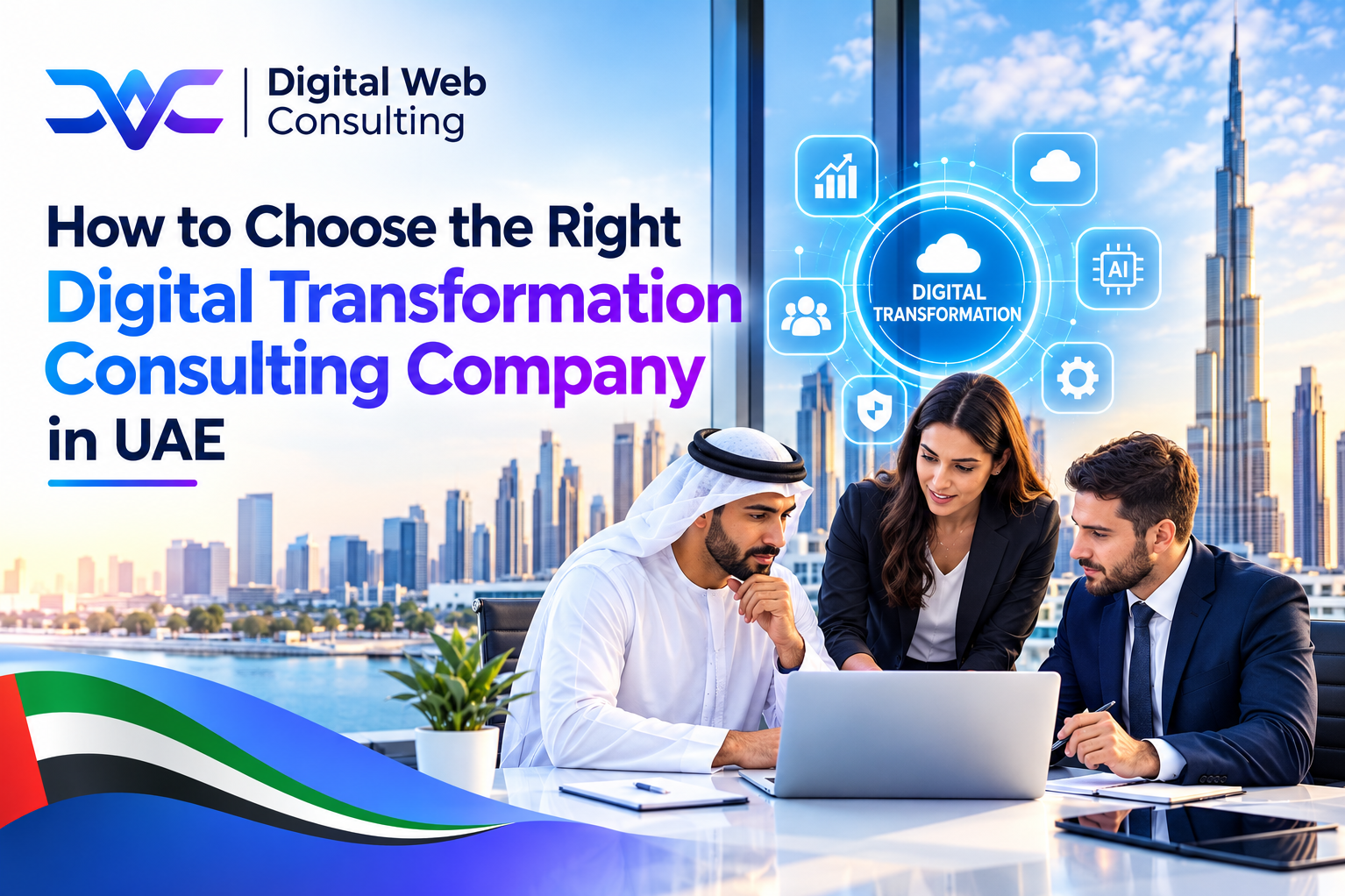
This guide covers the company evaluation process for digital transformation consulting in the UAE. It assumes the business has already identified that it needs transformation consulting and is now at the stage of evaluating which company to engage. The guide is focused on how to assess firms as organisations rather than how to assess individual proposals.
The Four Types of Digital Transformation Companies in the UAE Market
Recognising which type of firm is presenting at any stage of the evaluation significantly clarifies what that firm's proposal will deliver, what it will not deliver, and what the business will need to manage independently when the engagement begins. The four types below cover the majority of the UAE transformation consulting market.
Type One: Global Management Consulting Firms
What they do: Produce strategy-level transformation assessments and roadmaps using proven global methodologies and senior consultants. Their primary output is a transformation strategy document with detailed recommendations for the business to implement.
Best for: Large enterprises with internal transformation and technology teams who can execute against a strategy document, or businesses that need board-level credibility for a transformation investment decision and have the internal capability to implement the recommended programme independently.
Watch for: Strategy documents that are delivered and then left for the business to implement without the execution support that most UAE SMEs and mid-market businesses do not have internally. Also watch for fee structures that are calibrated for enterprise budgets rather than for growing businesses in the AED 5 million to AED 250 million revenue range.
Type Two: Technology Vendors With Consulting Arms
What they do: Offer transformation consulting as a vehicle for selling specific platform licences. The consulting engagement is designed to produce a recommendation that the vendor's own technology stack addresses, whether or not it is the best fit for the business's specific requirements.
Best for: Businesses that have already decided on a specific technology platform and need an implementation partner who specialises in that platform. The vendor's consulting arm is often excellent at implementing the specific platform it represents.
Watch for: Transformation advice that is constrained by the vendor's platform rather than by the business's requirements. A technology vendor's consulting arm is unlikely to recommend a competitor's platform even when it would better serve the business's needs. The transformation scope is bounded by what the vendor sells.
Type Three: Boutique UAE-Focused Consulting Firms
What they do: Deliver integrated strategy and execution within a single engagement, with UAE-specific market experience across the regulatory, cultural, and operational dimensions of the UAE business environment. Their primary output is operational change rather than a strategic document.
Best for: UAE SMEs and mid-market businesses that need a consulting partner who understands the UAE operating context, can design and deliver the transformation rather than just advising on it, and is sized to work effectively with a growing business rather than with a large enterprise.
Watch for: The boutique firm's capacity and team depth, which is smaller than the global firms. Verify that the specific individuals who will be assigned to the engagement have the UAE experience and technical capability the engagement requires, rather than relying on the firm's general positioning.
Type Four: Generalist IT Service Providers
What they do: Offer transformation consulting as an extension of their IT service offering, typically without a dedicated transformation practice or a track record of strategy-led transformation delivery. Their strength is in technology implementation rather than in operational change management.
Best for: Businesses that have a clear, specific technology implementation requirement and need a technically capable delivery partner. Not appropriate as the primary transformation consulting engagement for a business that needs strategic design alongside technical execution.
Watch for: The absence of change management capability, UAE regulatory and operational knowledge, and the business process design experience that distinguishes transformation consulting from technology implementation. A firm without these capabilities will deliver a technically functional system without the operational change the business needs.
Digital Web Consulting operates as a boutique UAE-focused consulting firm that integrates strategy design and execution delivery within a single engagement. Our Digital Transformation Consulting service covers the full transformation programme from operational assessment through implementation and adoption, with UAE-specific experience across the regulatory and operational dimensions that determine implementation quality in this market.
What Credentials and Certifications Actually Mean
Transformation consulting companies in the UAE present a range of credentials in their proposals and on their websites. Understanding what each credential verifies and what it does not helps the business use credentials as one input to the evaluation rather than as a proxy for overall capability.
Microsoft Gold or Solutions Partner Designations
Microsoft Solutions Partner designation verifies that the firm has delivered a minimum threshold of Microsoft technology implementations with verified customer success scores. It is a meaningful credential for firms whose transformation work is primarily delivered on the Microsoft technology stack, including Dynamics 365, Power Platform, and Azure.
It does not verify UAE market experience, change management capability, business process design experience, or the ability to deliver operational transformation rather than technology deployment. A Microsoft Solutions Partner is verified to implement Microsoft technology. It is not verified to transform a business. Both credentials are useful and neither tells the whole story.
Industry Awards and Recognition
Industry awards from UAE business publications, technology conferences, and partner programmes are marketing achievements rather than capability verifications. They reflect the firm's profile in its market, its investment in thought leadership, and sometimes its client relationships, but they are not independently verified assessments of the quality of the transformation outcomes the firm delivers.
Use awards as a signal that the firm is active and visible in the UAE market, not as evidence that its transformation engagements produce better outcomes than those of firms without comparable awards profiles.
Client Case Studies and Outcome Evidence
Case studies are the most valuable public credential a transformation consulting firm can present, and they are also the most frequently misrepresented. A case study that describes what was implemented and how the implementation was structured provides information about the firm's capability. A case study that describes specific operational outcomes achieved, with before-and-after metrics for the specific changes the engagement produced, provides evidence of the firm's track record.
Ask every firm under evaluation to provide at least two case studies that include specific before-and-after operational metrics from UAE businesses in industries comparable to yours, and to provide contact details for the named client so the metrics can be verified in a reference conversation. A firm whose case studies describe activities rather than outcomes, or whose case studies are not verifiable through client reference conversations, has a limited track record of outcome-accountable delivery.
Team Credentials vs. Firm Credentials
The firm's credentials are the firm's. The team assigned to the engagement may or may not reflect those credentials. A firm with a Microsoft Solutions Partner designation may assign a team that has not previously delivered a UAE Dynamics 365 implementation. A firm with extensive UAE case studies may assign a team that built those case studies alongside more experienced colleagues and is now leading a first engagement independently.
Ask for the specific CVs and UAE engagement histories of the named individuals who will be assigned to the programme before the contract is signed. The team's credentials, specifically their UAE experience and their track record on comparable engagements, are the credentials that will actually determine the engagement's quality.
How to Structure a Formal Evaluation
A formal evaluation of transformation consulting companies produces a more defensible selection decision and a more comparable assessment of options than an informal one. The structure below is appropriate for a UAE business commissioning a transformation programme of AED 100,000 or more in consulting fees.
Step One: Define the Evaluation Criteria Before Inviting Proposals
The evaluation criteria should be defined and weighted before any company is invited to submit a proposal, so that the criteria reflect the business's priorities rather than what the first proposal makes look important. The weighting should reflect the relative importance of each criterion to the specific business's situation.
• UAE market experience and track record in the relevant industry: suggested weighting thirty percent
• Integrated strategy-and-execution model rather than strategy-only or execution-only: suggested weighting twenty-five percent
• Proposal quality, including specificity of scope, UAE configuration, and success criteria: suggested weighting twenty percent
• Named team quality and UAE engagement history: suggested weighting fifteen percent
• Commercial structure, including post-go-live accountability and support: suggested weighting ten percent
Step Two: Issue a Request for Proposal With Specific Questions
A request for proposal that asks specific questions produces more useful and comparable responses than one that invites firms to describe their approach freely. Include the following specific questions in every RFP issued.
• Describe two transformation engagements completed for UAE businesses in our industry in the last two years, including the specific operational changes achieved and the client contact we can speak with to verify them
• Name the specific individuals who will be assigned to this engagement and provide their CVs with their UAE engagement histories
• Describe your data audit process and what happens when you identify data quality problems that need to be addressed before the transformation programme can proceed
• Describe the specific UAE configuration requirements for this programme, including VAT, multi-currency, and Arabic language, and how your methodology addresses each as standard rather than as a custom addition
• Define the success criteria for this engagement in operational outcome terms and describe how those criteria will be measured at the sixty-day and six-month review points
Step Three: Score the Proposals Against the Defined Criteria
Score each proposal against the weighted criteria defined in Step One immediately after it is received, before the firm's presentation, to ensure that the scoring reflects the proposal quality rather than the presentation quality. Presentations are designed to be persuasive. Proposals are the firm's documented commitment to what they will deliver. The proposal quality should carry more weight in the evaluation than the presentation quality.
How to Evaluate Proposals Side by Side
When two or three firms have submitted proposals that pass the initial scoring threshold, a side-by-side comparison across the most consequential dimensions reveals differences that the individual proposal scores may have obscured.
Scope Specificity
A specific proposal describes the exact deliverables for the engagement, the exact UAE configuration items that will be addressed, the exact data audit process that will be conducted, and the exact success criteria against which the engagement will be measured. A generic proposal uses language that applies to any transformation programme without committing to the specific requirements of this business's transformation.
Compare the proposals side by side on this dimension by identifying whether each proposal names the specific operational problems it is designed to solve, the specific UAE configuration requirements it will address, and the specific outcome metrics it will produce. The proposal that is most specific on all three dimensions reflects the most thorough understanding of the engagement requirements and the most confident commitment to the scope it describes.
Team Commitment
A strong proposal names the specific individuals who will work on the engagement with their specific UAE experience. A weak proposal describes the team in terms of roles and seniority without naming individuals or confirming their availability for this programme's timeline.
Name commitment in a proposal is a meaningful signal. A firm that names its team before the contract is signed has committed to a delivery team that the business can hold it accountable to. A firm that describes the team's profile without naming individuals retains the flexibility to assign whoever is available at the engagement's start date, which may not be the team whose experience the firm's credentials reflect.
Commercial Accountability
A proposal from a firm that is accountable for outcomes describes the success criteria in operational terms, a review process at defined milestones, and a mechanism for addressing below-expectation outcomes within the engagement scope. A proposal from a firm that is accountable for deliverables describes the outputs it will produce and when it will produce them, without committing to the operational outcomes those deliverables are designed to enable.
This distinction is the most commercially consequential difference in the proposals a UAE business will receive. The firm accountable for outcomes has every commercial incentive to design the engagement so that the outcomes are achieved. The firm accountable for deliverables has every commercial incentive to deliver the agreed outputs accurately and on time, which it will do, regardless of whether those outputs produce the operational changes the business commissioned them to produce.
The Reference Conversation and the Final Decision
The reference conversation is the most valuable and most frequently skipped step in the transformation company evaluation process. A reference client who has completed an engagement with the firm under evaluation has information that no proposal, presentation, or case study can provide: what the engagement was actually like, whether the firm delivered what it promised, and whether the operational outcomes it committed to were achieved.
What to Ask in a Reference Conversation
Four questions produce the most useful information from a reference conversation with a transformation consulting firm's previous UAE client.
• Did the firm deliver what the proposal described, and were there significant scope, cost, or timeline variances from what was agreed at the outset?: The answer to this question reveals whether the firm's proposals are accurate representations of what the engagement will involve or whether they are optimistic documents that the engagement regularly departs from.
• How did the firm handle situations where the original plan needed to change because of something discovered during the engagement?: This question reveals the firm's flexibility, its accountability model, and whether scope changes were handled as collaborative adjustments or as additional billing opportunities.
• What did the business look like operationally twelve months after the engagement completed, compared to how it operated before?: This question produces the outcome evidence that the case study provides in polished form but the reference client can provide with the unfiltered honesty that a case study cannot.
• Would you engage this firm again for a comparable programme, and what would you do differently in how you managed the engagement?: The answer to this question is the most reliable single indicator of the firm's quality. A client who would engage the firm again without qualification has experienced an outcome that met or exceeded the expectation. One who would engage it again with conditions has experienced an outcome with specific caveats. One who would not engage it again is telling the evaluating business what it most needs to know before committing.
The Final Decision Framework
When the evaluation has been completed, the proposals have been scored, and the reference conversations have been conducted, the final decision between two firms of comparable quality should rest on two factors that the evaluation process cannot fully quantify but that the evaluation process surfaces enough information to assess: cultural fit and risk appetite alignment.
Cultural fit describes whether the firm's communication style, working approach, and professional values are compatible with the business's management culture. A firm that communicates with the formality and the documentation discipline that a corporate management team expects will be uncomfortable for a business that communicates informally and values speed over process. A firm that is highly agile and iterative in its delivery will be uncomfortable for a business that needs clearly defined deliverables and milestones before each phase begins.
Risk appetite alignment describes whether the firm's approach to uncertainty, scope change, and outcome accountability matches the business's risk tolerance. A firm that treats every scope change as an additional billing event is right for a business with a fixed budget and a fixed scope. A firm that absorbs reasonable scope adjustment within the engagement is right for a business with an evolving requirement that will not be fully defined at the outset.
For UAE businesses at the evaluation stage and wanting to understand how Digital Web Consulting compares against the criteria and the evaluation framework in this guide, our IT Consulting Services include a structured evaluation conversation that covers our UAE track record, our team's specific experience, our commercial accountability model, and our reference client availability, in the format the evaluation framework requires.
The transformation company that earns the engagement is not necessarily the one that presents the most impressive credentials or the most sophisticated methodology. It is the one that answers the most specific questions about the most specific engagement requirements most honestly, names its team before the contract is signed, commits to outcome metrics rather than to deliverables, and provides reference clients whose experience confirms what the proposal claims. These signals are findable in any evaluation process that is designed to surface them.
The Right Evaluation Produces the Right Company
Choosing a digital transformation consulting company in UAE is one of the most consequential decisions a growing business makes. The wrong choice produces a strategy without execution, an execution without strategy, or a technically delivered programme that does not change how the business operates. The right choice produces operational change that compounds in value over years.
Digital transformation consulting services in UAE vary in quality, in commercial model, and in UAE market depth more than the polished proposals that represent them suggest. The evaluation framework in this guide, applied consistently across every firm under consideration, produces a decision that is grounded in the evidence that predicts engagement quality rather than in the presentation quality that reflects marketing investment. Firm type identification, credential assessment, structured proposal comparison, and direct reference conversations are the inputs that distinguish a confident selection decision from an optimistic one.
The business that applies this framework will find that the field of genuinely suitable candidates is smaller than the field of credentialled presenters. That is the point of the framework. A smaller field of firms that meet the specific criteria of a specific UAE business's transformation requirement is a more valuable field than a large field of firms that are technically capable of presenting a compelling proposal.
Ready to evaluate Digital Web Consulting against the framework in this guide? Start the conversation and ask us every question it contains. We welcome them through our Digital Transformation Consulting Services page
[digital transformation consulting services in UAE , digital transformation services Dubai , transformation consulting UAE , digital consulting UAE]