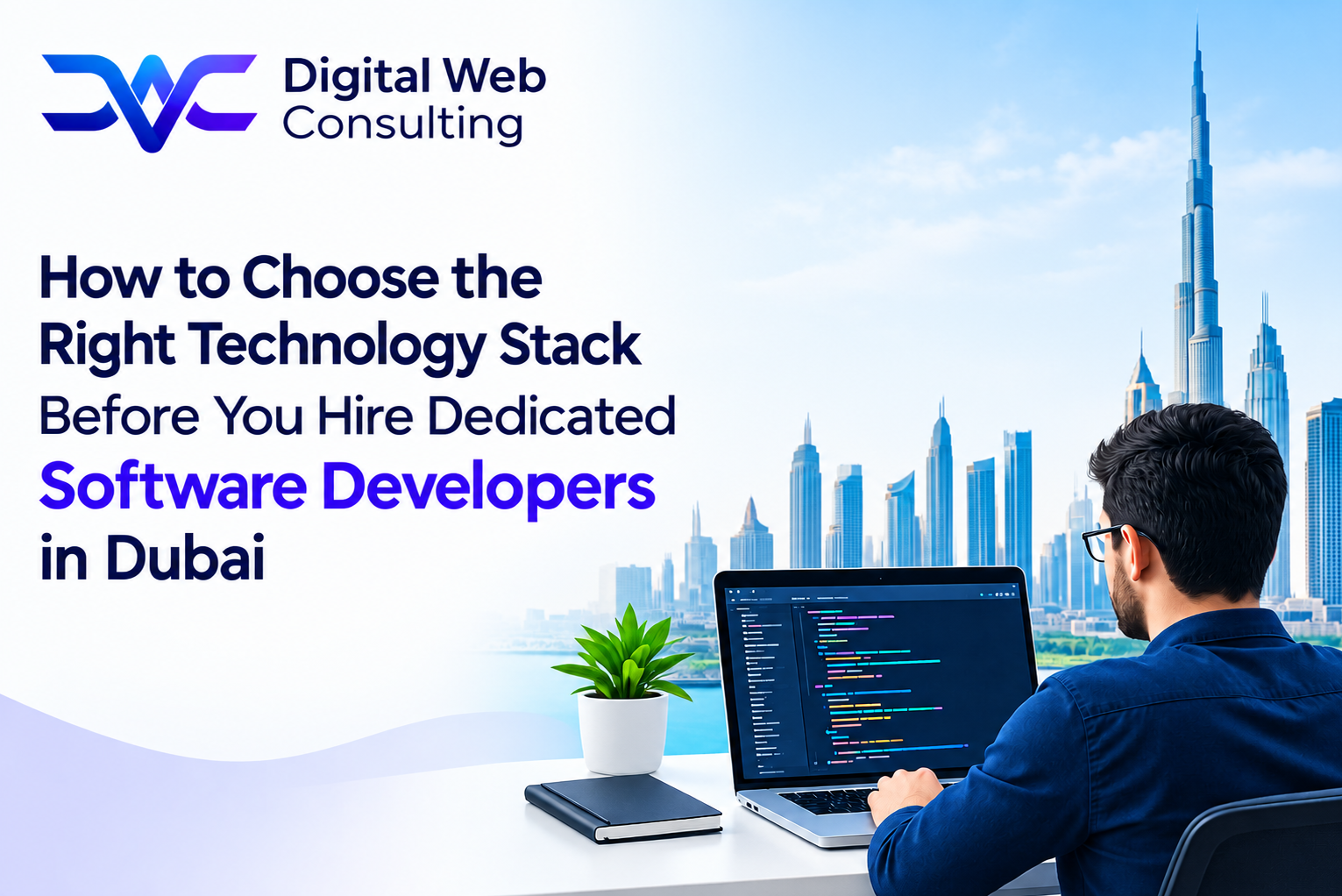
Why Stack Choice Matters Before You Hire Anyone
Most Dubai businesses approach software development hiring in the same sequence: identify the need, search for a developer, hire whoever seems most capable, and then let that developer recommend the technology stack. The stack decision is treated as a technical question that belongs to the developer rather than a business decision that belongs to the business.
This sequence is backwards, and the consequences are predictable. A developer who is hired before the stack is chosen will naturally recommend the stack they know best, regardless of whether it is the best fit for the project's requirements, the business's long-term maintenance needs, or the availability of developers in the Dubai market who could extend or replace the initial hire. The stack decision, made this way, is made by the wrong person using the wrong criteria at the wrong time.
Hiring dedicated software developers in Dubai after the stack decision is made rather than before it changes the hiring process fundamentally. The business knows what it is looking for, can evaluate candidates against a defined technical requirement, can compare the availability and cost of qualified developers in the Dubai market, and can make a hiring decision that is grounded in what the project needs rather than in what the first strong candidate happens to know.
The technology stack chosen for a project determines who can build it, who can maintain it, how long it takes, what it costs, and how easy it will be to find a replacement developer two years from now. These are business decisions, not technical ones. The business should make them before a developer is hired, not after.
This guide is written for business owners, project leads, and operations managers who are planning a software development project and want to make the right stack decision before hiring, without needing a technical background to do so. Technical terms are explained in plain language throughout.
The Four Questions That Drive the Right Stack Decision
The right technology stack for a project is determined by the answers to four questions. These questions are entirely answerable by a non-technical business owner and produce the information that a good technical advisor needs to make a specific stack recommendation.
What Are You Building?
The nature of the system being built is the primary determinant of the technology stack. A customer-facing web application has different technical requirements from an internal business management tool. A mobile application has different requirements from a web application. An e-commerce platform has different requirements from a data reporting system. The stack should be chosen to match what is being built, not what the developer happens to be experienced in.
Describe what you are building in operational terms, not technical ones. A system that allows our customers to place orders online, track their delivery status, and manage their account details is a sufficient description. The technical team translates this operational description into stack requirements. The business does not need to understand the translation to make a good decision about which translated options to choose between.
How Fast Does It Need to Scale?
Scale refers to how much the system needs to grow in terms of users, transactions, and data volume over the next two to three years. A system built for fifty internal users that will grow to two hundred over three years has different scaling requirements from a customer-facing platform expected to serve tens of thousands of users by the end of year two.
Some technology stacks are designed for rapid horizontal scaling and perform better under high-traffic conditions. Others are optimised for development speed and business application logic rather than for large-scale traffic management. A stack chosen for a small-scale internal application that is later expected to serve a large user base will require significant rework to handle the scale it was not designed for.
Who Will Maintain It After the First Developer?
The most overlooked dimension of stack selection is the maintenance question. The first developer builds the system. What happens when that developer leaves, the project grows beyond a single developer, or the business needs to add new features twelve months after the initial build? The technology stack determines how difficult and how expensive it is to find a second developer who can understand and extend what the first developer built.
A stack built in a widely used language with large developer communities, extensive documentation, and a broad Dubai talent pool is significantly easier and less expensive to maintain over the long term than one built in a niche framework with a small global developer community and virtually no local talent pool. The maintenance cost of the stack choice accumulates over years and frequently exceeds the initial development cost.
What Does the Dubai Talent Market Look Like for This Stack?
The availability of developers in the Dubai market for a specific technology stack affects the hiring timeline, the hiring cost, and the replacement risk when a developer leaves. A stack with a deep Dubai talent pool means faster hiring, more competitive rates, and lower replacement risk. A stack with a thin Dubai talent pool means slower hiring, premium rates, and significant project risk when the primary developer is unavailable.
This question is answerable without technical knowledge by looking at the volume and quality of candidates available in Dubai on professional platforms like LinkedIn when searching for a specific technology. A search that returns hundreds of Dubai-based candidates with relevant experience indicates a deep talent pool. A search that returns a dozen indicates a shallow one.
For businesses that need structured support making the stack decision before beginning a developer search, our Software Development Company service includes a pre-hire technology consultation that answers these four questions for a specific project and produces a stack recommendation with a supporting rationale before any hiring investment is made.
Common Project Types and the Stacks That Fit Them
The following project types cover the majority of software development needs for growing Dubai businesses. For each type, the recommended stacks reflect both the technical fit for the project requirements and the availability of qualified developers in the Dubai market.
Web Application or Business Portal
Recommended stacks: PHP with Laravel, Python with Django, Node.js with Express
Why: These three stacks represent the most widely supported and most cost-effective options for web application development in Dubai. PHP with Laravel has the largest developer pool in the UAE market and is the lowest-cost option for standard business web applications. Python with Django is preferred for applications that will incorporate data processing or machine learning features later. Node.js is appropriate for applications requiring real-time data updates such as dashboards or collaborative tools.
Mobile Application
Recommended stacks: React Native, Flutter
Why: Both React Native and Flutter allow a single codebase to produce applications for both iOS and Android, which reduces development cost and maintenance complexity compared to building separate native applications for each platform. React Native has a larger Dubai developer pool and is the more common choice. Flutter is gaining adoption rapidly and is preferred by some developers for its performance characteristics. Either is an appropriate choice for a standard business mobile application.
E-Commerce Platform
Recommended stacks: Shopify with custom development, WooCommerce on WordPress, custom Laravel
Why: The right e-commerce stack depends on the complexity and customisation requirements of the business. Shopify is the fastest to deploy and easiest to maintain for businesses with standard product catalogue and checkout requirements, and its large app ecosystem addresses most common e-commerce needs without custom development. WooCommerce on WordPress suits businesses that already have a WordPress presence and need e-commerce added without a platform migration. A custom Laravel build is appropriate when the business model requires checkout flows, subscription structures, or inventory management that standard platforms cannot support.
Custom ERP or CRM Build
Recommended stacks: .NET with C#, Python with Django, Node.js
Why: .NET with C# is the preferred choice for complex business application logic, particularly in organisations with existing Microsoft infrastructure, because of its strong typing, performance, and the broad availability of experienced .NET developers in Dubai. Python is appropriate for ERP or CRM builds that require significant data processing or analytical features. Node.js works well for CRM applications that need real-time data updates across multiple users simultaneously.
Data Reporting and Analytics Backend
Recommended stacks: Python, Power BI connected API
Why: Python is the dominant language for data processing and analytics work and has the best library support for the data manipulation tasks that underpin reporting infrastructure. Where the reporting layer is Power BI, the backend service that feeds data to Power BI dashboards is most cleanly built in Python, which integrates naturally with the data processing libraries and database connectors that Power BI requires.
These recommendations reflect the Dubai market conditions and the requirements of the project types described. Every project has specific requirements that may point toward a different stack than the general recommendation. The project type table above is a starting framework, not a prescription. A structured technical consultation for a specific project may produce a different recommendation for sound reasons specific to that project.
The Dubai Talent Market : Which Stacks Have the Best Developer Availability
Developer availability in the Dubai market varies significantly by technology stack. Understanding the availability landscape before committing to a stack prevents the hiring problems that come from choosing a technology with an insufficient local talent pool.
High Availability: Strong Dubai Talent Pool
• PHP and Laravel: The single deepest developer talent pool in the UAE market. Large numbers of developers at every seniority level, competitive rates, and fast hiring timelines. The right choice for projects that do not have specific technical requirements that rule it out.
• React and React Native: The most widely used frontend JavaScript framework globally, with a strong UAE developer presence. React developers are abundant at mid-level and senior level in Dubai, making it a reliable choice for web and mobile projects requiring a JavaScript frontend.
• Python: A rapidly growing developer pool in Dubai across backend, data, and automation applications. Strong availability at mid-level and above. The preferred choice for any project incorporating data processing, machine learning, or analytical features.
• WordPress and WooCommerce: The largest developer pool of any platform in Dubai, but with significant quality variation. The number of developers who can build and maintain well-structured custom WordPress themes and plugins is substantially smaller than the total WordPress developer count. Qualifying WordPress developer experience carefully is more important than for other stacks.
Moderate Availability: Adequate Dubai Talent Pool With Longer Search Times
• Node.js: Growing availability in Dubai with a reasonable mid-level developer pool. Hiring timelines are longer than for PHP or React but manageable. Node.js developers with strong backend architecture experience are the scarcest and most expensive segment of the stack.
• Flutter: A younger stack with rapidly growing Dubai adoption. Developer availability is sufficient for most projects but the senior Flutter developer pool is limited, which affects the feasibility of complex Flutter builds that require experienced architectural guidance.
• .NET and C#: Strong corporate and enterprise developer presence in Dubai but smaller than the open-source stack pools. Mid-to-senior .NET developers with UAE enterprise experience are available but command premium rates reflecting the smaller supply.
Lower Availability: Thin Dubai Talent Pool Requiring Extended Search or Remote Hiring
• Golang: growing globally but minimal UAE developer presence currently
• Rust: specialist language with very few UAE-based practitioners
• Scala: enterprise data engineering language with limited UAE availability
• Ruby on Rails: legacy framework with declining global adoption and very thin UAE presence
• Niche CMS and proprietary frameworks: extremely limited UAE availability with high replacement risk
Why Availability Affects More Than Hiring Speed
A stack with thin Dubai availability creates three problems beyond the longer initial hiring timeline. Replacement risk is higher because finding a qualified replacement when the primary developer leaves takes significantly longer, creating project continuity risk during the search period. Rate pressure is upward because the smaller supply of qualified developers in a thin talent pool produces higher rates for the available candidates. And quality floors are lower because a small candidate pool means the business has fewer options to choose between, which reduces the ability to be selective about quality.
For businesses that need to build on a stack with limited UAE availability and want to manage the talent risk effectively, our Hire Dedicated Software Developers service provides access to vetted developers for a broader range of stacks than the standard Dubai job market, including remote and hybrid arrangements that expand the talent pool beyond UAE geography.
The Mistakes Dubai Businesses Make When Choosing a Stack
Four stack selection mistakes appear consistently across Dubai software development projects that encounter avoidable problems. Each is entirely preventable when the stack decision is made correctly before hiring begins.
Choosing Based on What the First Developer Knows
A developer interviewed before the stack is chosen will describe their preferred stack in the most favourable terms available. Their assessment is not dishonest. They genuinely believe their preferred stack is the right choice. But their preference is shaped by what they know and are comfortable with, not necessarily by what the project requires or what the Dubai talent market can support for long-term maintenance.
The business that lets the first strong developer candidate determine the stack is outsourcing a business decision to a person whose interests are not perfectly aligned with the business's long-term needs. The right approach is to determine the stack requirements first, then hire for those requirements. The developer recommends implementation approaches within the chosen stack. The business chooses the stack itself, with appropriate technical guidance.
Choosing the Most Fashionable Framework Rather Than the Most Appropriate One
Technology trends produce frameworks that receive significant attention in developer communities for reasons that have more to do with novelty and community enthusiasm than with fitness for business application development. A business that chooses a stack because it is currently popular in developer forums rather than because it matches the project's requirements and the UAE talent market's capabilities will frequently find that the fashion has faded before the project is complete, leaving a codebase in a framework that has lost momentum and developer support.
The standard, well-supported stacks described in Section Three have achieved their position in the market through sustained fitness for the purposes they serve. They are not exciting choices. They are reliable ones. Reliability matters more than excitement for a business that needs the system to work and to be maintainable over years.
Choosing a Stack With No Local Developer Pool
Building a business-critical system in a stack with minimal UAE developer availability is an operational risk that compounds over time. The initial developer is found and the project begins. The project grows beyond what a single developer can sustain. Finding a second developer in the same stack takes months. The primary developer leaves. Finding a replacement takes four months during which the system cannot be extended or effectively maintained. The business has created a single-developer dependency in a technology that the local market cannot support.
Not Considering Who Will Maintain It in Year Two
The developer hired to build the initial version of a system is frequently not the developer who will maintain and extend it in year two and beyond. The system will change hands, and the stack it is built in determines how difficult and expensive that handover is. A system built in a well-documented, widely used stack with strong community support is transferable to a new developer with modest onboarding effort. A system built in a niche framework with minimal documentation and a small global community may require the incoming developer to reverse-engineer significant portions of the codebase before they can work on it effectively.
How to Validate Your Stack Choice Before Hiring
The Single Technical Conversation Every Non-Technical Buyer Should Have First
Before committing to a stack and beginning a developer search, every non-technical business owner should have one structured conversation with an experienced technical advisor who has no financial stake in the hiring outcome. This conversation should cover four points: whether the recommended stack fits the project's functional requirements, whether it scales to the expected user and transaction volume, whether qualified developers are available in Dubai at a cost within the budget, and whether the stack has the long-term community and support characteristics that make it maintainable over the life of the project.
A technical advisor who addresses all four points specifically and connects their recommendation to the business's stated project requirements has done the job the conversation requires. One who recommends a stack without discussing the Dubai talent market, the scaling requirements, or the maintenance implications has given a partial answer that could lead to a poor decision.
What a Good Technical Advisor Tells You
A good technical advisor in this context does not use jargon without explanation. They describe the recommended stack in operational terms: this stack is appropriate because it has a large developer pool in Dubai, which means your hiring search will take four to six weeks rather than twelve, your replacement risk is low, and your maintenance costs will be competitive. They describe the trade-offs honestly: this stack is faster to build in but harder to scale above ten thousand concurrent users, which may or may not be relevant to your project in the next two years. They give a recommendation, not a list of options to choose from, with a clear rationale for the recommendation.
When to Let the Developer Recommend the Stack : and When Not To
There are situations where letting a developer recommend the stack is appropriate. When the project has highly specific technical requirements that only an experienced developer can fully assess, when the business is building something at the frontier of technical complexity where stack selection genuinely requires deep domain expertise, or when the business has already established a technology environment and the new project must integrate with it, a developer's technical recommendation on stack is valuable and should carry significant weight.
The situation where the developer should not make the stack choice unilaterally is the most common one: a standard business application project where multiple stacks could serve the requirements equally well and the decision should be driven by business factors including Dubai talent availability, long-term maintenance cost, and the business's existing technical environment. In this situation, the business should make the decision with technical input, not delegate it.
For businesses that want a structured technical consultation before beginning a developer search, our IT Consulting Services include a pre-hire technology assessment that produces a specific stack recommendation, a Dubai talent availability assessment for that stack, and a hiring brief that the business can use to begin a focused developer search immediately after the consultation.
The technology stack chosen before the hire shapes every subsequent decision about the project: who can build it, how long it takes, what it costs, and how easy it is to maintain over the years that follow. An hour spent making the right stack decision before hiring saves months of avoidable complications after it.
The Right Stack Chosen Before the Hire Saves More Than It Costs
The technology stack decision is not a technical detail that can be safely delegated to the first developer who is hired. It is a business decision that affects the hiring timeline, the development cost, the long-term maintenance cost, the replacement risk, and the scalability of the system over its full operational life. Making it correctly before hiring begins rather than during or after the hiring process is the single most cost-effective decision a Dubai business can make at the start of a software development project.
Hiring dedicated software developers in Dubai with a defined stack requirement produces a faster, more focused search, more comparable candidates, a clearer evaluation framework, and a development engagement that starts from a foundation of shared technical direction rather than from a negotiation about which direction to take. The stack decision takes one structured conversation with a qualified technical advisor. The problems it prevents are months of avoidable cost and delay.
The developer search starts after the stack decision, not before it. In that order, every subsequent decision about the project is easier, faster, and less expensive than it would have been the other way around.
Ready to get a stack recommendation specific to your project before you begin a developer search in Dubai? Start the conversation with Digital Web Consulting through our Hire Dedicated Software Developers page
[hire dedicated software developers in Dubai , dedicated developers Dubai , software developers for hire Dubai ]