
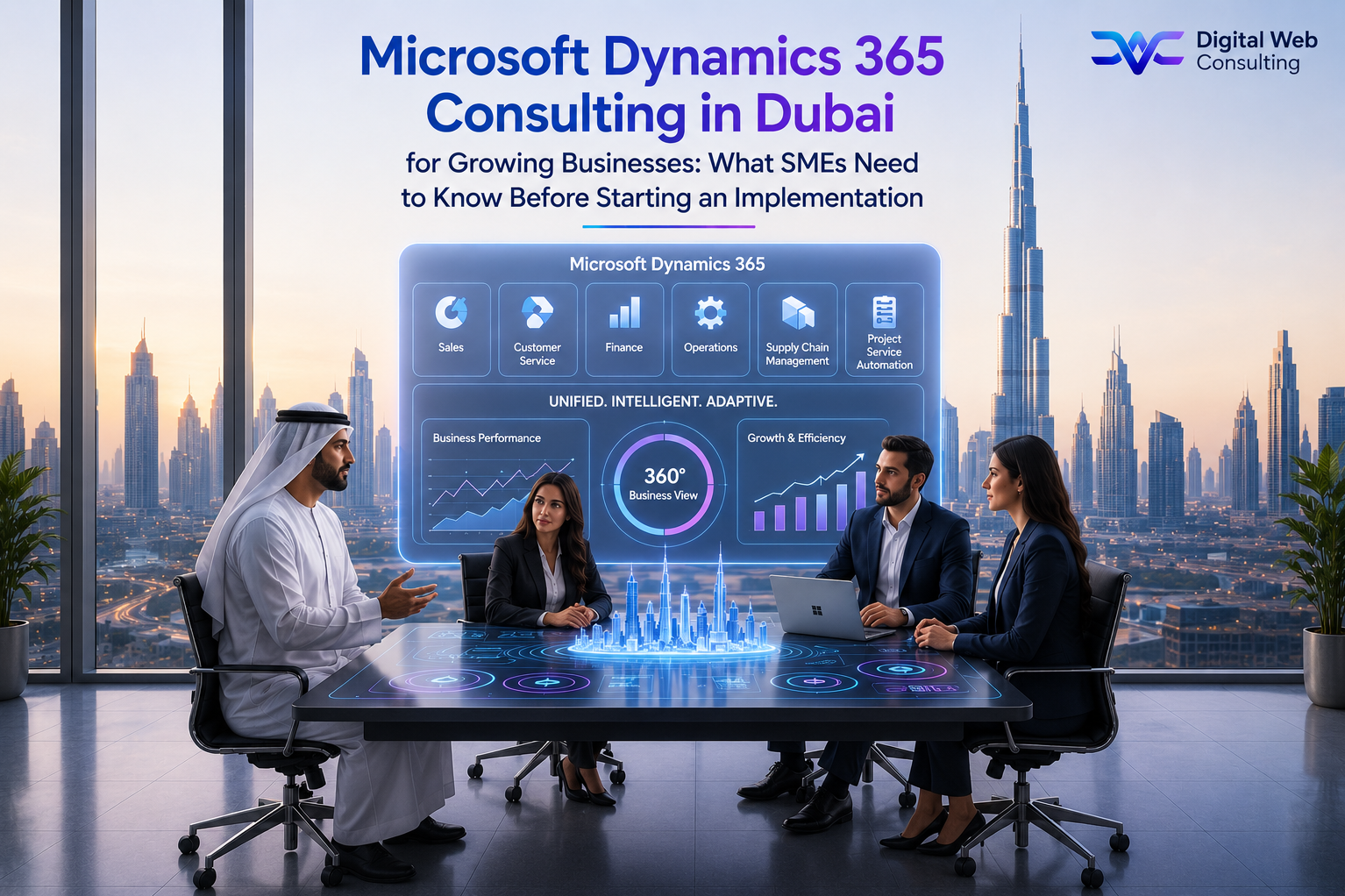
The SME Assumption About Dynamics 365 — And Why It Is Wrong
Ask a managing director of a fifty-person Dubai business what they know about Microsoft Dynamics 365 and you will almost always get one of three responses. It is for large companies. It is too expensive for our size. Or — we looked at it once and it seemed like overkill.
Each of these responses is understandable. For most of the platform's history, the marketing, the case studies, and the partner network were oriented toward enterprise buyers — businesses with dedicated IT teams, large implementation budgets, and the internal capacity to manage complex multi-year projects. The platform itself, however, has evolved significantly. Today's Dynamics 365 is modular, cloud-delivered, and available in configurations specifically designed for growing businesses that need genuine enterprise capability without enterprise complexity or enterprise cost.
The fastest-growing segment of Microsoft Dynamics 365 implementations in Dubai in 2024 and 2025 is not large enterprise — it is SMEs between fifty and five hundred employees who have outgrown their current systems and need an integrated platform that handles finance, operations, and customer management without requiring separate tools for each function. The assumption that Dynamics 365 is not for businesses of this size is one of the most expensive misconceptions in the Dubai technology market.
58% of new Dynamics 365 Business Central implementations globally in 2024 were in businesses with fewer than 200 employees — a significant shift from the platform's historical enterprise focus. — Microsoft Partner Network Report, 2024
“ Dynamics 365 is not too large for a growing Dubai business. The question is not whether the platform fits the business size — it is whether the right modules are selected, configured correctly for the UAE market, and implemented by a consultant who understands what a fifty-person business actually needs from an enterprise platform. ”
This guide is written specifically for Dubai businesses between thirty and five hundred employees — the segment where Dynamics 365 consistently delivers the highest ROI relative to the investment, and where the right consulting approach makes the difference between an implementation that transforms operations and one that overwhelms a small team.
Which Dynamics 365 Modules Actually Make Sense for a Dubai SME
One of the most important things a Microsoft Dynamics 365 consultant in Dubai does for an SME client is prevent them from buying too much platform too early. Dynamics 365 is a comprehensive suite — and comprehensive suites are dangerous for growing businesses because the temptation to implement everything at once consistently produces implementations that overwhelm the team, exhaust the budget, and deliver value years later than a phased approach would have. These are the modules that deliver the highest value for Dubai SMEs at the most appropriate starting point:
• 💰 Dynamics 365 Business Central
What it does: An all-in-one ERP for SMEs covering financial management, supply chain, inventory, sales orders, purchasing, and project management. Built specifically for growing businesses rather than scaled down from enterprise SAP or Oracle — which means it is designed for the volume, complexity, and team capacity of an SME rather than adapted from a platform built for something else.
SME value: For most Dubai SMEs, Business Central is the right starting point — and often the only Dynamics 365 module needed in the first two to three years. It replaces the combination of accounting software, inventory spreadsheets, and disconnected sales tools that most businesses of this size are running, and connects them into a single platform with UAE VAT compliance, multi-currency handling, and Arabic language support built in.
• 📋 Dynamics 365 Sales
What it does: A full CRM platform covering lead management, opportunity tracking, sales pipeline visibility, customer communication history, and sales team performance analytics — connected natively to Business Central so customer records, order history, and account status are visible across both platforms without manual data transfer.
SME value: Dubai SMEs with active sales teams managing relationship-driven deal cycles benefit significantly from Dynamics 365 Sales — particularly the integration with Outlook and Teams that keeps every customer communication logged without requiring manual CRM updates. For businesses already using Microsoft 365, the productivity gain from native integration is immediate.
• 🎙 Dynamics 365 Customer Service
What it does: A structured customer support platform managing service requests, case tracking, knowledge base management, and service level agreement monitoring — giving customer-facing teams a single place to manage every service interaction rather than tracking cases across email, WhatsApp, and informal notes.
SME value: For Dubai SMEs where customer service quality is a key differentiator — professional services, logistics, and B2B trading businesses especially — the ability to track every service interaction, measure resolution times, and identify recurring issues is a meaningful operational advantage over competitors still managing support informally.
• 📧 Dynamics 365 Marketing
What it does: An integrated marketing automation platform covering email campaigns, customer journey design, lead scoring, event management, and marketing analytics — connected to Dynamics 365 Sales so marketing-generated leads flow directly into the sales pipeline with full campaign attribution.
SME value: Dubai SMEs with active marketing programmes benefit from this module once their sales pipeline is structured in Dynamics 365 Sales. Starting Marketing before Sales is configured produces leads that flow into an unstructured pipeline — which is why phased implementation always starts with the operational core before adding marketing capability.
The right module selection for a specific SME depends on the business's current pain points, its existing technology stack, and its growth priorities. Our Microsoft Dynamics 365 Consulting service begins with a structured needs assessment that identifies the right modules, the right configuration scope, and the right implementation sequence before any licensing is purchased.
The most common and most expensive mistake in SME Dynamics 365 implementations is purchasing the full suite and attempting to implement it all simultaneously. The right approach is to start with the highest-impact module for the current pain point, achieve adoption, and then extend the platform — building capability as the business grows into it rather than ahead of it.
The Four SME-Specific Concerns About Dynamics 365 : Answered Honestly
These are the four questions that come up in almost every first conversation with a Dubai SME considering Dynamics 365. They deserve honest answers rather than sales reassurances.
Is it too expensive for our size?
Honest answer: Dynamics 365 Business Central starts at approximately USD 70 per user per month for the Essentials tier and USD 100 for the Premium tier. For a twenty-user implementation, that is USD 1,400 to USD 2,000 per month in licensing — comparable to or lower than what most Dubai SMEs are spending across separate accounting software, inventory tools, and CRM platforms combined. The implementation cost from a consultant adds to this, but the honest five-year comparison — including licensing, implementation, and the operational cost of the systems being replaced — consistently shows Dynamics 365 as financially competitive for businesses of this size.
Is it too complex for our team to manage?
Honest answer: This is the right concern to raise, and it requires an honest answer. Dynamics 365 is a sophisticated platform — more capable, and therefore more complex to configure, than the tools most SMEs are replacing. The key is that the complexity sits primarily in the implementation and configuration phase, which is handled by the consultant rather than the internal team. Once configured correctly for the business's specific processes, the day-to-day user experience is straightforward — and role-specific training ensures the team uses the features relevant to their work without needing to navigate the full platform.
Will it fit our UAE-specific processes?
Honest answer: Yes — when configured by a consultant with UAE implementation experience. Out of the box, Dynamics 365 requires specific configuration for UAE VAT compliance, FTA-aligned reporting, WPS payroll integration, Arabic language support across documents and interfaces, and multi-currency transaction handling in AED alongside other operating currencies. A consultant without UAE experience will miss or misconfigure these requirements. A consultant with UAE delivery history brings proven configuration approaches for all of them.
How long will it take to go live?
Honest answer: For a right-sized SME implementation focusing on Business Central as the core module, twelve to fourteen weeks from kickoff to go-live is a realistic and achievable target. This assumes good data availability, responsive business stakeholders during the configuration review process, and a phased approach that prioritises the highest-impact modules rather than attempting full-suite deployment in the initial implementation. More complex implementations with multiple modules, legacy data migration, or custom integration requirements will sit toward the longer end of a twelve to twenty-week range.
“ The businesses that succeed with Dynamics 365 at the SME level are not the ones with the largest internal IT teams. They are the ones with clear business requirements, engaged senior stakeholders, and a consultant who scopes the implementation correctly for the team's capacity rather than for the platform's maximum capability. ”
None of the four concerns above disqualify a Dubai SME from a successful Dynamics 365 implementation. They each have specific, addressable answers — and a consulting engagement that addresses them honestly before the project begins produces a significantly better outcome than one that reassures and proceeds.
What Microsoft Dynamics 365 Consulting in Dubai Does for an SME Specifically
The consulting engagement for a Dubai SME looks different from an enterprise implementation in four specific ways — and understanding these differences clarifies what you are buying when you engage Microsoft Dynamics 365 consulting in Dubai as a growing business rather than a large organisation:
• Right-sized implementation scoping: An SME does not need every Dynamics 365 module, every configuration option, or every integration capability the platform offers. A good consultant's first job is to identify the minimum viable implementation — the configuration that solves the actual business problems without adding complexity the team cannot absorb. This scope discipline is more valuable for an SME than for an enterprise, where internal capacity can absorb broader implementations. Every feature added beyond the right-sized scope adds training burden, adoption risk, and ongoing management overhead without proportional business value.
• UAE-specific configuration as a core deliverable: For a Dubai SME, UAE-specific configuration is not an optional add-on — it is the foundation of a usable system. VAT calculation logic aligned with FTA requirements, WPS-formatted payroll output, Arabic language support across customer-facing documents, and multi-currency transaction handling need to be configured correctly from day one. A consultant who treats these as afterthoughts produces a system that creates compliance problems rather than preventing them.
• Project management without consuming internal bandwidth: An SME does not have a project management office or a dedicated implementation team. The managing director, the finance manager, and the operations lead are all running the business while the implementation is happening. A good consultant manages the project with minimal demand on the client team — structuring review sessions efficiently, preparing testing scenarios in advance, and handling the technical complexity without requiring the business to develop Dynamics 365 expertise during the implementation. The business team provides business knowledge. The consultant applies it.
• Role-specific training for a small team: A twenty-person team cannot absorb a three-day generic Dynamics 365 training programme. Effective SME training is role-specific, scenario-based, and delivered in sessions short enough to fit around the team's normal working day. The finance manager learns the modules relevant to their function. The sales team learns the CRM and pipeline workflows. Senior leadership learns the reporting and dashboard layer. Nobody is trained on features they will never use.
For SMEs whose Dynamics 365 implementation needs to connect with existing tools — accounting software, WhatsApp Business, logistics platforms — our ERP Integration Services cover the API connections and data flows that make Dynamics 365 the operational hub of the business rather than another standalone system in a disconnected stack.
The difference between an SME Dynamics 365 implementation that succeeds and one that struggles is almost always the consultant's willingness to scope the project for the business's actual capacity rather than the platform's maximum capability. More is not better when more requires a larger team than the business has to manage and adopt it.
The Realistic Dynamics 365 Implementation Timeline for a Dubai SME
Twelve to fourteen weeks is the realistic and achievable go-live target for a right-sized Dynamics 365 Business Central implementation for a Dubai SME. Here is what happens at each phase:
Weeks 1 to 3 : Discovery and Requirements Definition
The consultant works with the business's key stakeholders — typically the managing director, finance manager, and operations or sales lead — to document the specific requirements the implementation must address. Current processes are mapped, data sources are identified, integration requirements are established, and the configuration scope is confirmed. The output of this phase is a requirements document that both parties sign off before any configuration work begins. For UAE businesses, this phase also includes confirmation of the VAT configuration requirements, payroll structure, and language preferences that will be applied throughout the implementation.
Weeks 4 to 8 : Configuration and Customisation
The Dynamics 365 environment is configured according to the agreed requirements — chart of accounts, VAT groups, document templates, approval workflows, user roles, and the data structures relevant to the business's operational model. Where standard configuration cannot address a specific requirement, custom fields, custom workflows, or custom reports are developed. The business team reviews each configured module against the requirements document before the consultant moves to the next module — catching misalignments when they are least expensive to correct.
Weeks 9 to 11 : Testing and Data Migration
Each configured module is tested against real business scenarios — using actual customer records, actual product data, and actual transaction volumes to validate that the system behaves correctly under real conditions. Data migration from legacy systems runs in parallel — extracting, cleaning, and loading historical records into the new environment. A parallel run period, where both the old system and Dynamics 365 run simultaneously for two weeks, gives the business confidence that the new system is producing accurate results before the old one is switched off.
Weeks 12 to 14 : Training, Go-Live, and Hypercare
Role-specific training is delivered to each user group in the two weeks before go-live. The system goes live on a planned date with the consultant on-site or available for immediate support. A two-week hypercare period provides dedicated consultant availability for the questions, adjustments, and minor corrections that emerge when the team uses the system for the first time in live operations. The hypercare period is the most important support investment in the entire implementation — it is when adoption habits are formed and when small issues are addressed before they become entrenched workarounds.
For businesses whose implementation timeline needs to account for broader operational changes alongside the Dynamics 365 project, our Digital Transformation Consulting service provides the programme design and change management that ensures the Dynamics 365 implementation lands in an organisation prepared to adopt it rather than one still adjusting to the decision to change.
Fourteen weeks is achievable when the business provides timely input during the requirements and review phases, data is accessible and reasonably clean for migration, and no significant scope changes occur after the requirements document is signed off. Businesses that maintain these conditions consistently achieve go-lives within this timeline.
How to Know If Your Dubai SME Is Ready for Dynamics 365
Readiness for a Dynamics 365 implementation is not about size — it is about operational maturity and growth stage. These signals indicate where a Dubai business sits on the readiness spectrum:
Signs your business is ready to start:
• You are running multiple disconnected systems: Separate accounting software, a CRM that does not connect to finance, inventory managed in spreadsheets, and sales orders tracked in email — this combination is the clearest signal that a unified platform is overdue.
• Manual reporting is consuming significant management time: If producing a weekly or monthly management report requires someone to extract data from multiple systems and combine it manually, the reporting infrastructure is not serving the business's decision-making needs.
• Growth is being constrained by operational capacity rather than market demand: When the team cannot take on more customers, process more orders, or manage more complexity because the current systems cannot support the volume — the operational platform is limiting growth rather than enabling it.
• You are planning to add headcount to manage administrative work: If the next hire is to handle manual processes that a well-configured system should automate, the investment is better directed at the system than the headcount.
• Leadership cannot see the operational position of the business in real time: When the answer to a basic management question requires someone to go and find the data rather than being immediately visible in a dashboard, the business is operating on incomplete information.
Signs you need foundational work first:
• Core business processes are not yet standardised: Dynamics 365 will replicate the processes it is configured around. If those processes vary significantly between team members or locations, the implementation will encode inconsistency permanently. Standardising key processes before implementation produces a system that enforces best practice rather than automating chaos.
• Historical data is heavily fragmented or of very poor quality: A data migration of significantly fragmented or inaccurate historical records will produce a new system with the same data quality problems as the old one. A structured data cleaning exercise before migration is a better investment than discovering the problem after go-live.
• Senior leadership is not available to participate actively in the implementation: A Dynamics 365 implementation without active senior leadership involvement in requirements definition, module review, and adoption governance produces a system that reflects what the consultant assumed the business needed — which is never as accurate as what the business itself defines. SME implementations specifically require the managing director or COO to be meaningfully engaged at key decision points.
For businesses in the foundational work phase, our IT Consulting Services include structured readiness assessments that identify exactly what preparation is needed before a Dynamics 365 implementation is likely to succeed — so the investment goes into a system the business is ready to adopt rather than one it is not yet organised enough to use effectively.
“ Readiness is not a fixed state — it is a preparation target. Every business that is not yet ready for Dynamics 365 can become ready. The question is whether the preparation is done before the implementation begins or discovered during it — and the cost difference between the two is significant. ”
The businesses that get the most from Dynamics 365 at the SME level are the ones that take readiness seriously before they start. A fourteen-week implementation timeline is achievable for a prepared business. For an unprepared one, the same implementation takes twice as long and costs significantly more.
Dynamics 365 Is Not Just for Large Enterprises : It Is for Businesses That Are Serious About Growing
The assumption that Microsoft Dynamics 365 is beyond the scale of a Dubai SME is costing growing businesses the operational foundation they need to compete effectively. The platform has evolved. The pricing has become accessible. The module structure allows right-sized implementation without paying for capability the business does not need. And the consulting approach for an SME is fundamentally different from an enterprise implementation — focused on scope discipline, UAE-specific configuration, and adoption management for a small team rather than on technical complexity for its own sake.
Microsoft Dynamics 365 consulting in Dubai for growing businesses is not about deploying the maximum capability of an enterprise platform. It is about deploying the right capability for a business at a specific stage — starting with the highest-impact modules, configuring them correctly for the UAE market, and building toward the full platform as the business grows into it. That approach consistently produces implementations that deliver within fourteen weeks and generate measurable operational improvement within the first quarter of go-live.
If your Dubai business is running between thirty and five hundred people and your current systems are creating operational friction rather than removing it, the Dynamics 365 conversation is worth having. Not to commit to an implementation — but to understand what the right implementation for your specific business would actually look like.
“ The right Dynamics 365 implementation for a Dubai SME is not a scaled-down version of an enterprise deployment. It is a purpose-built configuration for a growing business — scoped correctly, delivered efficiently, and adopted by a team that was never asked to absorb more than they needed to. ”
Ready to understand what a right-sized Microsoft Dynamics 365 implementation looks like for your Dubai business? Start the conversation with Digital Web Consulting through our Microsoft Dynamics 365 Consulting page →
[microsoft dynamics 365 consulting in dubai , Dynamics 365 consultant Dubai , D365 consulting Dubai , Microsoft Dynamics Dubai , Dynamics 365 for SMEs Dubai , Microsoft Dynamics 365 small business UAE , D365 consulting growing business Dubai]