The Partner Question: What Microsoft Does and What the Partner Does
When a UAE business decides to implement Dynamics 365, the first conversation is usually with Microsoft or a Microsoft reseller. The licence is purchased, the tenant is provisioned, and the platform is technically available. At this point, many businesses assume the implementation process has begun. It has not.
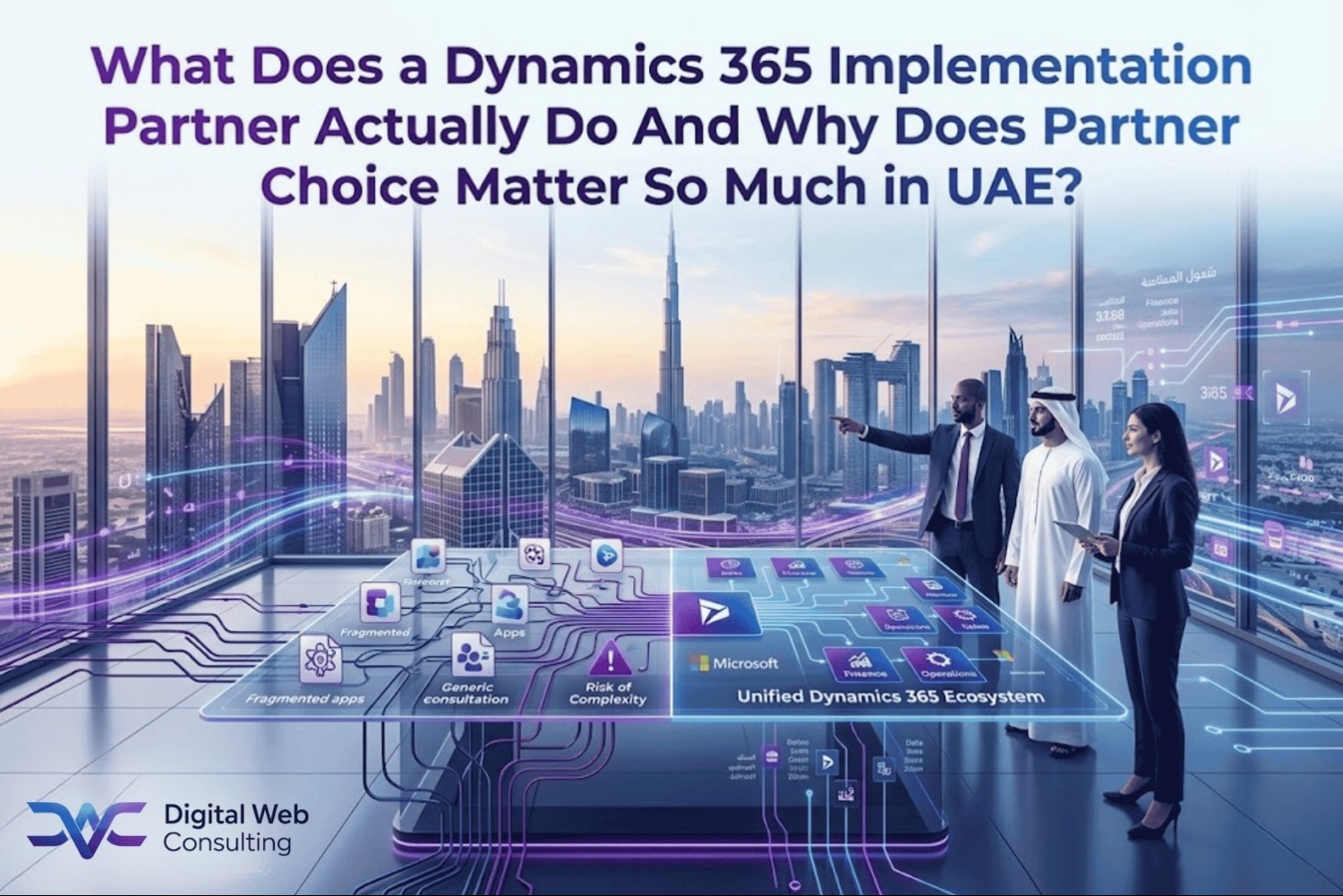
Microsoft provides the platform — the software, the cloud infrastructure, the support documentation, and the licensing framework. What Microsoft does not provide is the configuration work that turns a generic enterprise platform into a system that reflects how a specific UAE business operates, the data migration that brings historical records from legacy systems into the new environment, the integration work that connects Dynamics 365 to other tools the business uses, or the adoption programme that ensures the team actually uses the system effectively after go-live.
Every one of those responsibilities belongs to the implementation partner. Choosing the right Dynamics 365 implementation partner in UAE is not a procurement step that happens after the real decision — the platform selection — has been made. It is the decision that determines whether the platform investment delivers its promised value or joins the long list of enterprise software projects that went live without achieving their objectives.
67% of enterprise software implementations that fail their original objectives cite implementation partner quality as a contributing factor — not platform capability. — Panorama Consulting ERP Report, 2024
“ Microsoft builds the platform. The implementation partner builds the solution. These are fundamentally different capabilities — and confusing them is the most expensive misunderstanding in enterprise software procurement. ”
Understanding exactly what a Dynamics 365 implementation partner owns across the full project lifecycle is the foundation for choosing the right one and holding them accountable to the right standards throughout the engagement.
The Eight Responsibilities of a Dynamics 365 Implementation Partner
A certified Dynamics 365 partner owns eight distinct areas of responsibility across a Dynamics 365 implementation. Each one affects a different dimension of the outcome — and failure in any single area creates problems that the others cannot compensate for.
- 1. Business requirements analysis: The partner conducts structured interviews with stakeholders across every department the implementation will affect — documenting current processes, identifying gaps, defining what the system must do for each business function, and establishing the success criteria against which the implementation will be evaluated. This phase is the foundation of everything that follows. An analysis done poorly produces a system that solves the wrong problems.
- 2. Solution design and module selection: Based on the requirements analysis, the partner designs the Dynamics 365 solution architecture — which modules are implemented, how they are configured to work together, which standard functionality is used as-is, and which areas require custom configuration or development. This design becomes the blueprint for the build phase and the reference point for scope management throughout the project.
- 3. Configuration and customisation: The partner configures the Dynamics 365 environment to reflect the business's operational requirements — setting up entities, workflows, business process flows, automation rules, security roles, and dashboards. Where standard configuration cannot address a specific requirement, the partner develops custom components using the Power Platform or custom code, ensuring they are built in a way that remains compatible with future Dynamics 365 updates.
- 4. Data migration planning and execution: The partner plans and executes the migration of historical data from legacy systems into Dynamics 365 — designing the data mapping, cleaning source data to meet the new system's quality requirements, running test migrations to validate accuracy, and executing the final cut-over migration with minimal disruption to operations. Data migration is consistently the most underestimated task in any Dynamics 365 implementation.
- 5. Integration with existing systems: The partner designs and builds the connections between Dynamics 365 and the other systems the business runs — accounting platforms, ERP systems, e-commerce platforms, HR tools, and communication platforms. Each integration is built to handle the specific data flows the business requires, tested against real data volumes, and documented for future maintenance.
- 6. Testing and quality assurance: The partner conducts structured testing across functional, performance, security, and user acceptance dimensions — validating that the configured system meets the requirements documented in the analysis phase, performs acceptably under realistic load conditions, enforces security correctly across all user roles, and satisfies the business stakeholders who will sign off on go-live readiness.
- 7. Training and change management: The partner delivers role-specific training to every user group — not a generic system overview, but targeted sessions covering the specific workflows, dashboards, and features relevant to each team's daily work. The partner also manages the change management process, helping the business communicate the transition, address resistance, and build the habits that drive sustained adoption.
- 8. Go-live support and post-launch optimisation: The partner manages the go-live transition, provides dedicated support during the high-risk hypercare period immediately after launch, and conducts post-implementation reviews that identify optimisation opportunities as the team builds experience with the live system. This ongoing partnership is what transforms the initial implementation investment into compounding operational value.
For businesses whose Dynamics 365 implementation includes significant Power BI reporting requirements, our Power BI Dashboard Development service connects directly to the Dynamics 365 data model — extending the platform's built-in reporting into fully custom interactive dashboards built around the business's specific KPIs.
Each of the eight responsibilities above is a distinct capability area. A partner who is strong in configuration but weak in data migration will deliver a well-configured system with unreliable historical data. A partner strong in technical delivery but weak in change management will deliver a technically correct system that the team does not use. All eight matter, and all eight should be assessed during partner selection.
What Makes UAE Dynamics 365 Implementation Different From Other Markets
A Dynamics 365 implementation partner in Dubai serving UAE businesses needs expertise that goes beyond general Dynamics 365 capability. The UAE operating environment has specific regulatory, linguistic, and business structure requirements that affect how the platform must be configured — and that a partner without UAE market experience will not anticipate correctly.
- VAT configuration and FTA compliance: UAE VAT requirements — tax group structures, FTA-compliant invoice formats, input and output tax tracking, and VAT return data generation — must be embedded into the Dynamics 365 finance and sales configuration from the start. A partner without UAE VAT implementation experience will build a configuration that requires significant remediation when the first VAT filing reveals how the system is handling transactions.
- Arabic language and bilingual document generation: Customer invoices, delivery notes, purchase orders, and financial statements routinely need to be generated in both Arabic and English with correct right-to-left formatting for Arabic content. This affects the document template configuration, the data entry interface, and how records are stored and retrieved — none of which are handled by default Dynamics 365 configuration.
- WPS payroll and UAE Labour Law compliance: The Dynamics 365 HR and payroll configuration for UAE businesses must generate WPS-formatted salary transfer files, calculate end-of-service gratuity correctly under UAE Labour Law provisions, and handle the specific leave entitlement and overtime rules applicable in the UAE — not the default employment law framework the platform uses for other markets.
- Multi-currency and multi-entity group structures: UAE group companies and holding structures routinely operate multiple legal entities with different functional currencies, shared service functions, and intercompany transaction requirements. Configuring Dynamics 365 for these structures — including consolidated financial reporting across entities alongside entity-level reporting — requires specific experience with UAE corporate structures that generalist partners rarely have.
- Industry-specific UAE requirements: Trading companies managing letters of credit and multi-currency supplier terms, real estate developers tracking payment milestones and unit handovers, and logistics companies managing fleet and route operations all have requirements that go beyond standard Dynamics 365 configuration. A partner with UAE industry experience brings proven configuration approaches for these requirements rather than building them from scratch under project time pressure.
These UAE-specific requirements are not edge cases — they are standard operational realities for most UAE businesses. A partner who has not navigated them before will learn on your project, at your cost, within your timeline. Verifying UAE-specific implementation experience before engaging a partner is not optional.
Microsoft Partner Tiers: What the Certification Levels Actually Mean
Microsoft's partner programme uses a tiered designation system that signals different levels of verified capability and commitment. Understanding what each tier actually represents — and what it does not tell you — prevents businesses from over-relying on certification as a proxy for implementation quality.
Microsoft Solutions Partner
What it means: The foundational designation for Microsoft partners. To achieve this status, a partner must demonstrate a minimum number of customer deployments, meet performance thresholds, and have certified technical staff across the relevant Dynamics 365 solution areas. It is the baseline credential for any partner delivering Dynamics 365 implementations.
What to check beyond the tier: Solutions Partner status confirms minimum competence thresholds but says nothing about UAE market experience, industry depth, or the quality of the specific team that will work on your project. Treat it as a necessary but insufficient condition for partner selection.
Specialisation designations
What it means: Microsoft awards specific specialisation badges to partners who have demonstrated deeper expertise in defined solution areas — for example, Finance and Supply Chain, Customer Engagement, or Low Code Application Development. These specialisations require additional deployments, customer satisfaction scores, and technical assessments beyond the base Solutions Partner designation.
What to check beyond the tier: A specialisation in the specific Dynamics 365 application area you are implementing is a meaningful quality signal. A partner with Customer Engagement specialisation implementing a Finance and Operations project is operating outside their area of verified depth.
Partner of the Year awards
What it means: Microsoft annually recognises partners for exceptional customer outcomes, innovation, and contribution to the Microsoft ecosystem. These awards are competitively assessed and represent genuine peer-reviewed recognition of delivery quality.
What to check beyond the tier: Useful as a quality indicator but not sufficient on its own. A partner who won a global award two years ago may not have the UAE-specific experience your project requires. Check that the award was relevant to your implementation type.
Partner certification status can be verified independently through Microsoft's official partner directory at partner.microsoft.com. Any partner who is reluctant to have their certification verified independently should be treated as a significant concern. Our Microsoft Dynamics 365 Consulting service operates with full certification transparency and welcomes independent verification at any stage of the evaluation process.
Certification tells you a partner has met Microsoft's minimum standards. It does not tell you whether that partner has the UAE market knowledge, industry depth, and team quality your specific implementation requires. Both dimensions matter equally, and only direct assessment reveals the second.
The Six Questions That Separate Good Partners From the Rest
These six questions cut through certification claims and proposal polish to reveal the practical reality of how a partner delivers. Ask them in the first meeting and judge the answers on specificity, not confidence.
- How many Dynamics 365 implementations have you completed in UAE in the last two years — and in which industries? A partner with genuine UAE delivery experience answers this specifically — naming industries, describing the scope of each engagement, and offering references without prompting. A partner without this experience pivots to their global track record or their general Microsoft certification. UAE experience is not interchangeable with global experience when VAT compliance, Arabic language, and WPS payroll are involved.
- Which specific modules will your team configure directly — and which will be subcontracted? Subcontracting is common and not inherently problematic, but it must be disclosed. A partner who commits to delivering Finance and Operations but plans to subcontract the finance configuration to a third party has not disclosed the full delivery arrangement. Ask specifically who delivers each module and insist that all subcontractors are named in the contract.
- Who are the named consultants assigned to this project — and what is their relevant implementation experience? Every experienced buyer of implementation services has encountered the bait-and-switch — where senior consultants are presented in the sales process and junior consultants arrive for delivery. Ask to meet the specific team members before signing. Ask about their individual D365 implementation experience, their UAE market knowledge, and their availability for your project timeline. If the team cannot be named at proposal stage, that is a red flag.
- What is your data migration methodology — and what data quality issues have you encountered in similar implementations? A partner with genuine data migration experience describes their methodology specifically and discusses the data quality problems they commonly encounter — because those problems are real and consistent across legacy system migrations. A partner without this experience gives a generic answer about mapping and testing. The specific problems they name reveal the depth of their experience more accurately than any methodology document.
- How do you handle configuration issues that are discovered after go-live? Post-go-live issues are inevitable. The question is not whether they will occur — it is how the partner responds to them. A mature partner has a defined process: how issues are reported, how they are prioritised, what the response time commitment is, and how they are distinguished from new requirements that fall outside the original scope. A partner who says post-go-live issues do not happen on well-managed projects has not managed enough projects.
- Can we speak to a UAE client from a similar industry who went live in the last twelve months? A recent reference from a comparable UAE business is the most reliable quality signal available. A partner with strong recent delivery will provide this without hesitation. A partner who offers only older references, non-UAE references, or references from unrelated industries is either concealing recent delivery problems or does not have the UAE-specific track record the engagement requires.
The quality of a partner's answers to these six questions tells you more about how the implementation will go than any proposal document. Specificity, transparency, and willingness to be held accountable are the qualities that predict delivery performance — not sales confidence or proposal polish.
Red Flags in a Dynamics 365 Partner Proposal
These five signals appear consistently in proposals from partners who either lack the experience the engagement requires or have misaligned incentives that will create problems during delivery. Recognising them before signing is significantly less expensive than discovering them after the project has begun.
- No discovery phase before fixed pricing: A Dynamics 365 implementation cannot be accurately priced without first understanding the business's specific requirements through a structured discovery engagement. A partner who provides a fixed price before conducting discovery is pricing from assumptions — and those assumptions will surface as scope disputes, change requests, or quality compromises during the project. This is the most common source of budget overruns in UAE Dynamics 365 implementations.
- Offshore delivery with no local UAE project management: Offshore development teams can deliver excellent Dynamics 365 configuration work. But business requirements gathering, stakeholder management, and change management need to happen in the same time zone and cultural context as the business being implemented for. A partner with offshore delivery and no senior UAE-based project management creates communication gaps that compound throughout the project — particularly for UAE-specific configuration requirements that need ongoing business context to resolve correctly.
- Vague post-go-live support terms: A proposal that describes post-go-live support as included without specifying what is covered, for how long, at what response time commitment, and what falls outside the included scope is a proposal that has not thought through the post-delivery relationship. The months after go-live are when the most important support needs arise — and discovering that the partner's support terms do not cover those needs at that point is both expensive and avoidable.
- References that are not UAE-based or not from comparable industries: Global references demonstrate that a partner can deliver Dynamics 365. UAE references from comparable industries demonstrate that they can deliver it in the specific operational, regulatory, and cultural context your business operates in. These are different capabilities, and the second is what the UAE implementation requires.
- Timeline promises that do not account for data migration complexity: Data migration from legacy systems to Dynamics 365 is the most variable and most commonly underestimated task in any implementation. A proposal with an aggressive timeline that does not include a specific data migration workstream — with its own timeline, methodology, and risk allowance — has not accounted for the reality of what data migration involves. When the data migration problems emerge mid-project, that aggressive timeline fails — and the business absorbs the cost.
For businesses evaluating multiple Dynamics 365 partners and needing independent guidance on proposal quality and scope accuracy, our IT Consulting Services provide independent technology assessment engagements that review partner proposals against actual business requirements before any commitment is made.
“ A proposal without red flags does not guarantee a good partner. But a proposal with multiple red flags almost always signals a problem that will become significantly more expensive to manage after the contract is signed.”
The five red flags above are not rare. They appear in a significant proportion of Dynamics 365 partner proposals in the UAE market. A business that knows to look for them is a business that enters the vendor selection process with the same information advantage the vendor has — and that changes the quality of the decision that follows.
Partner Choice Is Not a Procurement Decision: It Is an Operational One
The Dynamics 365 platform will do what it is configured to do. If it is configured correctly, for your specific business, by a partner with genuine UAE implementation experience, it will transform how your organisation manages customers, finances, operations, and data. If it is configured by a partner who learned the platform on your project, the investment will deliver a fraction of its potential — at a cost that exceeds what a more capable partner would have charged.
Dynamics 365 implementation partner selection in UAE deserves the same rigour as any significant operational decision — not as a procurement exercise focused on price comparison, but as a strategic choice about who will build the operational foundation your business will run on for the next five to ten years. The eight responsibilities, the UAE-specific requirements, the certification context, the six questions, and the five red flags in this guide give you the framework to make that choice with genuine clarity rather than informed optimism.
The right partner is transparent about what they have done, specific about who will do the work, and accountable for what the system delivers — not just what it does on go-live day, but how it performs as the business grows.
“ Partner choice is the single most consequential decision in a Dynamics 365 implementation. The platform is the same regardless of who implements it. The outcome depends entirely on the quality of the partner who does.”
Ready to implement Dynamics 365 with a partner that answers all six questions specifically and owns every one of the eight responsibilities? Start the conversation with Digital Web Consulting through our Dynamics 365 Implementation Partner page →
[Dynamics 365 implementation partner UAE , Microsoft Dynamics partner UAE , D365 implementation company Dubai , certified Dynamics 365 partner , how to choose Dynamics 365 implementation partner UAE , Dynamics 365 go-live support Dubai ]