
The AI Consulting Confusion: What Most Businesses Get Wrong Before They Start
Most business leaders approach AI consulting with one of two misunderstandings. The first is that AI consulting means being sold an AI product, a chatbot, an automation tool, a machine learning platform, and that the consultant's role is to convince them to buy it. The second is that AI consulting is a technology conversation that their IT team should handle, not a business strategy conversation that belongs at the leadership level.
Both misunderstandings lead businesses toward the same outcome: either an AI implementation that solves a problem no one identified clearly, or an AI strategy that sits in a document and never gets implemented. Neither delivers the results that make AI consulting services in UAE worth the investment.
A well-run AI consulting engagement is neither a product pitch nor a technology discussion. It is a structured business analysis exercise with a specific goal: identify the places in your operation where artificial intelligence can create measurable, sustainable value, and build a prioritised, realistic plan for capturing that value in the right sequence.
Only 26% of AI initiatives in businesses outside the technology sector deliver measurable ROI, the primary reason being the absence of a structured AI strategy before implementation began., McKinsey Global AI Report, 2024
“ AI consulting is not a commitment to deploy artificial intelligence. It is a commitment to understanding where AI creates real value in your specific business, and that understanding is what separates AI implementations that work from ones that disappoint. ”
The businesses that get the most from AI consulting are the ones that enter the engagement with open questions rather than predetermined answers. The consultant's role is to find the right questions before proposing any solutions.
What an AI Consulting Engagement Actually Produces
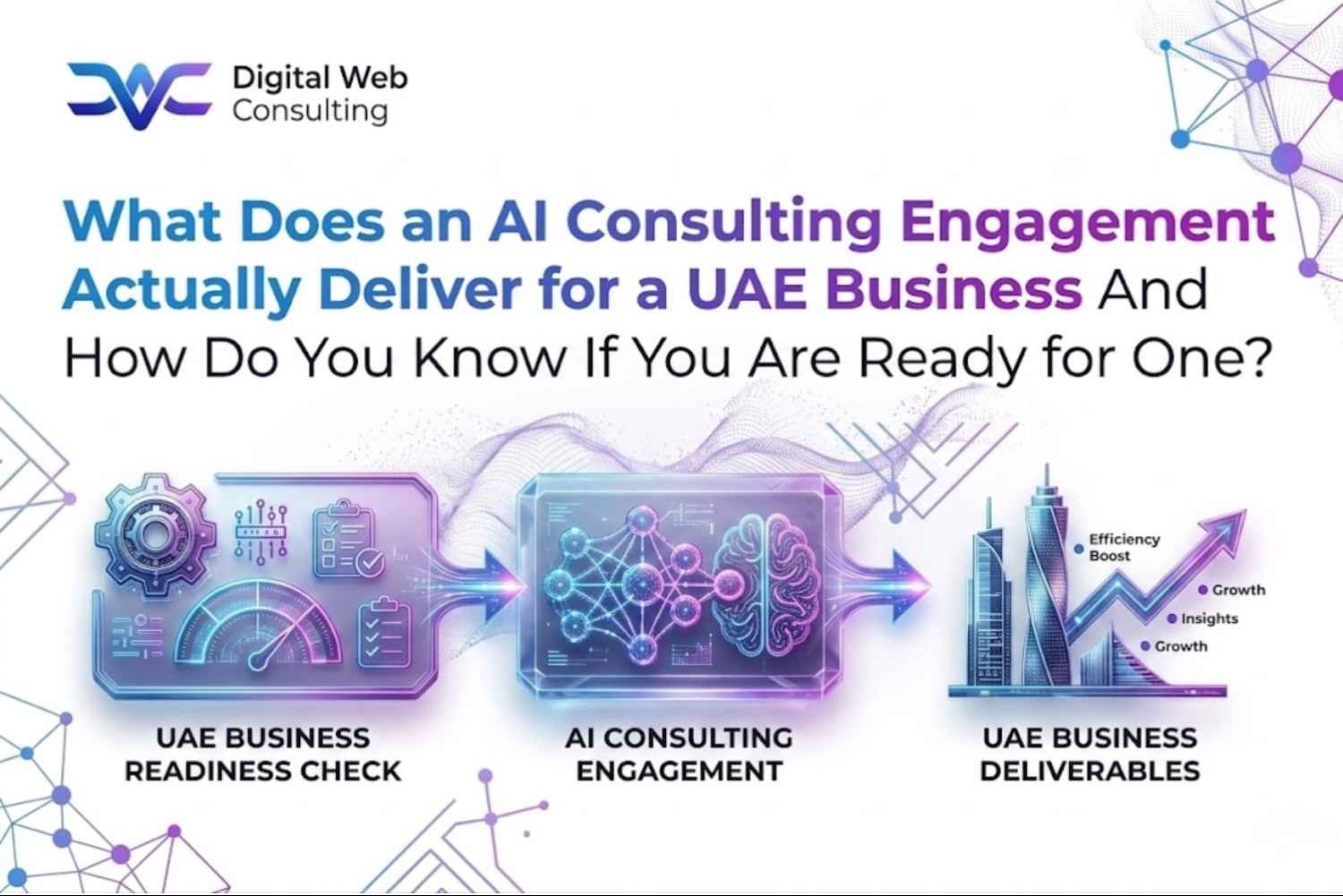
The output of a well-structured AI consulting engagement is not a presentation deck. It is a set of working documents that give the business a clear, evidence-based foundation for making AI investment decisions. Here are the five tangible deliverables a business should have in hand when the engagement ends:
- AI opportunity map: A documented inventory of the specific processes, workflows, and decision points across your business where AI can create measurable improvement. Each opportunity is described in operational terms, not technical ones, with an estimate of the business impact and the data requirements for implementation.
- Data readiness assessment: An honest evaluation of the data your business currently holds, its quality, its accessibility, and its sufficiency for the AI applications identified. This assessment identifies data gaps that need to be addressed before certain AI applications can be implemented and flags quick wins where the data is already in good shape.
- Prioritised AI roadmap: A sequenced implementation plan that orders AI initiatives by their combination of business impact and implementation feasibility. High-impact, low-complexity initiatives come first. The roadmap gives the business a realistic twelve to twenty-four month view of how AI adoption can progress without overwhelming operational capacity.
- Business case for priority initiatives: For the top two or three AI opportunities identified, a quantified business case that translates the opportunity into financial terms, cost reduction, revenue uplift, time saving, or error reduction, giving leadership the basis for an informed investment decision.
- Implementation requirements and vendor guidance: For each priority initiative, a clear specification of what needs to be built, integrated, or procured, and guidance on whether to build internally, work with a specialist partner, or adopt an existing platform. This prevents the common mistake of committing to an AI technology before understanding what the business actually needs from it.
For businesses whose AI roadmap identifies process automation as a priority use case, our AI Automation Solutions service covers the implementation side of what the consulting engagement identifies, moving from roadmap to working automation in a structured, phased programme.
The value of an AI consulting engagement is not in the sophistication of the AI it recommends. It is in the accuracy of the problem it identifies and the practicality of the plan it produces. The best AI roadmap is the one the business can actually execute.
The AI Readiness Assessment: How Consultants Evaluate Whether a Business Is Ready
Before any AI adoption strategy in UAE can be designed, the business needs an honest assessment of its current readiness across four dimensions. These four areas determine which AI opportunities are immediately actionable and which require foundational work before implementation can begin:
- Data readiness: AI systems learn from data and perform in proportion to its quality and volume. The assessment examines what data the business currently collects, how it is stored, how consistently it is structured, and whether it is accessible in a form that AI systems can work with. A business with clean, well-structured, consistently recorded operational data is significantly more ready for AI than one with fragmented records spread across disconnected systems and spreadsheets.
- Process readiness: AI performs best on processes that are clearly defined, consistently followed, and well-documented. If the process the business wants to automate or augment with AI varies significantly between team members, locations, or time periods, the AI will reflect that inconsistency in its outputs. The assessment identifies which processes are stable enough for AI application and which need standardisation first.
- People readiness: AI implementation requires people who can work with AI outputs, evaluate their accuracy, and provide feedback that improves system performance over time. The assessment looks at whether the business has the internal capacity to manage an AI implementation, not just technically, but operationally. This includes change management readiness: how receptive is the team to AI-assisted workflows, and what support will they need during the transition?
- Infrastructure readiness: AI applications need to integrate with the systems that hold the data they work with and the systems that act on their outputs. The assessment evaluates whether the business's current technology infrastructure can support AI integration, or whether foundational system improvements are needed before AI initiatives can be implemented effectively.
For businesses whose readiness assessment identifies infrastructure gaps, particularly around data integration between systems, our IT Consulting Services address the foundational technology decisions that determine how well the infrastructure can support AI applications once the readiness work is complete.
“ A readiness assessment is not a gatekeeping exercise. It is a navigation tool. It tells you which AI opportunities you can start today, which ones require six months of foundational work first, and which ones are genuinely not appropriate for your business at this stage. ”
Most UAE businesses that go through a structured AI readiness assessment discover they are closer to ready than they expected in some areas and further than they assumed in others. The assessment replaces assumption with evidence, and that is exactly the foundation a good AI roadmap needs.
The Four Most Valuable AI Use Cases for UAE Businesses Right Now
AI opportunity identification is context-specific, the right use case depends on the business, the industry, and the data available. That said, four AI applications consistently deliver the highest measurable value for UAE businesses across sectors in the current landscape:
- Predictive analytics for sales and inventory
What it does: Machine learning models trained on historical sales data, seasonal patterns, and external market signals predict future demand with significantly higher accuracy than manual forecasting. For trading companies and distributors in UAE, this means stock positions that match actual demand rather than approximated from last year's numbers.
What it replaces: Manual demand forecasting, reactive stock replenishment, and the costly combination of overstock in slow lines and stockouts in fast ones.
Cost of leaving it in place: Excess inventory carrying costs, lost sales from stockouts, and working capital tied up in stock that moves slowly, all of which compound monthly.
- Intelligent document processing
What it does: AI systems that read, classify, and extract data from unstructured documents, supplier invoices, purchase orders, delivery notes, contracts, automatically and accurately, without human data entry. For UAE businesses processing high volumes of multilingual commercial documents, this reduces processing time from minutes per document to seconds.
What it replaces: Manual document review, data entry by finance or operations staff, and the error-checking that follows when entry mistakes affect downstream records.
Cost of leaving it in place: Hours of staff time daily, a consistent error rate in financial records, and the compliance risk that comes from misclassified or mis-entered financial documents.
- Customer service automation with AI
What it does: AI-powered response systems that handle first-contact customer queries, classify incoming requests by type and urgency, provide accurate answers to frequently asked questions in Arabic and English, and route complex cases to the right human agent with full context already assembled.
What it replaces: First-response handling by human agents for queries that follow predictable patterns, manual query routing, and the inconsistent response quality that comes from high-volume customer communication managed entirely by people.
Cost of leaving it in place: Agent time spent on routine queries rather than complex issues, slower response times during peak periods, and customer experience inconsistency that affects retention.
- AI-powered financial forecasting
What it does: Machine learning models that analyse historical financial data, current pipeline, outstanding receivables, and payment pattern data to generate rolling cash flow forecasts and financial performance projections that update automatically as new data is recorded.
What it replaces: Manual cash flow modelling in spreadsheets, weekly finance team effort to update forecasts, and the lag between events occurring and the financial model reflecting them.
Cost of leaving it in place: Finance team hours consumed by model maintenance, leadership decisions made on forecasts that are already outdated, and cash flow surprises that better forecasting would have made visible weeks earlier.
For businesses ready to move beyond consulting into implementation, our Machine Learning Development service covers the build side of AI use cases, developing the models, pipelines, and integration layers that turn the opportunities identified in consulting into working AI systems.
The four use cases above are not the only AI applications relevant to UAE businesses, they are the ones with the most established track record, the most accessible data requirements, and the clearest ROI in the current market. They are also the right starting points for businesses building AI capability for the first time.
What a Real AI Consulting Engagement Looks Like Week by Week
An AI consulting engagement for businesses in Dubai follows a structured eight-week process that moves from understanding the business to delivering an actionable roadmap. Here is what each phase involves:
Weeks 1 to 2: Discovery and Stakeholder Interviews
The consulting team conducts structured interviews with stakeholders across every major department, operations, finance, sales, HR, and IT. The goal is not to collect a wish list of AI features. It is to understand the operational reality: where time is lost, where errors occur, where decisions are delayed, and where data exists but is not being used effectively. These interviews surface AI opportunities that no technology-first approach would identify.
Weeks 3 to 4: Data Audit and Use Case Identification
The data the business holds is audited across all systems, ERP, CRM, spreadsheets, and any other operational records. Volume, quality, consistency, and accessibility are assessed for each data source. Simultaneously, the AI opportunities identified during discovery are mapped against the available data to determine which are immediately viable and which require data improvements first.
Weeks 5 to 6: Feasibility Assessment and Prioritisation
Each identified AI opportunity is assessed across three dimensions: business impact, implementation complexity, and organisational readiness. This assessment produces a prioritised list of AI initiatives ordered by their combination of value and achievability. The businesses that gain the most from AI consulting are the ones that use this prioritisation honestly, resisting the temptation to start with the most ambitious initiative rather than the most achievable one.
Weeks 7 to 8: Roadmap Delivery and Implementation Planning
The final deliverable is a detailed AI roadmap, a sequenced implementation plan covering the first twelve to twenty-four months of AI adoption, with business cases for priority initiatives, implementation requirements for each, and guidance on build-vs-buy decisions. The roadmap is presented to leadership with full supporting documentation and a clear recommended first step.
Eight weeks is the right length for a thorough AI consulting engagement for a UAE business of moderate complexity. Shorter engagements sacrifice the depth needed for accurate opportunity identification. Longer ones risk scope creep and decision fatigue before the roadmap is delivered.
How to Know If Your Business Is Ready for AI Consulting Right Now
The honest answer to this question is that most UAE businesses with more than twenty employees and at least two years of operational history are ready for AI consulting, even if they do not feel ready. Readiness for consulting is not the same as readiness for AI implementation. Here is how to tell the difference:
✔ Five signs you are ready for AI consulting right now:
- You have operational data you are not fully using: If your ERP, CRM, or other systems hold years of transaction data that is used primarily for historical reporting rather than forward-looking insight, you have the raw material for AI applications that could deliver significant value.
- Manual processes are creating a measurable capacity constraint: If your team is spending time on tasks that follow predictable patterns, data entry, document review, report compilation, query routing, those tasks are candidates for AI augmentation or automation.
- Decision-making is slower than your market requires: If leadership decisions are regularly delayed by the time it takes to gather and analyse operational data, AI-powered analytics and forecasting can compress that cycle significantly.
- You are growing and manual processes are not scaling: If the volume of work is increasing faster than the team can absorb it without proportional headcount growth, AI is one of the most cost-effective ways to break that constraint.
- You have a specific pain point with a clear data trail: If there is a well-understood operational problem, customer churn, inventory waste, late collections, high error rates in a specific process, and the data around that problem exists in your systems, you have a concrete starting point for AI consulting.
⚠ Three signs you need foundational work first:
- Your data lives primarily in spreadsheets and emails: AI systems need structured, accessible data. If the majority of your operational data is unstructured or inaccessible, the first priority is building the data infrastructure, CRM, ERP, or integrated reporting, before AI applications can be effective.
- Your core processes are not yet standardised: AI learns from patterns. If the same process is done differently by different people in different locations, the AI will learn inconsistency rather than best practice. Process standardisation is foundational work that unlocks AI value.
- Your technology stack is heavily fragmented and disconnected: If your systems do not communicate with each other and data lives in isolated silos, integration work needs to precede AI work. AI applications that cannot access the data they need cannot deliver value regardless of how sophisticated they are.
For businesses in the third category, our Digital Transformation Consulting service addresses the foundational technology and process work that creates the conditions for effective AI adoption, so that when the AI consulting engagement begins, the business is genuinely ready to act on what it finds.
The question is never whether it is too early for AI, it is which phase of the AI readiness journey your business is currently in. Understanding that accurately is itself a valuable outcome of the first conversation.
The Right Question Is Not Whether to Adopt AI: It Is Where to Start
Artificial intelligence is not a technology trend that UAE businesses can choose to monitor from a distance until it becomes relevant. It is already relevant, to every business that manages data, makes operational decisions, and competes in a market where speed and accuracy determine outcomes.
AI consulting services in UAE do not tell businesses to adopt AI. They identify specifically where AI creates measurable value in the context of that particular business, its processes, its data, its industry, and its growth trajectory. The engagement ends not with a commitment to a technology platform but with a clear, prioritised understanding of the three or four AI initiatives that would deliver the highest return for the lowest implementation risk.
That clarity is what most businesses lack before they start, and it is the single most valuable thing an AI consulting engagement provides.
“ AI adoption without a strategy produces technology projects. AI adoption with a well-structured consulting foundation produces operational improvements. The difference is in the question you start with, and whether that question is about the technology or about the business. ”
Ready to find out specifically where AI can create measurable value in your UAE business? Start with Digital Web Consulting through our AI Consulting Services page →
[AI consulting services UAE , artificial intelligence consulting Dubai , AI strategy consulting UAE , AI advisory services , AI consulting for businesses in Dubai , how AI consulting helps UAE companies , AI adoption strategy UAE ]