

The ERP Paradox: Expensive Software That Still Does Not Work
Here is a situation that is remarkably common across UAE businesses. A company invests significantly in an ERP system, the licensing fees, the implementation partner, the data migration, the training. The system goes live. And within six months, the team has built an entire layer of spreadsheets to manage what the ERP cannot.
The ERP is technically running. But the business is running around it.
This is not a people problem. It is not a training problem. It is a fit problem. The system was built for a generalised version of a business that does not match how your specific operation works. And every day that gap exists, it costs time, accuracy, and ultimately money.
55% to 75% of ERP implementations are considered to have failed to meet their original business objectives, Gartner Research.
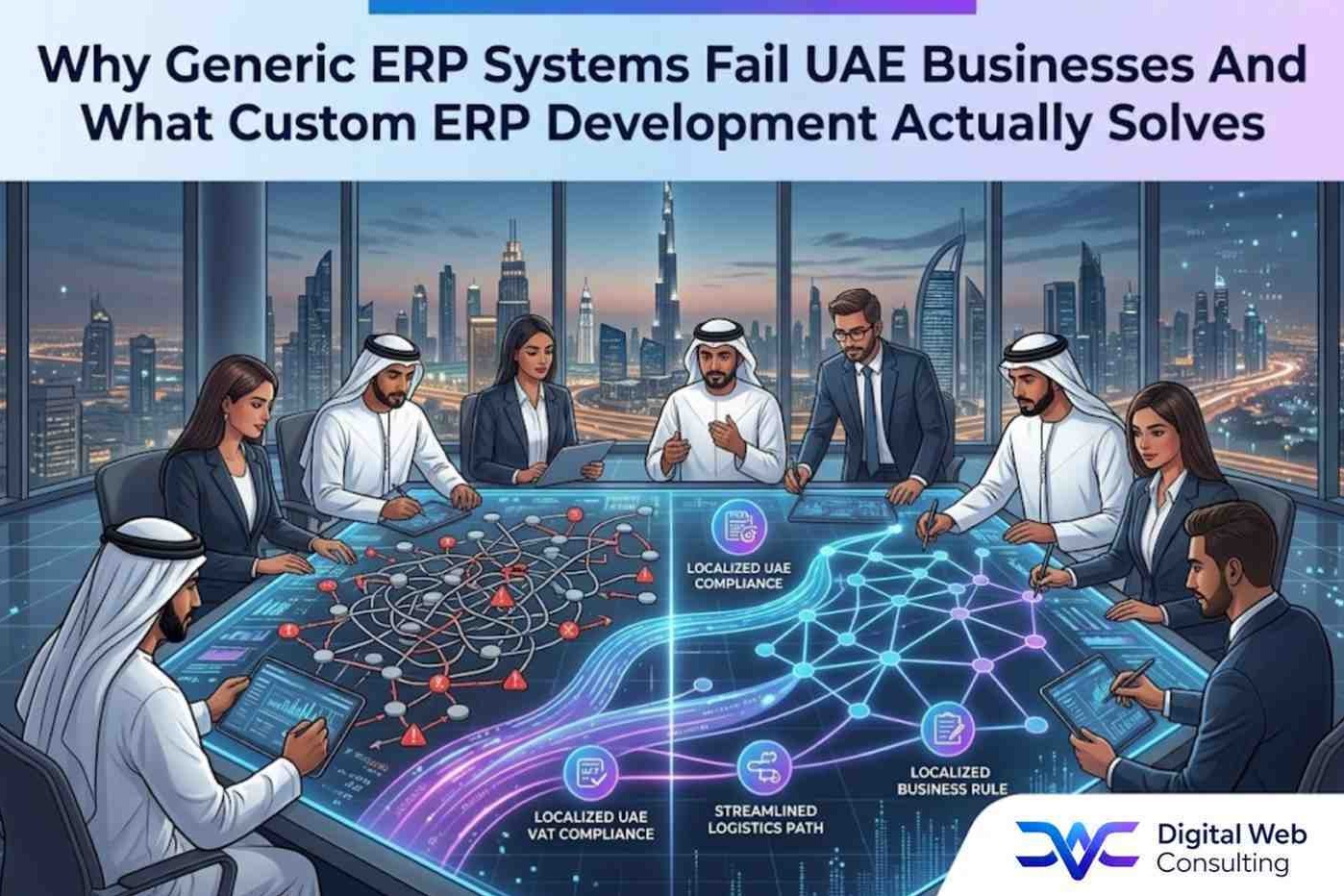
The failure is rarely technical. The platform usually works as designed. The problem is that it was designed for a different kind of business than the one trying to use it. For UAE companies with complex, high-volume, multi-currency, and multi-entity operations, that mismatch is especially pronounced.
“ An ERP that forces your business to adapt to its logic is not a solution. It is a constraint wearing the label of a solution. ”
The distinction between an ERP that works and one that merely runs is the difference between a system your team trusts and one they work around. Custom ERP development in UAE exists specifically to close that gap.
Why Generic ERP Platforms Struggle in the UAE Market Specifically
Standard ERP platforms are designed for the median business. They account for common workflows, common data structures, and common compliance environments. The UAE business environment is not median. It is a highly specific operating context with requirements that most global ERP vendors build around as an afterthought, if at all.
Here is what UAE businesses deal with that generic ERP platforms consistently handle poorly:
- Multi-currency and multi-entity operations: Trading companies, holding groups, and businesses with regional offices routinely manage transactions across AED, USD, EUR, and INR simultaneously. Standard ERP multi-currency modules are often designed for occasional foreign transactions, not for businesses where currency complexity is a daily operational reality.
- VAT compliance and local regulatory requirements: UAE VAT rules, including FTA filing, tax group structures, and specific invoice formatting requirements, need to be embedded into how the ERP handles every transaction. Many global ERP platforms treat UAE VAT as a configuration option rather than a structural design consideration.
- Industry-specific workflows that do not map to standard modules: A real estate developer tracking payment milestones per unit across multiple projects has fundamentally different operational logic from a retail business. A logistics company managing fleet allocation, route costing, and client delivery records needs modules that generic ERP simply does not include.
- Arabic language and bilingual document generation: Invoices, purchase orders, delivery notes, and financial reports frequently need to be generated in both Arabic and English. This is not just a translation requirement, it affects document layout, right-to-left formatting, and how records are stored and retrieved.
- WPS payroll compliance: The Wage Protection System mandates specific payroll data formatting and submission requirements that standard international HR modules do not account for by default.
Each of these gaps creates workarounds. Each workaround creates risk, of data errors, of compliance failures, of decisions made on incomplete information. A bespoke ERP solution in UAE is built with these realities as first-order requirements, not as add-ons applied after the fact.
The cost of workarounds is rarely measured directly, but it accumulates in every manual adjustment, every re-entry, every report that cannot be trusted until someone has checked it against a spreadsheet.
What Custom ERP Development Actually Means
Custom ERP development is frequently misunderstood. It does not mean taking an existing ERP and changing its colour scheme or adding a few extra fields. It means building an enterprise system, or extending a flexible open-source framework, around the specific logic of your business from the ground up.
Three approaches exist, and it is worth understanding the difference between them:
- Customising a standard ERP platform: Modifying an existing commercial ERP such as SAP, Oracle, or Microsoft Dynamics to better fit your needs. This approach has limits, you are working within the platform's architecture, and heavy customisation often creates maintenance problems when the vendor releases updates.
- Extending an open-source ERP framework: Using a flexible base such as Odoo or ERPNext and building industry-specific modules on top of it. This gives more architectural freedom than customising a commercial platform while reducing the total build effort compared to starting from scratch.
- Building a fully custom ERP system: Designing and developing an enterprise system from the ground up using your technology stack of choice. This delivers complete control over every module, every workflow, and every data structure, with no licensing dependency and no vendor constraints. It is the highest-effort approach but also the one that produces the closest fit to complex, unique operational requirements.
For businesses weighing these options, the right choice depends on the degree of operational complexity, the scale of current workarounds, and the long-term growth trajectory. Our IT Consulting Services include structured technology assessments that help businesses make this decision based on evidence rather than assumptions.
“ Custom ERP development is not about building something complicated. It is about building something accurate, a system that reflects how your business actually runs rather than how a software vendor assumed it might. ”
The most important measure of an ERP system is not its feature list. It is how closely its logic matches the operational logic of the business using it.
The Core Modules Typically Built in a Custom ERP for UAE Businesses
While every custom ERP is designed around the specific needs of the business it serves, certain modules appear consistently across UAE implementations because they address the operational realities most businesses here share:
- Financial management with VAT compliance: A full chart of accounts, multi-currency handling, bank reconciliation, FTA-compliant VAT calculations, tax group management, and financial reporting built around UAE regulatory requirements, not retrofitted into a template designed for another jurisdiction.
- Inventory and warehousing: Real-time stock level tracking across multiple locations, goods receipt and dispatch workflows, stock movement history, expiry date management where relevant, and automated reorder triggers based on minimum stock thresholds configured per SKU and location.
- Sales and procurement: End-to-end workflows from quotation to invoice on the sales side and from purchase requisition to supplier payment on the procurement side. Including approval chains, credit limit enforcement, landed cost tracking, and supplier performance records.
- HR and WPS-compliant payroll: Employee records, contract management, leave and attendance tracking, gratuity calculations aligned with UAE Labour Law, and payroll output formatted for WPS submission, all within the same system that manages the rest of the business.
- Reporting and real-time dashboards: Management dashboards that show the data leadership actually needs, not the default reports a vendor includes, built around your actual KPIs and updated in real time as transactions are recorded across the system.
These modules are not isolated. In a well-built custom ERP, data flows between them automatically, a confirmed sales order updates inventory, triggers a procurement request if stock is low, and posts the financial entry without anyone manually moving information between systems. For businesses exploring how this integrated data flow extends to customer-facing operations, our ERP Integration Services cover how custom ERP connects to your CRM, e-commerce platforms, and third-party tools.
The real value of a custom ERP is not in any individual module. It is in how all the modules work together, sharing data, enforcing business rules, and giving every department a single accurate picture of operations.
Custom ERP vs. Standard ERP: An Honest Cost Comparison
The common objection to custom ERP development is cost. And it is a fair concern, building a custom system requires a meaningful upfront investment. But the comparison is rarely made honestly, because the full cost of a standard ERP is almost always underestimated.
Consider what the five-year total cost of a standard ERP actually includes:
- Annual licensing fees: Most commercial ERP platforms charge per user, per module, or both. For a business with thirty users across multiple modules, these fees accumulate significantly over a five-year period and continue indefinitely.
- Implementation and customisation costs: Standard ERP implementations almost always require customisation to address gaps. Those customisations are expensive, time-consuming, and often create technical debt that compounds with every platform update.
- Upgrade costs and compatibility breaks: When the ERP vendor releases major updates, customisations frequently break and need to be rebuilt. These costs are unpredictable and can be substantial, particularly for businesses that have heavily modified the standard platform.
- The hidden cost of poor fit: Productivity lost to workarounds, data errors corrected manually, reports that cannot be trusted, and decisions delayed waiting for information the system cannot provide, none of this appears on an invoice, but all of it has a real cost.
A custom ERP development project in UAE carries a higher upfront cost but eliminates licensing fees entirely, removes vendor dependency, and produces a system that fits the business closely enough to actually be used as designed. Over a five-year horizon, the total cost comparison is often closer than businesses expect, and the operational benefit is not comparable at all.
“ The question is not whether custom ERP costs more than a standard platform. The question is what the standard platform is actually costing you once you include everything it cannot do. ”
Ownership matters in enterprise software. A custom ERP is an asset your business controls completely, its architecture, its data, its roadmap. A licensed platform is a dependency that can change its pricing, its terms, or its direction at any time.
How a Custom ERP Development Project Actually Runs
One of the most common concerns businesses raise about custom ERP development is the fear of a runaway project, scope creep, missed deadlines, and a system that still does not work when it eventually goes live. A well-structured development process addresses all of these risks directly.
- Discovery and business analysis: Every module, workflow, and data requirement is documented before development begins. This is not a questionnaire, it is a structured engagement where the development team works alongside your operational leads to map processes, identify integration points, and establish exactly what the system needs to do. No assumptions, no guesswork.
- Architecture and module design: Once requirements are clear, the system architecture is designed, database structure, module relationships, API interfaces, and reporting logic. This design phase is reviewed and approved before development begins, ensuring the build reflects the business requirements accurately.
- Phased build with team feedback: Development happens in phases, with working modules delivered incrementally so your team can review, test, and provide feedback before the full system is complete. This keeps the build aligned with actual needs and catches misalignments early when they are inexpensive to correct.
- Go-live, training, and post-launch support: Deployment is planned to minimise operational disruption. Teams are trained on the specific workflows relevant to their roles, not on a generic system overview. Post-launch support ensures the system performs as designed in real conditions and that refinements are made quickly as they become necessary.
For businesses considering custom ERP as part of a broader operational modernisation, our Digital Transformation Consulting service looks at how ERP fits within the wider technology and data strategy, including how it connects to existing CRM systems through our CRM Integration Services.
A phased build approach is not just a project management technique. It is a risk management strategy, one that keeps the business informed, involved, and in control throughout the development process rather than waiting months for a big reveal.
Fit Matters More Than Features
The most feature-rich ERP on the market is worth nothing to a business whose team works around it every day. The most important quality of an enterprise system is not how many modules it has, it is how accurately those modules reflect the way the business actually operates.
Generic ERP platforms fail UAE businesses not because they are bad software, but because they were not built for the specific complexity of operating in this market. Custom ERP development in UAE addresses this directly, building systems that match your workflows, your compliance requirements, your data structure, and your growth plans from the very first module.
If your current ERP is producing workarounds instead of efficiency, the problem is almost certainly fit, and fit is fixable.
“ The right ERP does not require your team to adapt to the software. It adapts to your team, and that distinction determines whether enterprise software delivers on its promise or simply adds to the operational burden. ”
Ready to explore what a custom-built ERP could look like for your business? Start the conversation with Digital Web Consulting through our Custom ERP Development Services page →
[ custom ERP development UAE , ERP development company Dubai , bespoke ERP solutions UAE , enterprise resource planning UAE , custom ERP system for UAE trading company , why build custom ERP UAE , ERP development cost Dubai ]