
The Investment That Has Moved From Optional to Necessary
Three years ago, a UAE business owner who invested in digital transformation consulting was doing something that most of their peers considered ambitious, forward-thinking, and probably premature. The businesses around them were growing without transformation. The operational problems that transformation addresses were present but tolerable. The investment looked large relative to an operational improvement that was difficult to quantify in advance.
Today, the same investment looks different. The businesses that transformed in 2021 and 2022 are now operating with structural advantages that are visible in how they respond to customers, how they manage their costs, and how quickly their leadership can make decisions from current information. The businesses that have not transformed are not simply running the same operations as before. They are running the same operations as before in a market where an increasing number of their competitors are running better ones. The gap is widening, and the business owners who are considering transformation now are increasingly aware that they are not evaluating an opportunity. They are evaluating a catching-up exercise.
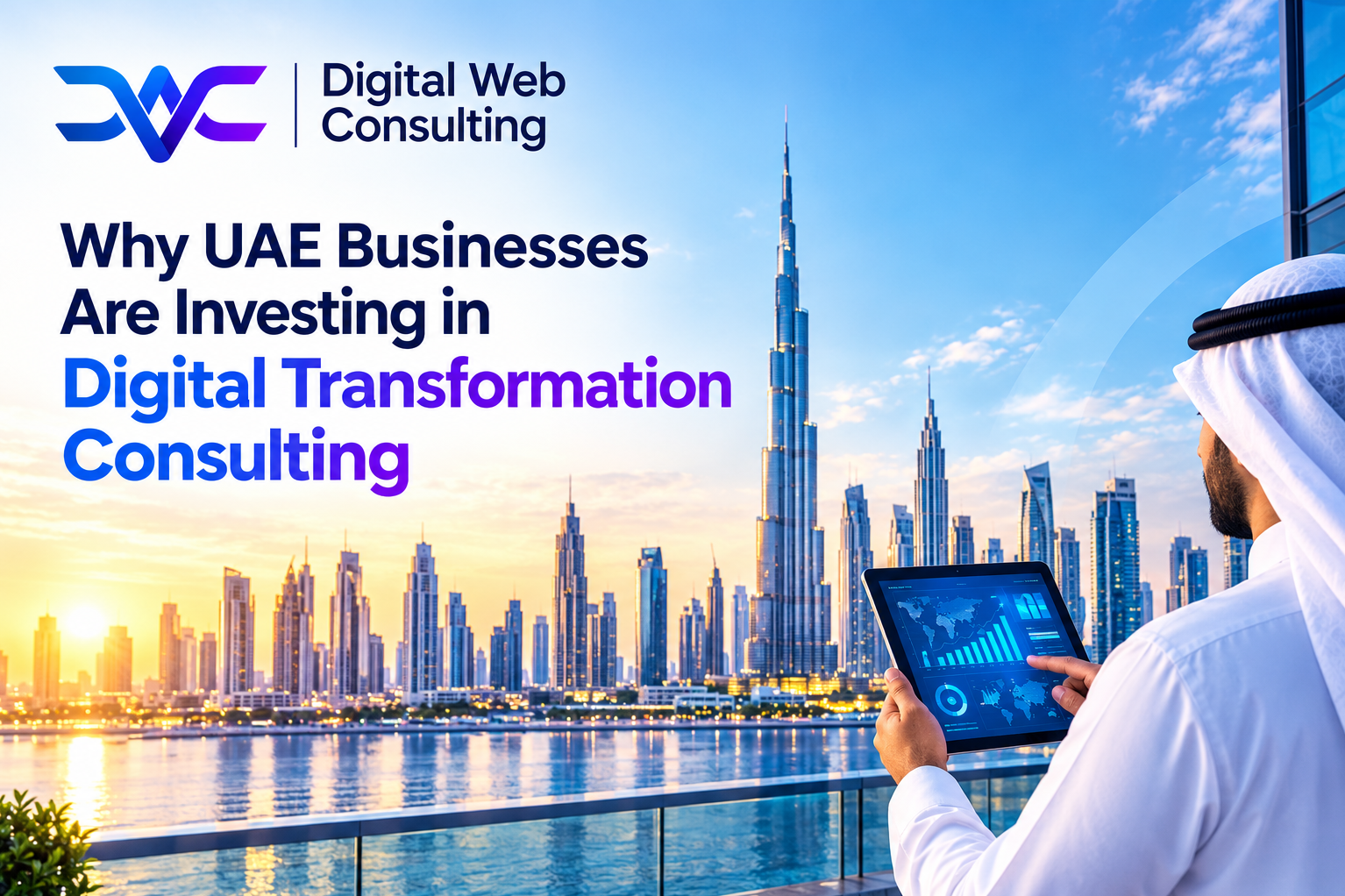
Digital transformation consulting services in UAE are attracting investment from businesses that would not have considered it two years ago, for reasons that are specific to the UAE market and the business conditions of 2024 and 2025. This guide describes those reasons: the government initiatives that have created regulatory and commercial incentives for digitisation, the competitive pressures from within the UAE market, the operational maturity stage that most growing UAE businesses have now reached, and the technology and talent conditions that have made transformation more accessible than it has ever been.
The UAE business owner who invested in digital transformation three years ago was making a strategic bet on where the market was going. The one investing today is responding to where the market already is. Both investments are rational. The second is more urgent.
UAE Government Initiatives Driving Private Sector Digitisation
The UAE federal and emirate-level governments have been among the most active governments in the world in creating the conditions for private sector digitisation. These conditions are not aspirational policy documents. They are specific programmes, regulatory requirements, and commercial incentives that directly affect the operating environment of private businesses across every major UAE industry.
UAE Vision 2031 and the Digital Economy Target
The UAE's Vision 2031 sets a specific target for the digital economy's contribution to GDP. The pathway to that target runs through the digitisation of private sector businesses, because government digital infrastructure alone cannot produce the digital economy contribution the vision targets. The government's investment in digital infrastructure, including cloud connectivity, digital payment systems, and data governance frameworks, creates the technical foundation that private sector transformation builds on.
For UAE businesses, Vision 2031 is not an abstract government aspiration. It is a signal that the regulatory and commercial environment will increasingly favour digitised businesses over non-digitised ones. Procurement preferences for digitally capable suppliers, regulatory reporting requirements that assume electronic record-keeping, and government service integrations that require connected business systems are all practical manifestations of the Vision 2031 direction that create direct operational pressure on businesses that have not digitised.
FTA Digital Reporting Requirements
The Federal Tax Authority's ongoing development of its digital reporting infrastructure has progressively increased the documentation and reporting requirements for UAE businesses. VAT registration, quarterly returns, and the record-keeping requirements associated with FTA compliance all assume electronic business records. Businesses managing their VAT obligations from paper records or disconnected spreadsheets face increasing compliance risk and increasing administrative cost relative to those whose accounting and transaction records are in connected digital systems that can produce FTA-compliant outputs automatically.
The UAE's participation in global initiatives for automatic exchange of tax information and its alignment with international digital commerce standards are further signals that the regulatory environment for UAE businesses is moving toward assuming digital operational infrastructure rather than accommodating its absence.
DIFC and ADGM Digital-First Requirements
The Dubai International Financial Centre and the Abu Dhabi Global Market, the UAE's two major financial free zones, have both invested heavily in digital infrastructure and digital-first regulatory frameworks. Businesses operating in or transacting with DIFC or ADGM entities are increasingly expected to meet digital documentation, reporting, and communication standards that assume digital operational capability.
For UAE businesses with DIFC or ADGM relationships, transformation from manual processes to connected digital systems is increasingly a prerequisite for maintaining the quality of those relationships rather than an optional operational improvement.
The Competitive Pressure From Within the UAE Market
Government initiatives create the regulatory and commercial framework within which the private sector competitive dynamic operates. The competitive pressure that most UAE business owners report as the most immediate driver of their transformation investment decisions is not regulatory. It is the visible operational advantage that competitors who have already transformed are now demonstrating in the market.
Customer Experience Expectations Have Changed
The customer expectations that a UAE B2B buyer brings to a supplier relationship have been shaped by the best digital experiences they have had with any supplier, anywhere. A buyer who receives an order confirmation within minutes from a digitised trading company and waits two days for confirmation from a non-digitised competitor has experienced a service gap that informs their next supplier evaluation. A buyer who can check their order status, their invoice history, and their account balance through a self-service portal provided by one supplier and must call a coordinator for the same information from another has formed a preference that influences retention decisions.
Customer experience expectations do not adjust to the lowest performing supplier in the market. They are set by the highest performing one. Businesses that have not digitised their customer-facing processes are competing against a service standard set by businesses that have.
The Price and Margin Pressure From Digitised Competitors
A digitised competitor operating with automated procurement, connected inventory management, and a finance team that closes the month in two days rather than five has a lower cost structure at equivalent revenue than a non-digitised competitor performing the same functions manually. That lower cost structure creates commercial flexibility that the non-digitised competitor cannot match: lower prices, faster responses, better payment terms, or simply better margins at the same prices.
UAE business owners who are investing in transformation are frequently responding to a specific competitive observation: a competitor who is pricing more aggressively than seems rational, who is growing their transaction volume without apparent proportional headcount growth, or who is responding to customer requests faster than their apparent team size should allow. The explanation for each of these observations is often the same. The competitor has digitised the operational processes that the non-digitised business is performing manually, and the cost and speed advantages of that digitisation are showing up in their commercial behaviour.
Talent Attraction and Retention in a Competitive Market
The Dubai technology talent market is competitive enough that the quality of a business's digital working environment is a meaningful factor in its ability to attract and retain the professional talent it needs to grow. A finance manager who spends three days of every month on manual reconciliation work that a connected system would do automatically, and who has worked in an environment where that reconciliation was automated, is not satisfied with their professional contribution. A sales team member who manages their pipeline in a spreadsheet while their peers at competing businesses use a live CRM is aware that they are working with a less capable tool.
Businesses that invest in digital transformation are investing in the working environment that attracts and retains professionals who have choices about where they work. The transformation's return is not only operational efficiency and competitive positioning. It is also the ability to attract the talent that produces the operational efficiency and the competitive positioning.
The Operational Maturity Stage Most UAE Businesses Have Reached
Beyond the external pressures from government and competitors, the most common internal driver of digital transformation investment in UAE businesses is a specific stage of operational maturity that most growing UAE businesses reach between five and fifteen years of operation. At this stage, the operational infrastructure that was adequate at an earlier size has become the primary constraint on what the business can achieve.
The Manual Process Ceiling
A business that has grown from ten to forty employees over eight years has almost certainly accumulated a set of manual processes that were workable at ten employees and have become visibly inadequate at forty. The monthly close that took two days with a two-person finance team takes five days with a four-person team because the volume of transactions has grown proportionally but the process has not evolved. The purchase approval that worked when the managing director personally reviewed every order is now a bottleneck because the volume of orders that requires sign-off exceeds what personal review can handle without creating delays.
At this stage, the business is not growing slowly because of market conditions or because of the quality of its team. It is growing slowly because its operational processes are limiting the pace at which it can serve customers, manage its costs, and make decisions. This is the manual process ceiling, and it is the internal driver that transforms digital transformation from an aspiration into a business imperative for most UAE businesses at this stage of their development.
The Data Invisibility Problem
A business at the manual process ceiling is also typically experiencing the data invisibility problem: the managing director and the senior leadership team cannot see what is happening in the business with the currency and the granularity that effective management requires. They know what happened last month from the management accounts. They know what the sales pipeline looks like from the sales director's weekly update. They know the cash position from the bank balance and the finance manager's estimate of the outstanding commitments.
What they do not know is what is happening today, in each part of the business, in sufficient detail to identify problems before they become consequential and opportunities before they pass. The data invisibility problem is not solved by hiring more staff to compile more reports. It is solved by connecting the systems that generate the data and building the reporting infrastructure that makes that data visible to leadership in real time.
The Scaling Cost Problem
A business at forty employees that is growing toward sixty faces a specific scaling cost problem. The manual processes that run the business at forty employees require approximately forty employees to run them. Growing to sixty customers' worth of volume requires sixty employees' worth of manual process capacity. The overhead grows with the revenue because the processes are manual and therefore headcount-dependent.
The business owner who is investing in transformation at this stage is investing in the ability to serve sixty customers' worth of volume with forty employees' worth of overhead. That is the operational leverage that automation provides and the reason the transformation investment's return is often most clearly visible in the businesses that made the investment immediately before their next growth phase rather than immediately after.
The Technology and Talent Conditions That Now Make It Achievable
The final driver of the increase in UAE transformation investment is the combination of technology conditions and consulting talent availability that has made transformation genuinely achievable for businesses at a scale and a price point that was not available five years ago.
Cloud-Based Platforms Have Removed the Infrastructure Barrier
Dynamics 365 Business Central, Power Platform, and the Microsoft Azure infrastructure that supports them are all cloud-based, subscription-priced services. A UAE business implementing Dynamics 365 Business Central in 2024 does not need to purchase, install, or maintain any server infrastructure. The platform is accessed through a browser or a mobile application on whatever device the team uses. The licensing is a monthly per-user fee rather than a large upfront capital commitment.
Five years ago, implementing an ERP system for a forty-person UAE business required either a significant capital investment in on-premise infrastructure or a complex, expensive customisation of a cloud platform that was not yet designed for businesses at this scale. Today, the platform is designed for this scale, priced for this scale, and deployed for this scale as a standard engagement rather than as a custom enterprise project. The infrastructure barrier to transformation has been substantially removed.
Local Consulting Expertise Has Reached Critical Mass in Dubai
The availability of UAE-experienced transformation consulting teams has grown significantly in the last three years. In 2020, a Dubai business seeking a transformation consulting partner with genuine UAE operational experience, local delivery capability, and a track record of comparable UAE implementations was searching in a thin market. In 2024, that market has depth. Businesses can now find consulting partners who have delivered transformation programmes for businesses in their specific industry, in their specific UAE regulatory context, and at their specific scale without the constraint of a thin local market forcing them to choose between global firms whose UAE depth is limited and local firms whose transformation methodology is immature.
Integration Technology Has Simplified System Connectivity
The API and integration tools available in 2024 have significantly reduced the cost and complexity of connecting the existing systems that a UAE business runs with the new systems that a transformation programme deploys. A business that has been running a specific accounting platform for eight years does not need to replace it immediately to implement a CRM or a procurement module. The integration tools available through the Microsoft Power Platform can connect these systems at a fraction of the cost that the same integration would have required three years ago, making the transformation programme's scope more focused and its initial investment smaller.
For UAE businesses assessing whether the current technology and consulting conditions make transformation achievable for their specific operational context and budget, our Digital Transformation Consulting service includes a feasibility assessment that maps the business's current operational environment against the available technology platforms and produces a realistic scope, cost, and timeline estimate before any implementation commitment is made.
What the Investment Produces : And Why the Timing Matters
The combination of government-created commercial incentives, competitive pressure from digitised competitors, internal operational constraints, and favourable technology and consulting conditions has created a specific window for UAE business transformation investment. The businesses that invest in this window benefit from the advantages of early adoption within their industry while the technology and consulting costs are still at the current level. The businesses that wait until the pressure becomes acute will pay more to close a larger gap against competitors who have been compounding the returns of their earlier investment for another two or three years.
The Compounding Return of Early Investment
A Dubai trading company that implemented Dynamics 365 Business Central and a Power BI reporting environment in early 2022 has now been compounding the operational advantages of that investment for three years. The finance team has been closing the month in two days rather than five for three years. The managing director has been making purchasing and credit decisions from current financial data for three years. The sales team has been working from a live pipeline for three years. Each of these improvements has been producing return every week for thirty-six months.
A competitor that makes the same investment in late 2024 starts producing the same returns from the implementation date, but the compounding advantage that the earlier investor has built over thirty-six months does not disappear when the second business goes live. The gap narrows as the second business adopts the platform, but the first business continues to compound its advantage while the second business is still absorbing the learning curve of its implementation.
The Cost of Waiting
The cost of delaying a transformation investment is not the foregone return alone. It is also the widening competitive gap during the delay, the accumulating technical debt of increasingly outdated manual processes, and the growing difficulty of the transformation itself as the volume of historical data requiring migration grows with each year of continued manual operation.
A UAE business that delays its transformation investment by two years will find that its data migration scope is larger, its process standardisation task is more complex because more variation has accumulated, and the competitive gap it needs to close is wider. The investment that closes the gap in 2024 is a smaller investment than the one required to close the larger gap in 2026. This is not a marketing argument for urgency. It is a compounding arithmetic observation about operational debt.
The Right Time Is Before the Pressure Becomes Acute
The most common experience reported by UAE business owners who have completed transformation programmes is that they wished they had started sooner. Not because the programme was more difficult than expected, but because the operational advantages they gained at the end of the programme were advantages they could have been compounding for the year or two they spent deciding whether to start.
The businesses investing in digital transformation consulting in the UAE today are the ones that have understood this dynamic and made the decision before the pressure from the market, the regulators, or their own operational constraints forces the decision on them. That proactive decision is the one that produces the most complete return on the investment.
The UAE business owner who asks 'why are other businesses investing in digital transformation consulting?' is already a step behind the ones they are asking about. The better question is 'what is it costing me each month that I am not?'. The answer to that question is almost always more than the monthly cost of the transformation investment that would have stopped the cost accumulating.
The Drivers Are Clear. The Decision Is Yours.
The UAE businesses that are investing in digital transformation consulting in 2024 and 2025 are responding to a specific and well-defined set of market conditions: government initiatives that create regulatory and commercial incentives for digitisation, competitive pressure from businesses that have already transformed, internal operational constraints that have reached the point where they limit growth, and technology and consulting conditions that have made transformation genuinely accessible at the scale and the price point of the growing UAE business.
Digital transformation consulting services in UAE are attracting investment not because the businesses making that investment are unusually ambitious or unusually well-resourced. They are attracting investment because the combination of conditions described in this guide has made the case for transformation clear enough that the decision to invest is no longer a strategic bet on where the market is going. It is a response to where the market already is and to what it will continue to become.
The question for any UAE business reading this guide is not whether these conditions apply to its market and its operational situation. They almost certainly do. The question is what the right moment within the current window is for the specific business to make the investment that the conditions are making necessary. For most businesses, that moment is sooner than the current decision timeline suggests.
Ready to understand what digital transformation investment looks like for your specific UAE business in the current market conditions? Start the conversation with Digital Web Consulting through our Digital Transformation Consulting Services page
[digital transformation consulting services in UAE , digital transformation services Dubai , transformation consulting UAE , digital consulting UAE]