
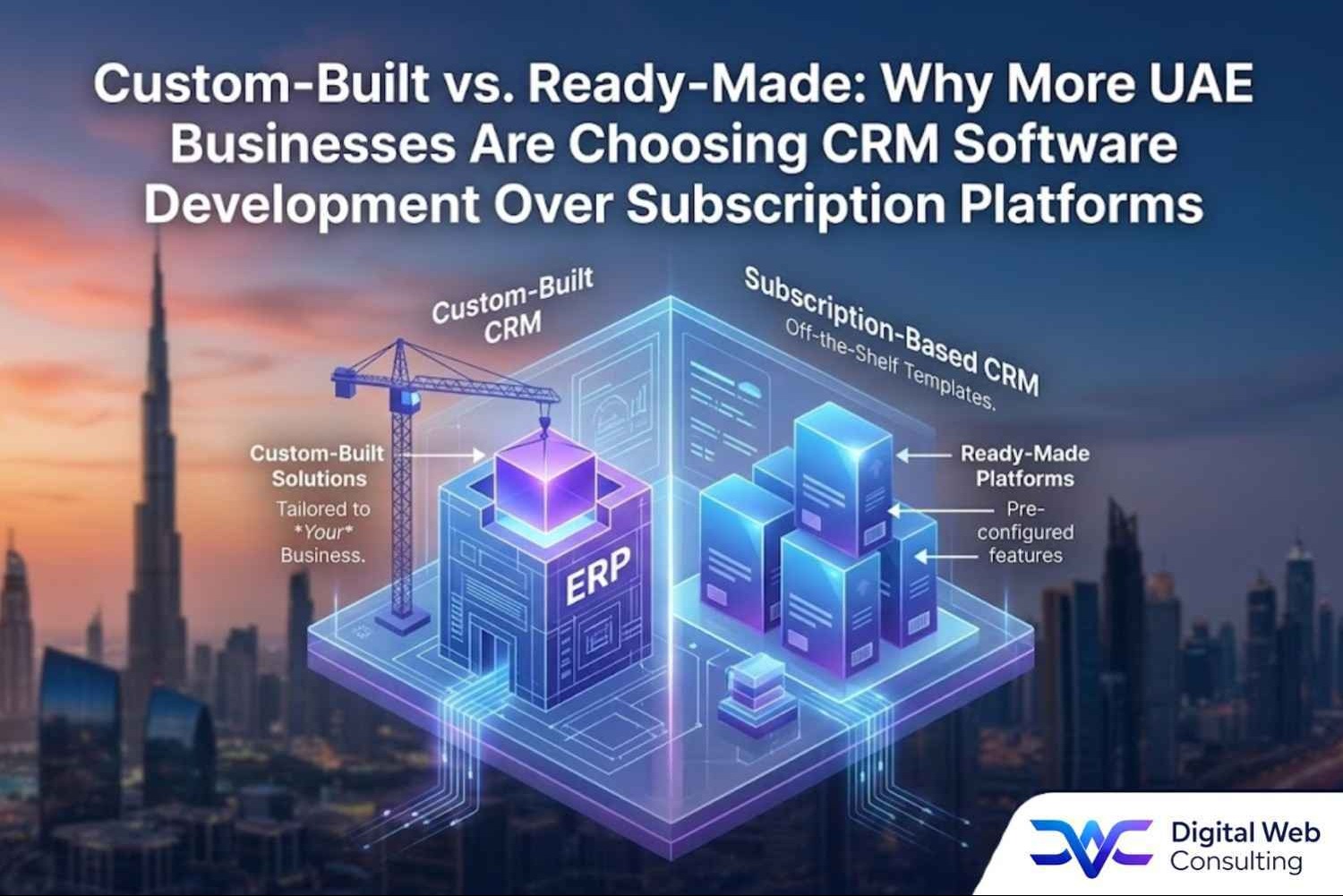
The Build vs. Buy Question Every Growing UAE Business Eventually Faces
At some point in the growth of almost every UAE business, the same conversation happens. The team has outgrown spreadsheets. A CRM is clearly needed. Someone pulls up a comparison of Salesforce, HubSpot, and Zoho. The per-user pricing looks manageable. The demo looks clean. And the decision to subscribe seems like the obvious, low-friction path.
Two years later, the same business is paying for features it does not use, working around module limitations it cannot change, and seriously considering either a migration to a different platform or a full custom CRM software development project — which it should have evaluated properly the first time.
This is not a criticism of SaaS CRM platforms. Many of them are genuinely excellent for the businesses they were designed to serve. The problem is that they were not designed for every business — and the gap between what a subscription platform offers and what a specific UAE business actually needs is often wider than it appears during the sales process.
91% of businesses with more than 11 employees now use a CRM — but fewer than half report being satisfied with the fit between their CRM and their actual sales process. — SuperOffice Research
“ The choice between building and buying a CRM is not a technical decision. It is a strategic one — and it deserves the same rigour as any other significant operational investment. ”
This guide lays out both options honestly — what ready-made platforms do well, where they fall short for UAE businesses specifically, and what custom CRM software development actually delivers in return for the additional upfront investment.
What Ready-Made CRM Platforms Do Well — And Where They Stop
It is worth being fair to subscription CRM platforms before examining their limits. For certain types of businesses at certain stages of growth, they are the right choice — and understanding why helps clarify when they are not.
✔ What SaaS CRM platforms genuinely do well:
- Fast deployment: A subscription CRM can be set up and operational within days. For early-stage businesses that need basic contact management and pipeline tracking immediately, that speed is a real advantage.
- Regular feature updates: SaaS vendors continuously add features, integrations, and improvements. Businesses benefit from new capabilities without commissioning development work.
- Predictable monthly cost: Per-user licensing makes the cost of a SaaS CRM easy to budget, even if that cost grows significantly as the team scales.
- Broad ecosystem of native integrations: Major platforms like Salesforce and HubSpot have large libraries of pre-built connectors to popular tools — email, marketing platforms, accounting software — that reduce integration effort for standard tool stacks.
✗ Where subscription CRM platforms consistently fall short for UAE businesses:
- Rigid data models: SaaS CRMs define how data is structured. Custom fields help to a point, but the underlying data architecture cannot be changed. For businesses with complex, non-standard data relationships — common in UAE trading, real estate, and logistics — this rigidity creates permanent workarounds.
- Per-user pricing that punishes growth: A business with fifty users paying per-seat licensing on an enterprise-tier CRM is often spending more annually on software fees than it would cost to maintain a custom-built system. The cost curve of SaaS CRM works against growth.
- UAE-specific gaps: VAT-compliant document generation, Arabic language support, WPS-aligned HR records, and multi-currency deal management are handled inconsistently or not at all by platforms designed primarily for Western markets.
- Vendor dependency: When the CRM vendor changes its pricing, discontinues a plan, or modifies a feature your team depends on, your business absorbs the impact. Your data lives in their system under their terms.
- Customisation limits that compound over time: Early in deployment, platform limits are manageable. As the business grows and processes become more specialised, the gap between what the platform can do and what the business needs widens — and the workarounds multiply.
For businesses already experiencing these limits, our CRM Customization Services can often extend the life of an existing platform. But for businesses where the limits are structural rather than configurable, CRM software development in UAE is the more practical long-term path.
The inflection point — where a subscription CRM's limits begin costing more than they save — arrives earlier than most businesses expect. Recognising it before committing to another two-year contract is the difference between a planned transition and a forced one.
What Custom CRM Software Development Actually Delivers
A custom CRM built from scratch is not simply a subscription platform with extra fields added. It is a purpose-built software system designed around your specific sales process, your customer data structure, your team's workflow, and your business's growth trajectory. Every design decision reflects your operational reality rather than a vendor's assumptions about how businesses generally work.
Here is what that actually means in practice:
- Complete data ownership: Your customer data lives in your own database, on infrastructure you control. There is no vendor who can change the terms of access, limit data exports, or hold your operational history in a system you cannot fully control.
- A sales process that matches how you actually sell: Every stage, every field, every automation rule, and every dashboard is designed around your real sales methodology — not a generic pipeline template that your team has to approximate their process within.
- No per-user fees or feature tier limits: A custom CRM is licensed to your business, not charged per seat. Adding ten users costs nothing in licensing. Accessing advanced reporting features costs nothing extra. The system grows with the team without the cost curve that subscription platforms impose.
- Integration built to your exact requirements: Rather than relying on native connectors that sync limited fields in limited directions, a custom CRM integrates with every system your business uses via purpose-built API connections that handle your specific data flows and business logic.
- A development roadmap you control: When your business needs a new feature, you build it. When a process changes, the system changes with it. There is no waiting for a vendor's product roadmap to align with your requirements or paying for custom development within a platform you do not own.
“ A custom CRM is not a more expensive version of a subscription platform. It is a fundamentally different kind of investment — one that produces an asset your business owns rather than a service it rents. ”
The businesses that benefit most from custom CRM development are those whose sales process, customer data structure, or integration requirements are genuinely specific enough that no off-the-shelf platform addresses them adequately. In the UAE, that describes a significant proportion of trading, real estate, logistics, and professional services firms.
Industry-Specific Reasons UAE Businesses Choose Custom CRM
The UAE's dominant industries each have operational characteristics that push against the limits of subscription CRM platforms in very specific ways. Here is what that looks like across four of the most common sectors:
- Real estate: Property developers and brokers need to track individual units, plot numbers, payment plan milestones, handover schedules, owner communication histories, and post-handover service records — all linked to the same customer across multiple transactions spanning years. No subscription CRM handles this data structure adequately without significant workarounds that eventually break down.
- Trading and import-export: Multi-currency deal management, letter of credit tracking, supplier CRM alongside customer CRM, freight and logistics coordination linked to customer orders, and customs documentation management are all standard requirements for UAE trading companies that subscription platforms were never designed to address.
- Logistics and freight: Customer records in logistics need to be directly linked to active shipments, delivery tracking data, driver assignment records, and billing milestones that update as physical events occur. A custom CRM built for logistics companies treats shipment data and customer data as inseparable — because operationally they are.
- Professional services: Consultancies, law firms, and engineering companies manage retainer-based relationships where the CRM needs to track billable hours, project milestones, contract renewal dates, and service delivery records alongside standard contact and deal management. These requirements sit at the intersection of CRM and project management in ways that generic platforms address awkwardly if at all.
For any of these industries, a custom CRM development in Dubai project begins not with technology choices but with a detailed mapping of the industry-specific workflows the system needs to support. Our Custom CRM Development service covers this discovery process in detail — ensuring the system built reflects how the business actually operates before a single line of code is written.
Industry fit is the single most important factor in CRM effectiveness. A system built for your industry's specific data relationships and workflow logic will outperform a generic platform regardless of feature count — every time.
The Real Cost Comparison Over Five Years
The upfront cost of custom CRM development is higher than subscribing to a SaaS platform. That is a straightforward fact. What is less straightforward is the total cost of each option over a realistic business timeframe — and this is where the comparison often surprises businesses that have not done the full calculation.
💳 The true five-year cost of a subscription CRM for a 30-user UAE business:
- Annual licensing fees: Enterprise-tier CRM platforms typically cost between USD 75 and USD 300 per user per month. For 30 users over five years, that represents a licensing spend of between USD 135,000 and USD 540,000 — before any add-ons.
- Add-on modules and integrations: Features that matter to UAE businesses — advanced reporting, marketing automation, telephony integration, custom objects — are frequently locked behind higher tiers or sold as paid add-ons that compound the annual cost significantly.
- Implementation and customisation costs: Getting a SaaS CRM configured properly for a UAE business typically requires consultant fees that can run from USD 10,000 to USD 80,000 depending on complexity. These are sunk costs that produce no asset.
- Migration costs at the end of the contract: When a subscription CRM no longer serves the business and migration becomes necessary, the cost of extracting, cleaning, and migrating data to a new system — plus retraining the team — is substantial and entirely wasted from a value perspective.
💻 The five-year cost of a custom CRM for the same business:
- Development investment: A well-built custom CRM for a UAE business of 30 users typically costs between USD 40,000 and USD 120,000 to build, depending on complexity. This is a one-time capital investment that produces an owned asset.
- Hosting and infrastructure: Annual hosting costs for a custom CRM at this scale typically run between USD 3,000 and USD 10,000 per year — a fraction of per-user SaaS licensing.
- Maintenance and feature development: Ongoing maintenance, updates, and new feature development are budgeted and controlled by the business. There are no surprise price increases, no feature removals, and no terms changes imposed by a vendor.
Over five years, the total cost of ownership for a properly built custom CRM is frequently comparable to — and often lower than — the total cost of a subscription platform that never quite fits the business. The difference is that the custom CRM produces an asset at the end of that period, while the subscription produces nothing that the business owns.
“ The honest five-year comparison almost always looks different from the month-one comparison. Subscription costs that appear manageable at launch compound significantly at scale — while custom development costs are paid once and do not grow with the team. ”
The right financial comparison is not custom development cost versus first-year SaaS fees. It is custom development cost versus five-year SaaS total cost of ownership — including licensing, add-ons, customisation, and eventual migration.
How to Know Which Option Is Right for Your Business Right Now
Neither option is universally correct. The right answer depends on your current stage, your operational complexity, and your growth trajectory. Here is a clear framework for making the decision:
✔ Signs a subscription CRM is still the right fit:
- Early-stage business with standard processes: If your sales process closely resembles the generic pipeline that SaaS CRM platforms are built around, a subscription platform will serve you well at lower cost and faster deployment than custom development.
- Team of fewer than 15 people: At smaller team sizes, the per-user cost is more manageable and the operational complexity that drives custom CRM value is typically lower.
- Budget constraints that make upfront development impractical: If the capital required for custom development is not available, a SaaS CRM with a clear migration plan for when the business grows is a sensible interim choice.
✗ Signs you have outgrown subscription platforms:
- Your team maintains workarounds alongside the CRM: Spreadsheets, WhatsApp notes, and manual processes running parallel to the CRM are a direct signal that the platform cannot accommodate your actual workflow.
- You are on the highest subscription tier and still hitting limits: When enterprise-tier features are insufficient, the platform has reached its structural ceiling for your use case.
- Your per-user licensing cost has become a significant line item: If annual CRM licensing is costing more than USD 30,000 to USD 50,000 per year, the five-year custom development comparison is worth doing seriously.
- Your industry has data requirements the platform cannot model: If your customer records routinely need to carry data that does not fit the platform's object model, custom development is the appropriate solution.
For businesses that are genuinely unsure which path is right, an independent technology assessment is the most reliable way to get an honest answer. Our IT Consulting Services include structured build-vs-buy evaluations that examine your current system, your operational requirements, and your growth plans before recommending a path forward.
The businesses that make this decision well are the ones that evaluate it based on a full five-year cost comparison and an honest assessment of operational fit — not on which option requires the smallest initial commitment.
The Right CRM Is the One Built for Where Your Business Is Going
Subscription CRM platforms serve a real purpose — they are the right choice for businesses at a certain stage with standard processes and manageable scale. But they are not built for every business, and the gap between what they offer and what a growing UAE company actually needs widens steadily as the business becomes more specialised and more complex.
CRM software development in UAE addresses that gap directly — not by adding complexity, but by removing the friction that comes from forcing a growing, specialised business into a system designed for the median company. A purpose-built CRM gives your team a platform that reflects exactly how you sell, exactly how you manage customers, and exactly how you want to grow.
The question is not whether custom development costs more than a subscription. It is whether the subscription you are currently paying for is delivering the value your business needs — and whether it will continue to do so as your operation scales.
“ The best time to evaluate custom CRM development is before you sign another two-year subscription contract. The second best time is right now. ”
Ready to explore what a custom-built CRM would look like for your business? Start the conversation with Digital Web Consulting through our CRM Software Development page →
Related Services:
Custom CRM Development | CRM Customization Services | CRM Integration Services | IT Consulting Services
[ CRM software development UAE , custom CRM software Dubai , CRM app development UAE , build CRM from scratch , CRM software development for real estate UAE , custom CRM vs off-the-shelf , CRM development cost Dubai ]