
Why Most Digital Transformation Content Is Written for the Wrong Audience
Search for digital transformation consulting services in UAE and you will find a consistent set of case studies, frameworks, and service descriptions. Multi-year programme roadmaps. Organisational change management at scale. Enterprise architecture reviews. Cloud migration strategies for hundreds of applications. Digital centre of excellence design. The language is confident, the frameworks are sophisticated, and almost none of it applies to a fifty-person trading company in Dubai that is trying to stop managing its inventory in spreadsheets.
This is not accidental. The largest consulting firms publish the most content, and the largest consulting firms work primarily with enterprise clients. The result is a body of digital transformation knowledge that is genuinely useful for businesses with dedicated IT teams, multi-year programme budgets, and the internal capacity to absorb organisation-wide change over eighteen to twenty-four months. It is significantly less useful for a growing UAE business whose most urgent transformation need is connecting three disconnected systems so that the finance team stops re-entering data every morning.
Digital transformation consulting services in UAE for SMEs need to start from a different place. Not from enterprise frameworks applied at a smaller scale, but from the specific operational realities of a growing business: limited internal bandwidth, fixed budgets, the need for visible results within weeks rather than years, and the risk that a failed or stalled transformation attempt damages the organisation's appetite for change for years afterward.
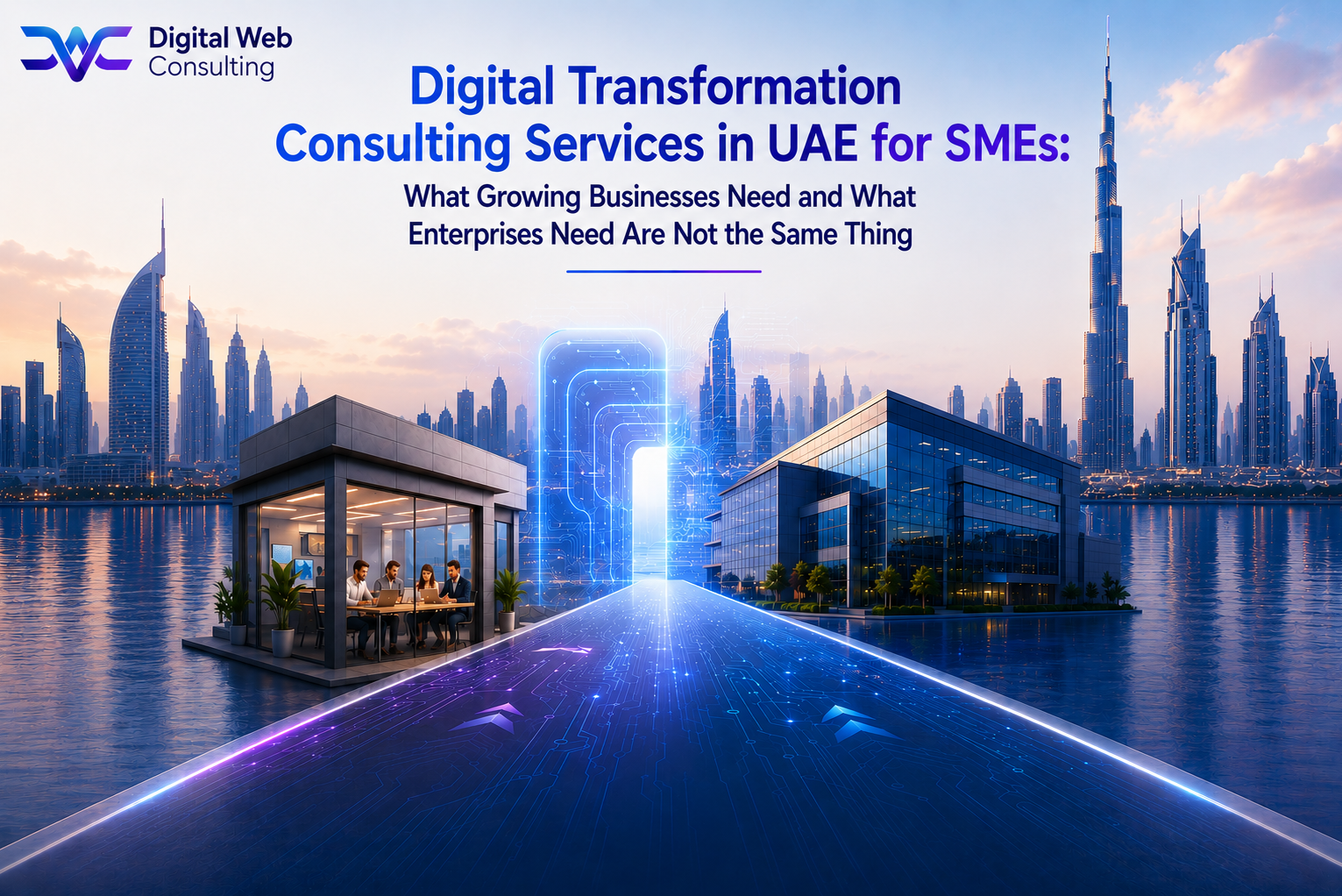
The transformation that a 50-person UAE business needs is not the transformation that a 5,000-person enterprise needs, simplified. It is a different discipline, with different starting points, a different pace, and a fundamentally different definition of what success looks like at the end of the first engagement.
This guide is written for UAE businesses with annual revenues between AED 3 million and AED 100 million and team sizes between fifteen and two hundred employees. The principles are consistent across this range. The specific starting points and investment levels vary with the complexity of the operational environment being transformed.
The Five Differences Between SME and Enterprise Transformation
Understanding where SME transformation differs from enterprise transformation is the foundation for choosing consulting services that are actually calibrated to the business engaging them. These five differences are the most consequential.
Problem Scope
Enterprise transformation programmes address organisation-wide change across multiple business units, geographies, and technology platforms simultaneously. The problem to be solved is systemic and requires coordinated change across many parts of the organisation before results become visible.
SME transformation addresses specific, identifiable operational friction points. The finance team spends three hours every Monday compiling a report that Power BI could produce automatically. The sales team manages its pipeline in WhatsApp because the CRM was never properly configured. The warehouse runs on spreadsheets because the ERP integration was never built. These are not systemic problems requiring multi-year programmes. They are specific problems with specific solutions that can be designed, implemented, and producing results within eight to twelve weeks.
Budget Structure
Enterprise transformation budgets are multi-year programme investments approved at board level, often running into the tens of millions of AED. They accommodate long periods of planning, architecture design, vendor selection, and change management before any operational improvement is visible.
SME transformation budgets are outcome-linked investments approved by the managing director or owner, typically in the range of AED 30,000 to AED 200,000 for an initial engagement. They require visible, measurable results within a timeframe the business can sustain before the next investment decision is made. A consulting engagement that produces a strategy document and a roadmap without implementing anything is not delivering what a growing UAE business needs from its transformation investment.
Speed to Results
Enterprise transformation programmes measure success over years. The first year is typically spent on programme design, platform selection, and change management preparation. Operational improvements become visible in years two and three.
SME transformation must produce visible results within weeks. Not because growing businesses are impatient, but because the internal commitment to change that makes transformation successful depends on the organisation seeing evidence that the effort is producing value before that commitment expires. A transformation engagement that takes six months to produce its first visible operational improvement will lose the internal support it needs to sustain the programme.
Internal Capacity
Enterprise transformation is managed internally. Large organisations have programme management offices, change management teams, IT departments, and dedicated project resources. The consulting firm provides expertise and methodology. The internal organisation provides capacity.
SME transformation must be managed primarily externally. The managing director, the finance manager, and the operations lead are all running the business while the transformation is happening. They can provide business knowledge, decision-making authority, and review capacity. They cannot provide the project management, technical delivery, and change management capacity that the transformation requires. A consulting engagement calibrated for SMEs accounts for this constraint from the first day of the programme.
Risk Tolerance
Enterprise organisations can absorb a failed transformation programme. The organisation continues to function. The programme is reviewed, restructured, and restarted. The cost is significant but the business continues.
SMEs cannot absorb a failed transformation attempt in the same way. A twelve-month programme that consumes management attention, disrupts operations, and produces no operational improvement damages the organisation's capacity and appetite for change in ways that take years to recover from. This is why the scope discipline, the phased delivery approach, and the outcome focus that characterise SME transformation consulting are not optional enhancements. They are structural requirements that protect the business from a level of programme risk that its size cannot absorb.
For growing UAE businesses evaluating transformation consulting services, our Digital Transformation Consulting service is specifically structured around SME operational realities rather than enterprise programme frameworks. The engagement scope, the delivery timeline, and the success criteria are all calibrated to what a growing business can invest, absorb, and sustain.
None of the five differences above mean that SME transformation is simpler than enterprise transformation. They mean it is differently complex. The discipline of identifying the right starting point, scoping the engagement correctly, and delivering visible results quickly is as demanding as running a large programme. It is simply a different skill set.
What Digital Transformation Consulting Services Actually Look Like for a UAE SME
The most useful way to understand what SME transformation consulting looks like in practice is to describe what it produces, rather than what it involves. The output of a well-designed eight to twelve week SME transformation engagement for a UAE business is not a strategy deck. It is a combination of the following elements, depending on the specific starting point.
A Working Plan With a Defined First Step
The engagement produces a prioritised implementation plan where the first initiative is not a recommendation but a completed piece of work. The highest-impact, most achievable operational improvement identified during the discovery phase is implemented during the consulting engagement rather than planned for implementation afterward. A growing UAE business should emerge from a transformation consulting engagement with something working differently, not just something planned differently.
Process Automation Before Platform Replacement
The default SME response to operational friction is to buy a new system. The default SME transformation consulting response is to ask whether the current system, properly configured and with the right automation applied, can eliminate the friction without the cost, disruption, and adoption risk of a platform replacement. Automation of specific processes within existing systems is almost always faster, cheaper, and less risky than replacing the systems themselves. It is also the work that creates the data and process clarity that makes a future platform replacement succeed when it is eventually needed.
Data Infrastructure Before Analytics
Growing UAE businesses frequently want reporting and analytics capability before they have the data infrastructure to support it reliably. A Power BI dashboard built on top of inconsistent, fragmented, or manually maintained data produces dashboards that cannot be trusted, which produces the same decision-making problem the dashboard was supposed to solve. SME transformation consulting that is sequenced correctly establishes the data infrastructure, which means clean data sources and reliable system connections, before building the analytical layer on top of it.
Integration Before New Systems
The most common source of operational friction in a growing UAE SME is not missing functionality. It is missing connections between systems that already exist. Finance, CRM, inventory, and communication tools that do not talk to each other force manual data transfer, create data inconsistency, and produce the operational fragmentation that feels like a systems problem but is actually an integration problem. Solving integration before adding new systems eliminates the majority of operational friction for most growing businesses at a fraction of the cost and disruption of a platform replacement.
For businesses whose transformation starting point is system integration, our ERP Integration Services and CRM Integration Services address the specific connections that eliminate the highest-volume manual handoffs in the business before any new platform investment is considered.
An SME transformation consulting engagement that ends with a roadmap and no implemented change has delivered a document, not a transformation. The distinction matters because the organisational commitment required to act on a roadmap without visible momentum is significantly higher than the commitment to continue a programme that is already producing results.
The Three Most Common SME Transformation Starting Points in UAE
While every SME transformation engagement is shaped by the specific operational context of the business, three starting points account for the majority of engagements with growing UAE businesses. Understanding which applies to a specific business points directly to the right first conversation with a consulting partner.
Starting Point One : Eliminating Manual Processes That Are Limiting Scale
The business is growing, but the team is growing proportionally to handle the same manual tasks at higher volume. Finance is processing more invoices by adding more staff. Operations is managing more orders by hiring more coordinators. Sales is following up more leads by expanding the team. The manual processes themselves are not changing. Only the headcount required to run them is increasing.
The transformation starting point here is process mapping followed by targeted automation. Every manual process is documented, the automation potential of each is assessed, and the highest-volume, highest-frequency tasks are automated first. The result is a business that can grow its transaction volume without growing its administrative headcount proportionally, which changes the unit economics of growth in ways that compound over time.
The consulting engagement for this starting point typically runs eight to ten weeks. It produces a completed automation of two to four high-volume processes, a documented map of the remaining automation opportunities, and a prioritised sequence for addressing them in subsequent phases.
Starting Point Two : Connecting Disconnected Systems That Create Data Fragmentation
The business runs multiple systems that do not communicate. The CRM does not know what the ERP knows about a customer. The accounting system does not receive data from the sales system automatically. The inventory system is updated manually from warehouse records. Every department works from a different version of operational reality, and resolving the differences consumes time that should be going toward customers and growth.
The transformation starting point here is integration architecture followed by system connection. The highest-value data flows between systems are identified, the connection method for each is designed, and the integrations are built and validated in sequence. The result is a business where data flows automatically between the systems that generate it, eliminating the manual transfer work and the data inconsistency that creates operational friction and poor decision-making.
The consulting engagement for this starting point typically runs eight to twelve weeks depending on the number and complexity of the integrations required. It produces working, tested integrations for the highest-priority data flows, a documented integration architecture for the full system environment, and a maintenance and monitoring plan that keeps those integrations reliable as the connected systems evolve.
Starting Point Three : Building Reporting Visibility That Leadership Currently Lacks
The business generates significant operational data but cannot see it clearly. The financial position is known only after the monthly close. The sales pipeline is visible only through spreadsheet reports that take two days to compile. The inventory position is known only after a physical count. Leadership makes daily decisions without a current, accurate picture of how the business is performing, which means problems are identified late and opportunities are missed entirely.
The transformation starting point here is data infrastructure followed by dashboard development. The data sources that hold the relevant information are connected and standardised, the data model that structures the analytical view is built, and the dashboards that give leadership the visibility they need are developed and tested against real data before go-live. The result is a business where the current operational position is visible in real time without anyone spending time compiling it.
For businesses whose starting point is reporting visibility, our Power BI Dashboard Development service provides the analytical layer that makes operational data visible and actionable, calibrated to the data environment and KPI requirements of a growing UAE business rather than an enterprise analytics programme.
These three starting points are not mutually exclusive. Many growing UAE businesses have operational friction across all three dimensions simultaneously. The role of the initial consulting engagement is to identify which starting point will produce the highest-impact, fastest-visible return, and to focus the first phase of the programme there rather than attempting to address all three simultaneously.
What SME Digital Transformation Consulting Should Cost in UAE
The investment range for digital transformation consulting services calibrated to UAE SME scale is significantly lower than enterprise transformation pricing, and significantly higher than the cost of buying a software tool without consulting support. Understanding what each investment level should produce prevents two common mistakes: paying enterprise prices for SME-scale problems, and paying tool prices without the consulting that makes the tool deliver its intended value.
Initial Discovery and Assessment Engagement
An initial discovery engagement for a UAE SME, covering operational assessment, technology audit, starting point identification, and a prioritised implementation plan, typically costs between AED 15,000 and AED 40,000 depending on the complexity of the business and the breadth of the operational scope assessed. The output is a documented current state assessment, a prioritised list of transformation opportunities with effort and impact estimates, and a recommended first engagement scope with a defined budget and timeline.
A firm that charges enterprise pricing for a discovery engagement at this scale, or one that conducts discovery without producing a concrete implementation recommendation, is not calibrated to SME transformation. The discovery engagement should pay for itself in the clarity it produces before any larger investment is committed.
Implementation Engagement
A first implementation engagement for a UAE SME, covering one of the three starting points described above and producing working, tested improvements in live operations, typically costs between AED 40,000 and AED 150,000 depending on the starting point, the number of systems involved, and the complexity of the process changes or integrations being implemented.
At this investment level, the business should receive not just consulting recommendations but completed implementation. Automated processes that are running. Integrations that are live and tested. Dashboards that are connected to real data and producing accurate output. The investment in consulting should be smaller than the operational value the implementation produces, measured over twelve months.
Red Flags That Indicate Enterprise-Priced Consulting Sold to SME-Scale Problems
• Proposals measured in months rather than weeks: An eight-month consulting engagement for a fifty-person business is almost certainly scoped for the wrong audience. SME transformation engagements measured in weeks rather than months are the norm, not the exception.
• Deliverables that are primarily documents rather than implemented changes: A strategy document, a transformation roadmap, and an architecture review are legitimate deliverables for an enterprise programme where internal teams will execute the implementation. For an SME without dedicated transformation capacity, documents without implementation are not transformation.
• Pricing that does not scale with business complexity: A AED 500,000 transformation engagement for a thirty-person business is priced for a different client entirely. The right investment for an SME is proportionate to the operational complexity being addressed and the measurable return it will produce.
For businesses comparing transformation consulting proposals, our IT Consulting Services include independent technology assessments that evaluate whether a proposed transformation scope is correctly calibrated to the business's size and operational context before any investment is committed.
How a UAE SME Knows It Is Ready to Start
Five Readiness Signals
• Manual processes are consuming a measurable and increasing proportion of team time as the business grows, with no current plan to address this through technology
• Operational data exists across multiple systems but cannot be accessed in a combined, current view without manual compilation effort
• Leadership is making significant operational decisions without a real-time view of the relevant data, relying instead on periodic reports that are always several days out of date
• Growth is being constrained by operational capacity rather than market demand, meaning the business could take on more customers or more volume if the administrative overhead of doing so were lower
• A senior decision-maker is willing and available to participate actively in a structured transformation engagement, providing the business knowledge and decision-making authority the consulting team needs to design and implement the right changes
Three Foundational Conditions That Must Exist First
• At least one operational system generating reliable data: Transformation consulting cannot create value from a business that has no structured operational data. At minimum, a functioning accounting platform with consistent records, a CRM or sales tracking system, or an inventory or operations platform needs to exist before the analytical and automation layer can be built on top of it.
• Standardised core processes in at least the primary operational area: Automation of inconsistent processes produces automated inconsistency. If the process being targeted for transformation is done differently by different team members or at different times, standardisation is the prerequisite. Consulting that standardises and then automates produces durable results. Consulting that automates without standardisation produces systems that work intermittently.
• A senior sponsor who will own the transformation outcomes: Transformation without ownership fails. The managing director, the finance director, or a designated operational lead needs to be the internal owner of the transformation programme, not just a stakeholder who approves budgets. The consulting team provides expertise and delivery capacity. The internal sponsor provides direction, decision-making authority, and the organisational commitment that sustains momentum through the inevitable challenges of operational change.
Readiness is not a fixed state that a business either has or does not have. It is a preparation target. A business that is not yet ready for transformation consulting can become ready in a matter of weeks by standardising its core processes and ensuring its primary data sources are functioning reliably. The consulting conversation is the right place to assess readiness honestly, because the output of that conversation is either a recommendation to start or a clear description of what needs to happen first.
Transformation at SME Scale Is a Different Discipline Entirely
The digital transformation frameworks that dominate the consulting industry were designed for large organisations with dedicated programme capacity, multi-year budgets, and the ability to absorb significant operational disruption during the change process. They are not wrong. They are simply written for a different type of business than the growing UAE SME trying to stop managing its operations in spreadsheets and disconnected systems.
Digital transformation consulting services in UAE that are genuinely calibrated to SME scale start from the specific operational friction points the business experiences today, produce visible results within weeks rather than months, are priced proportionately to the business's size and the value the transformation delivers, and are structured around the limited internal capacity that a growing business can dedicate to a transformation programme alongside running the business.
The five differences, the three starting points, the investment framework, and the readiness signals in this guide give any UAE SME a clear picture of what SME transformation consulting looks like, what it should cost, and whether the business is ready to start. The most useful next step is a conversation with a consulting team that can assess that readiness honestly and recommend a starting point calibrated to the business's specific operational context.
Ready to discuss what digital transformation looks like specifically for your UAE business at its current size and stage? Start the conversation with Digital Web Consulting through our Digital Transformation Consulting Services page
[digital transformation consulting services in UAE , digital transformation services Dubai , transformation consulting UAE , digital consulting UAE , digital transformation for SME UAE , digital transformation small business Dubai , transformation consulting growing business UAE ]