
The Gap That Costs UAE Businesses the Most
The most expensive document a UAE business can commission is a digital transformation strategy that is never implemented. It costs a significant consulting fee to produce, consumes weeks of leadership attention during the discovery and review process, and ends with a presentation that describes with considerable precision exactly what the business needs to change and why. Then the consulting firm moves on to its next engagement, the business returns to its operational responsibilities, and the strategy document sits in a shared drive folder that is occasionally referenced in management meetings but never acted on in any systematic way.
This pattern is more common in the UAE than in most comparable markets, and its frequency is not accidental. It reflects a structural gap in how digital transformation consulting services are typically designed and sold. Strategy consulting and execution delivery are frequently offered as separate services by different types of firms. Large consulting firms produce strategies. Technology implementation firms deploy systems. The handoff between the two, which is where the actual transformation either happens or stalls, is left to the business to manage with internal capacity it rarely has.
Digital transformation consulting services in UAE that cover both strategy and execution within the same engagement close this gap structurally rather than hoping the business will bridge it independently. The strategy is designed with the execution in mind from the first session. The execution is guided by the strategy at every decision point. The two are not sequential phases separated by a handoff. They are a continuous, interdependent process that produces operational change rather than documented intent.
A strategy without execution is a document. Execution without strategy is rework. The consulting service that produces transformation is the one that treats these two disciplines as inseparable rather than as sequential products delivered by different teams at different prices.
This guide is written for CEOs, COOs, and transformation leads in UAE who are evaluating digital transformation consulting services and want a clear framework for distinguishing between a service that will produce a strategy, a service that will deploy a system, and a service that will produce the operational change the business actually needs.
What Strategy-Only Consulting Produces : And What It Does Not
A strategy-only digital transformation engagement produces a specific set of outputs that are genuinely valuable when the business has the internal capacity and the ongoing consulting support to act on them. Understanding what those outputs are, and what they leave for the business to do independently, is the prerequisite for evaluating whether a strategy-only engagement is the right starting point for a UAE business at its current stage.
What a Strategy Engagement Delivers
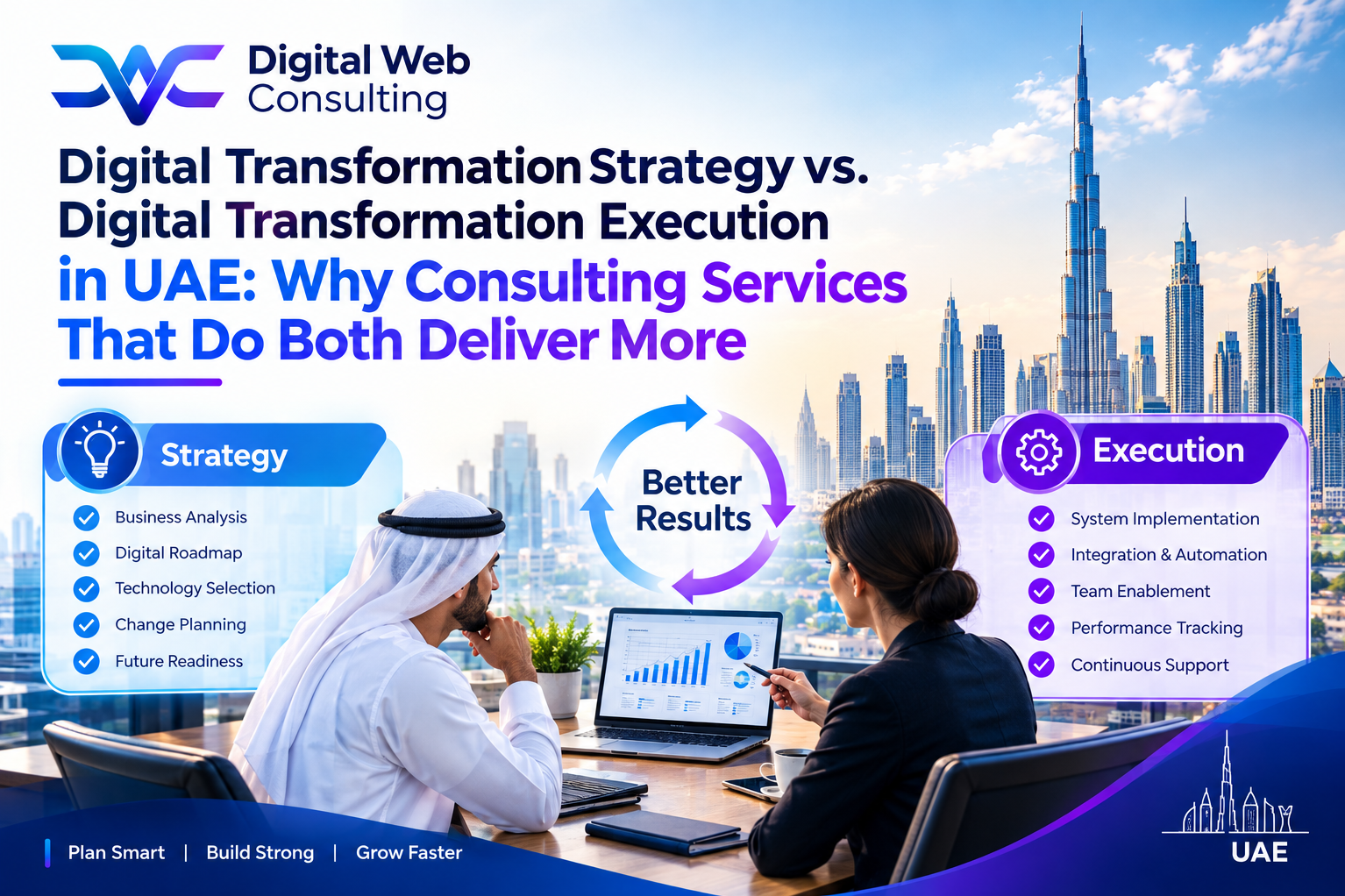
A well-executed strategy engagement produces a current state assessment of the business's operational processes, technology stack, and data infrastructure. It identifies the gaps between the current state and the operational capability the business needs to achieve its growth objectives. It defines a set of transformation initiatives prioritised by impact and feasibility. And it produces a roadmap that sequences those initiatives in a way that builds capability progressively rather than attempting to change everything simultaneously.
This is genuinely useful work. The current state assessment alone frequently reveals operational problems and technology gaps that the business's leadership had not fully articulated. The prioritisation framework is valuable for a leadership team that is trying to decide where to focus limited transformation capacity. And the roadmap provides a reference point for evaluating whether the business is making progress against its transformation objectives.
What a Strategy Engagement Leaves for the Business to Do
A strategy engagement does not implement anything. It does not configure any systems, automate any processes, connect any data sources, or train any team members. The entire operational value of the strategy depends on what the business does after the strategy is delivered. For a UAE business with a dedicated internal transformation team, a technology function, and ongoing consulting support contracted for the execution phase, this division of labour can work. For the majority of UAE SMEs and mid-market businesses that have none of these, it consistently does not.
Why the Handoff From Strategy to Execution Is Where UAE Transformations Stall
The handoff from strategy to execution is the point at which the consulting firm's involvement typically ends and the business's internal capacity is expected to take over. In practice, the internal capacity available for transformation execution in most UAE businesses is the same capacity that runs the business daily. The managing director, the finance director, and the operations lead who participated in the strategy workshops are not available to manage a transformation programme alongside their existing responsibilities. The strategy sits on the shelf not because it was a poor strategy but because the business never had the execution capacity to act on it.
The Assumption Embedded in Strategy-Only Consulting
Strategy-only consulting contains an embedded assumption that the business will either find the execution capacity internally or engage a separate firm to deliver the implementation. For large enterprises with internal project management offices and technology teams, this assumption is occasionally valid. For most UAE SMEs and mid-market businesses, it is optimistic to the point of being commercially irresponsible. A consulting firm that delivers a strategy without either providing the execution capacity or confirming that the client has it has produced a deliverable whose value is dependent on a condition it has not verified.
For businesses that have already received a transformation strategy and need execution support to implement it, our Digital Transformation Consulting service can engage at the execution phase of an existing strategy, provided the strategy is sufficiently specific and the business's readiness conditions have been confirmed.
What Execution-Only Delivery Produces : And What It Misses
The opposite problem to strategy without execution is execution without strategy. A technology implementation firm that is engaged to deploy a system without a clear strategic framework for what the system needs to achieve, how it fits into the broader operational context, and what the business needs to look like after it goes live will deploy a technically functional system that does not produce the operational transformation the business was trying to achieve.
What Happens When Technology Is Deployed Without Strategic Framing
An ERP deployed without a clear operational design for how the business's processes will work in the new system produces a system that reflects the legacy processes rather than the improved ones. A CRM implemented without a clear sales process design produces a system that tracks the existing sales behaviour rather than enabling better behaviour. A Power BI environment built without a clear definition of the decisions it needs to support produces dashboards that show what the data says rather than what the business needs to know.
In each case, the technology is correctly deployed. The system works as specified. But the specification was wrong because it was drawn from the current state rather than from a clearly defined future state. The implementation delivered what it was asked to build. It was asked to build the wrong thing.
The Rework Cycle That Execution-Only Delivery Creates
Execution-only delivery without strategic framing typically produces a rework cycle rather than a completed transformation. The first implementation produces a system that the business does not use as intended. The business engages the implementation firm for a second phase to reconfigure the system based on what they learned from the first deployment. The second phase produces improvement but does not fully address the problem because the problem was in the design, not in the configuration. A third phase of smaller adjustments follows.
This rework cycle is expensive, demoralising, and avoidable. It is consistently produced by implementations that began with a technology selection and a configuration brief rather than with a strategic design of what the business needed to operate differently and why. The technology should follow the operational design. When the technology precedes it, the rework cycle is the predictable result.
Execution-only firms are not incompetent. They are frequently excellent at deploying the technology they specialise in. Their limitation is that they are solving a technical problem when the actual problem is an operational design problem. Giving an execution-only firm a correct operational design to build to eliminates this limitation. Asking them to derive the operational design from the current state while deploying the technology does not.
What an Integrated Strategy-and-Execution Consulting Service Looks Like
An integrated consulting service does not simply combine a strategy engagement with an implementation engagement and sequence them back to back. It designs the strategy with the execution in mind from the first conversation and allows the execution experience to refine the strategy at every phase of the programme. The two disciplines are not sequential. They are continuous and mutually informing throughout the entire engagement.
How Strategy and Execution Inform Each Other Continuously
In an integrated engagement, the strategy defines the operational outcomes the business needs to achieve and the sequence in which the changes that produce those outcomes will be made. The execution then tests those assumptions against the realities of the business's data, processes, and systems as they actually exist. Where execution reveals that a strategic assumption was incorrect, for example that a process the strategy assumed was standardised is actually performed differently by different teams, the strategy is adjusted before the execution continues. The adjustment is made quickly, informed by real data, rather than being discovered at the end of a long implementation and addressed in a rework phase.
What the Delivery Model Looks Like in Practice
An integrated strategy-and-execution engagement for a UAE business typically follows a phased structure where each phase produces working operational change rather than a document or a system in isolation. The first phase combines a focused discovery and design exercise with the implementation of the highest-priority initiative. The second phase extends the implementation to the next priority area while the first phase's changes are being adopted and refined. The third phase addresses the remaining priorities and consolidates the changes into a stable operational state.
At the end of each phase, the business has something working rather than something planned. The cumulative output of the programme is a business that operates differently, not a document that describes how it should operate differently.
How Scope Evolves When Execution Reveals What Strategy Assumed
One of the most valuable characteristics of an integrated approach is its ability to handle the inevitable gap between what the strategy assumed and what the execution discovers. Every transformation programme encounters this gap. The strategy assumes that certain data is available and reliable. The execution discovers it is not. The strategy assumes that a process is performed consistently. The execution discovers it varies by team member. The strategy assumes that a system integration is straightforward. The execution discovers a compatibility issue that requires a different approach.
In a strategy-plus-separate-execution model, these discoveries produce scope disputes and additional cost. The strategy was delivered as specified. The execution firm is being asked to handle something outside the original specification. The business pays for the gap. In an integrated model, these discoveries are handled within the programme because the firm delivering the execution is also responsible for the strategy. The gap is addressed as part of the work, not billed as an addition to it.
For businesses evaluating integrated transformation consulting services, our IT Consulting Services include a structured engagement model that covers strategy definition, execution delivery, change management, and post-implementation support within a single accountability framework rather than across separate contracts with separate firms.
How to Identify Which Type of Consulting Service You Are Buying
The distinction between strategy-only, execution-only, and integrated consulting services is not always clear from a firm's marketing materials, which tend to claim comprehensive capability regardless of what the firm actually delivers. The questions below reveal which model a consulting firm is actually operating, based on how they answer rather than what they claim.
Questions That Reveal a Strategy-Only Model
• What happens after the strategy is delivered — do you stay involved in implementation or does that engagement end? A strategy-only firm describes a clean handover at the end of the strategy phase.
• Who will implement the recommendations in your strategy? A strategy-only firm describes implementation as the client's responsibility or refers the client to a separate implementation partner.
• How do you handle it when the strategy assumptions turn out to be incorrect during implementation? A strategy-only firm cannot answer this question from direct experience because they are not present during implementation.
Questions That Reveal an Execution-Only Model
• How do you determine what should be built before you start building it? An execution-only firm describes a requirements gathering process that draws from the current state rather than from a strategically designed future state.
• How does the implementation scope connect to the business's operational objectives? An execution-only firm describes the implementation scope in technical terms rather than in operational outcome terms.
• What happens if the implemented system does not produce the operational improvement the business expected? An execution-only firm treats this as a scope issue rather than as a design issue, which means the business pays to correct it.
Questions That Confirm an Integrated Approach
• Can you describe how the strategy you define informs the specific configuration decisions made during implementation? An integrated firm describes a direct connection between the strategic design and the technical choices made during delivery.
• Who is accountable for the operational outcome of the programme, and how is that outcome measured? An integrated firm names a specific outcome metric that the programme is held accountable to, not a delivery milestone.
• How do you handle the gap between what the strategy assumed and what the execution discovers? An integrated firm describes an internal process for adjusting the plan within the programme without additional cost to the business.
What the Proposal Structure Tells You
A proposal from a strategy-only firm ends with a deliverable: a strategy document, a roadmap, a recommendation deck. A proposal from an execution-only firm ends with a system: a configured platform, a deployed integration, a trained team. A proposal from an integrated firm ends with an outcome: a business that processes its invoices automatically, a sales team that works from a live pipeline, a finance director who sees the monthly close in real time. The difference in how the success of the engagement is defined in the proposal tells you more about the firm's model than anything in its capability description.
Why UAE Businesses Specifically Need the Integrated Approach
The structural gap between strategy and execution that affects transformation programmes globally is more acute in the UAE than in most comparable markets, for four specific reasons that a consulting service designed for this market needs to account for explicitly.
UAE Market Pace and Competitive Pressure
The competitive environment in UAE markets, particularly in Dubai, moves at a pace that does not accommodate the luxury of a twelve-month strategy phase followed by an eighteen-month execution phase. Competitors who are transforming their operations are not waiting for the strategy document to be finalised before beginning implementation. The integrated approach compresses the timeline by running strategy and execution in parallel, producing visible operational improvements within eight to twelve weeks rather than beginning implementation at the point where a strategy-only model would be presenting the final document.
The SME Capacity Constraint
The majority of UAE businesses that invest in digital transformation are SMEs and mid-market businesses whose leadership teams are fully occupied running the business. The capacity available for a transformation programme is typically one senior sponsor who can dedicate a meaningful proportion of their time alongside their existing role. This capacity is sufficient to support an integrated consulting engagement where the firm carries the programme management and execution work. It is not sufficient to manage the handoff from strategy to execution independently, which is what a strategy-only model requires.
Cultural and Organisational Change Requirements
Digital transformation in the UAE's multicultural, multilingual, hierarchically structured business environment requires change management that is designed for specific organisational realities rather than applied from a generic framework. The change management workstream in a UAE transformation programme needs to address the language and communication diversity of the team, the hierarchical communication structures that determine how change is communicated effectively, and the specific resistance patterns that are common in UAE workplaces. An integrated consulting service designs the change management approach alongside the technical implementation. A strategy-only service leaves the change management to the business.
What the Right Consulting Partner Provides That Neither Strategy Nor Execution Alone Can
The integrated consulting partner provides something that neither a strategy firm nor an implementation firm can provide independently: accountability for the operational outcome. A strategy firm is accountable for the quality of the strategy. An implementation firm is accountable for the technical correctness of the system. An integrated firm is accountable for whether the business operates differently after the programme than it did before it. That accountability changes how the firm designs the engagement, how it manages the programme, and how it responds when the plan needs to change.
For UAE businesses that have previously worked with strategy-only or execution-only consulting services without achieving the operational change they commissioned the engagement to produce, our AI Automation Solutions and Business Automation Solutions are delivered within an integrated model that covers the operational design, the technical implementation, and the change management as a single accountable engagement.
The question a UAE business should ask before commissioning any transformation consulting service is not whether the firm can produce a strategy or whether it can deploy a system. It is whether the firm will be accountable for the operational outcome that the strategy describes and the system is supposed to enable. That accountability is what distinguishes a consulting service that transforms from one that advises and one that installs.
A Strategy Without Execution Is a Document. The Integrated Approach Is the Transformation.
The distinction between strategy-only consulting, execution-only delivery, and integrated strategy-and-execution is not a technicality in how consulting services are structured. It is the primary determinant of whether a UAE business's transformation investment produces operational change or produces documents and systems that describe what operational change would look like if it were achieved.
Digital transformation consulting services in UAE that integrate strategy and execution within a single accountable engagement close the gap that costs UAE businesses the most. The strategy is designed with the execution in mind. The execution is guided by the strategy at every decision point. The scope adjusts when execution reveals what strategy assumed. And the firm remains accountable throughout the programme not for the quality of the document or the technical correctness of the system, but for whether the business operates differently at the end of the engagement than it did at the beginning.
That is what transformation means. And it is what the integrated approach is designed to produce.
Ready to discuss a transformation consulting engagement that is accountable for operational outcomes rather than for documents and systems? Start the conversation with Digital Web Consulting through our Digital Transformation Consulting Services page