
Why Misconceptions About Dynamics 365 Cost UAE Businesses Real Money
Microsoft Dynamics 365 is one of the most capable business platforms available to UAE organisations. It covers CRM, ERP, finance, operations, HR, customer service, and business intelligence in a single, integrated cloud environment, and it connects natively with Power BI, Microsoft Teams, Outlook, and the rest of the Microsoft ecosystem that most UAE businesses already use.
And yet, implementations fail. Budgets overrun. Teams resist adoption. Systems go live with less than half their potential being used. The platform rarely gets the blame, because the platform is not the problem. The misconceptions businesses bring into the project are.
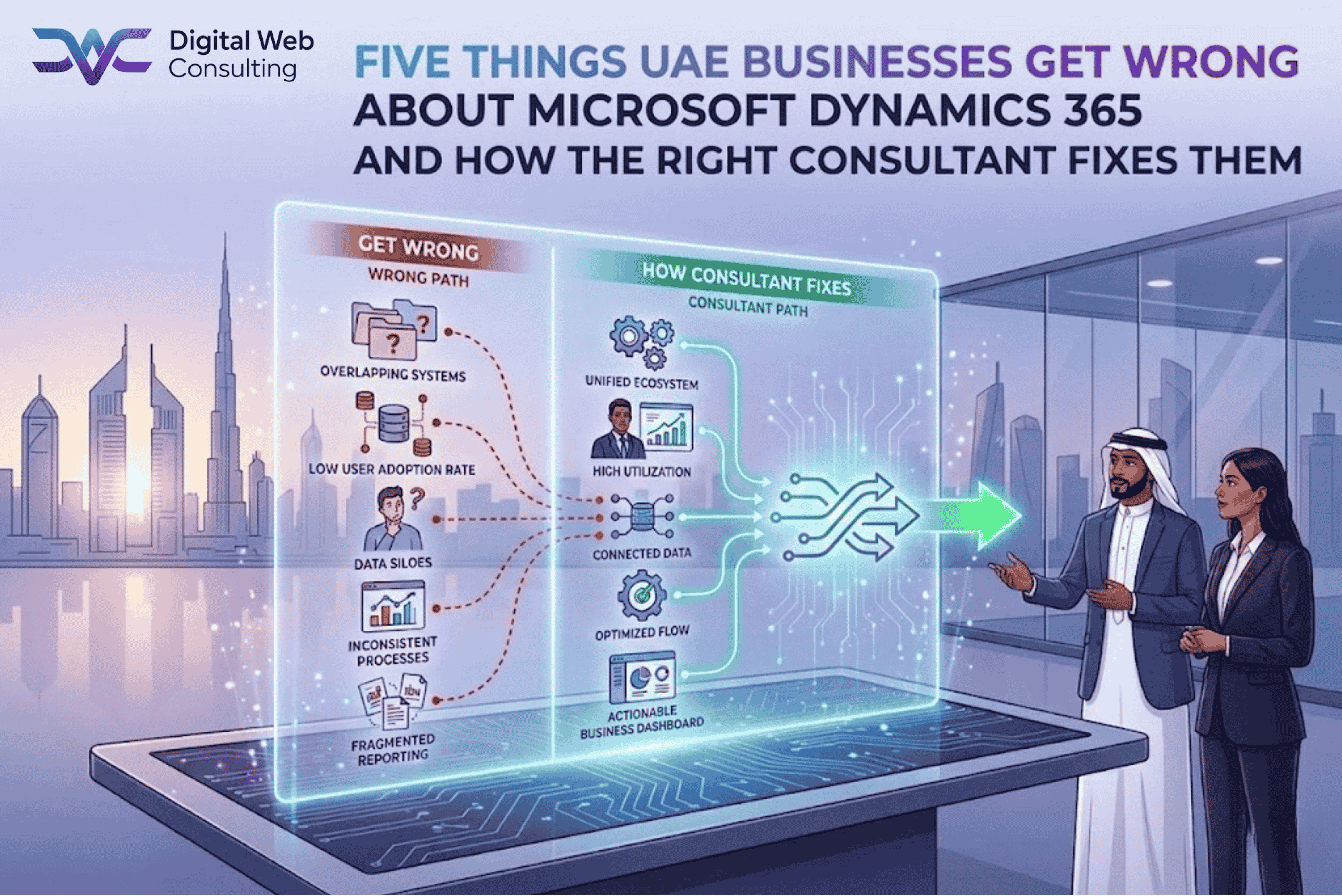
These five misconceptions show up consistently in the UAE market. Each one is understandable, they usually come from sales conversations, blog posts, or peer experience that presented part of the picture. But each one leads businesses toward decisions that cost more than they should, deliver less than they expected, or require expensive correction after go-live. Microsoft Dynamics 365 consulting in UAE exists precisely to address these gaps before they become problems, not to sell a platform, but to ensure the platform that has already been chosen gets implemented in a way that actually serves the business.
43% of Dynamics 365 implementations in the Middle East and Africa region are reported as underperforming against original business objectives within the first twelve months of go-live, Microsoft Partner Network, 2024
“ Dynamics 365 is not a complicated platform to use. It is a sophisticated one to configure correctly. The gap between those two things is where most UAE implementation problems live, and where the right consultant makes all the difference.”
Each misconception below is followed by what the reality actually looks like and what a competent Dynamics 365 consultant does to address it. Reading through all five gives any UAE business a clearer picture of what to expect from a well-run implementation, and what to avoid in one that is not.
MISCONCEPTION 1: “Dynamics 365 Is Just a CRM”
This is the most pervasive misconception in the UAE market and the one that most consistently leads to underinvestment in the platform's potential. When businesses think of Dynamics 365 as a CRM, they configure and use it as a CRM, and leave the rest of the platform completely untouched.
Dynamics 365 is a suite of integrated business applications that covers a far broader scope than customer relationship management alone. The full platform includes dedicated modules for finance and accounting, supply chain management, field service operations, project service automation, human resources, commerce, marketing automation, and embedded AI across all of these functions. Each module is built to work natively with the others, which means data flows between finance, operations, and customer management automatically rather than requiring manual transfer or third-party integration.
The businesses that treat Dynamics 365 as a CRM are paying for an enterprise platform and using a fraction of it. They are also missing the integration benefits that come from operating finance, operations, and customer management within the same platform, which is precisely what makes the investment worthwhile for UAE businesses with multi-function operational complexity.
What the right consultant actually does:
- Conducts a full platform scope review: before configuration begins, mapping which Dynamics 365 modules address each business function and where the integration between modules delivers the most operational value.
- Designs a phased rollout plan: that starts with the highest-priority modules and adds capability over time rather than attempting to implement everything at once, keeping the initial investment focused while leaving the roadmap open.
- Demonstrates cross-module value: specifically in the UAE business context, showing how finance data connects to the CRM, how operations data informs customer service, and how the integrated picture changes the quality of management decisions.
The businesses that get the most from Dynamics 365 are the ones that understand from the start that they are investing in an integrated business platform, not a contact management tool with extra features. That understanding changes how the implementation is scoped, how the team is trained, and how the ROI is measured.
MISCONCEPTION 2: “We Can Implement It Ourselves Using Microsoft's Documentation”
Microsoft's documentation for Dynamics 365 is extensive, well-maintained, and genuinely useful for teams with technical experience in enterprise software configuration. It is not a substitute for implementation expertise, UAE market knowledge, or the accumulated experience of having navigated the specific configuration decisions that determine whether an implementation succeeds or struggles.
The documentation tells you how the platform works. It does not tell you which configuration choices will cause problems six months after go-live. It does not address UAE-specific requirements around VAT configuration, WPS payroll compliance, Arabic document generation, or multi-entity financial consolidation. It does not walk you through the data migration decisions that will affect reporting accuracy for years. And it does not help you manage the change management process that determines whether your team actually adopts the system or silently reverts to their previous tools.
Self-implementation of Microsoft Dynamics 365 in UAE consistently costs more than consultant-led implementation when the full accounting is done. The internal time investment is significant. The configuration mistakes that require correction are expensive. The adoption failures that follow poorly managed go-lives are costly. And the opportunity cost of an enterprise platform running at partial capacity for twelve months while the team figures out what went wrong is the largest and least visible cost of all.
What the right consultant actually does:
- Brings UAE-specific configuration knowledge: that Microsoft's documentation does not contain, VAT group structures aligned with FTA requirements, WPS payroll formatting, Arabic-English bilingual document generation, and multi-currency transaction handling specific to UAE trading and services businesses.
- Manages the implementation risk: by sequencing configuration decisions correctly, validating each stage before proceeding to the next, and catching the edge cases and data anomalies that self-implementation teams typically discover after go-live.
- Owns the adoption outcome: not just the technical delivery, ensuring training is role-specific, the go-live plan minimises disruption, and the post-launch support period addresses the questions that emerge when real users engage with the live system for the first time.
For businesses evaluating the full scope of a Dynamics 365 implementation alongside their existing technology infrastructure, our IT Consulting Services provide independent technology assessments that clarify exactly what an implementation requires before any commitment is made to a vendor or timeline.
The businesses that successfully self-implement Dynamics 365 have one thing in common: they have done it before on a different project. The learning curve is real, and UAE businesses pay for it in time, mistakes, and delayed value realisation when they treat it as documentation-navigable rather than expertise-dependent.
MISCONCEPTION 3: “Dynamics 365 Will Work Out of the Box for Our Industry”
Out of the box, Dynamics 365 is a powerful general-purpose business platform. It handles standard sales pipelines, generic finance workflows, typical customer service processes, and common supply chain patterns with no configuration required. For a business whose operations closely resemble the generic case the platform was designed for, this is genuinely valuable.
Most UAE businesses are not the generic case. A trading company managing letters of credit, multi-currency invoicing, and supplier credit terms has operational logic that the standard Dynamics 365 configuration does not reflect. A real estate developer tracking payment milestones, unit handovers, and snag resolution processes needs workflows the standard platform does not include. A logistics company managing fleet allocation, route costing, and real-time delivery tracking operates in ways the out-of-the-box modules were not built for.
The gap between what Dynamics 365 does out of the box and what a specific UAE business needs it to do is the configuration and customisation scope, and it is almost always larger than businesses expect when they first see the platform working in a demo environment. The demo shows the platform at its most general. The implementation requires it to reflect a specific business in a specific market with specific regulatory requirements.
What the right consultant actually does:
- Conducts a gap analysis: between the standard Dynamics 365 functionality and the specific operational requirements of the business before any configuration work begins, so the scope is defined by evidence rather than assumption.
- Applies UAE-specific configuration: for VAT compliance, FTA-aligned reporting structures, WPS payroll integration, Arabic language support across documents and interfaces, and multi-currency transaction management that reflects the daily reality of operating in the UAE market.
- Customises workflows and modules: for the industry-specific processes that the standard platform does not address, building on the Dynamics 365 foundation rather than replacing it, ensuring the customisations remain compatible with future platform updates.
For businesses whose Dynamics 365 implementation includes significant custom module development alongside the standard platform configuration, our Dynamics 365 Implementation Partner service covers both the standard implementation and the custom development within a single integrated engagement.
“ A Dynamics 365 demo shows you what the platform can do for any business. A Dynamics 365 consultant shows you what it can do for your business specifically, and those are very different conversations with very different scopes. ”
The businesses that discover the configuration gap mid-implementation face a difficult choice: accept a system that does not fully fit the business, or commission the configuration work under time pressure at a point when it is most disruptive and expensive to add. Neither outcome is acceptable. The right time to identify the gap is during the pre-implementation assessment.
MISCONCEPTION 4: “The Cheapest Implementation Partner Delivers the Same Result”
The Dynamics 365 partner market in UAE ranges from globally certified Microsoft Solutions Partners with deep UAE industry experience to generalist IT vendors who list Dynamics 365 among fifty other services they offer. The price difference between them can be significant. The outcome difference is consistently larger.
What separates a qualified Dynamics 365 implementation partner from a generalist vendor is not just the Microsoft certification, it is the accumulated experience of having navigated the specific decisions that determine whether an implementation succeeds. Which Dynamics 365 modules work well together and which create friction when configured simultaneously. How to handle UAE VAT configuration for businesses with complex entity structures. How to manage data migration from legacy systems without creating historical reporting anomalies. How to design the adoption programme for a UAE workforce with mixed technical comfort levels.
These capabilities are not documented. They are accumulated through implementation experience, and they are what make the difference between a system that goes live on time, within budget, and gets used by the team, and one that goes live late, costs fifty percent more than quoted, and has adoption rates that never recover to the level the business needed.
What the right consultant actually does:
- Verifies Microsoft certification status: specifically for the modules relevant to the business, not just a general Dynamics 365 certification, but certification in the specific application areas being implemented.
- References UAE-specific implementations: of comparable scope and industry, speaking to clients whose businesses resemble yours in size, complexity, and operational requirements, not to clients in different markets or different industries where the implementation challenges were fundamentally different.
- Evaluates the team that will deliver: not the team that will sell, meeting the specific consultants who will work on the project, reviewing their individual experience, and confirming they have the right background for the implementation at hand.
The cheapest Dynamics 365 partner in UAE is rarely the least expensive implementation. Partner quality differences show up most clearly in the things that are hardest to measure upfront, configuration accuracy, data migration quality, adoption programme effectiveness, and post-launch responsiveness. By the time these differences become visible, the contract is already signed.
MISCONCEPTION 5: “Once It Is Live, the Project Is Done”
Go-live is one of the most significant milestones in a Dynamics 365 implementation. It is also the point at which the most important and most commonly overlooked work begins.
The first ninety days after go-live are when user adoption patterns are established, when the data quality assumptions built into the configuration are tested against real operational volume, when the edge cases that testing did not anticipate emerge in live conditions, and when the organisation's relationship with the system is either cemented positively or begins the gradual deterioration that leads to underutilisation.
Businesses that treat go-live as the project endpoint almost always end up with a Dynamics 365 environment that performs at a fraction of its potential twelve months later. The configuration that was appropriate for the business at implementation is no longer appropriate for a business that has grown, added products, entered new markets, or changed its operating model. Without a structured post-implementation optimisation programme, the system calcifies around its initial configuration, and the gap between what it does and what the business needs it to do widens steadily over time.
What the right consultant actually does:
- Defines the post-launch support period explicitly: in the implementation contract, specifying what is included, for how long, at what response time, and what the cost structure is for ongoing support beyond the included period.
- Conducts structured post-launch reviews: at thirty, sixty, and ninety days after go-live, assessing adoption rates by department, identifying configuration adjustments that real-world usage has revealed as necessary, and producing a prioritised list of optimisation improvements.
- Provides a platform evolution roadmap: that aligns Dynamics 365 development with the business's growth plans, so new modules, new integrations, and new analytical capabilities are added in a structured sequence rather than reactively, when the business has already outgrown the current configuration.
For businesses whose Dynamics 365 environment needs to connect with Power BI for live reporting, our Power BI Consulting Services cover the full scope of connecting Dynamics 365 data to interactive business intelligence dashboards, extending the value of the platform beyond transaction management into real-time operational visibility.
“ An enterprise system that is not actively maintained, optimised, and evolved alongside the business it serves will deliver its lowest value in year three, exactly when the business has grown into needing it most. Post-implementation is not an afterthought. It is where the return on the initial investment is either realised or eroded. ”
The best Dynamics 365 implementations in UAE are the ones that define post-launch care as carefully as they define the initial configuration scope. A system with a structured evolution plan delivers compounding value. One treated as complete at go-live delivers diminishing returns.
Dynamics 365 Is Only as Good as the Implementation Behind It
Microsoft Dynamics 365 is a platform that rewards depth of implementation. The businesses that get the most from it are not necessarily the ones that invest the most, they are the ones that approach the implementation without the five misconceptions above, choose their consulting partner based on UAE-specific experience and delivery track record, and treat go-live as the beginning of an ongoing optimisation programme rather than the end of a project.
Microsoft Dynamics 365 consulting in UAE addresses every one of the misconceptions above before they become problems, scoping the full platform potential, applying UAE-specific configuration, closing the gap between out-of-the-box and fit-for-purpose, and building the post-implementation support structure that determines whether the system delivers its promised value over the years that follow.
The five corrections in this guide are what separate implementations that work from ones that disappoint, and every one of them is addressable before the project begins if the right conversation happens first.
“ The most expensive Dynamics 365 mistake a UAE business can make is not choosing the wrong platform. It is choosing the right platform and implementing it with the wrong assumptions. The right consultant fixes the assumptions before the configuration begins. ”
Ready to implement Microsoft Dynamics 365 without the five misconceptions that cost UAE businesses time and money? Start the conversation with Digital Web Consulting through our Microsoft Dynamics 365 Consulting page →
[Microsoft Dynamics 365 consulting UAE , Dynamics 365 advisory UAE , D365 consulting services Dubai , MS Dynamics consulting , Dynamics 365 consulting for SMEs UAE , Microsoft Dynamics 365 implementation consultant Dubai ]