


Before You Write a Single Line of Code
Most ERP software development projects that fail do not fail during development. They fail before it begins. The team rushes past the preparation phase, eager to see something being built, and arrives at the build stage with requirements that are incomplete, a scope that is poorly defined, and expectations that are misaligned between the business and the development team.
The result is predictable: a system that addresses some of what the business needed, misses what was not clearly articulated, and requires expensive rework to correct. In the UAE market, where ERP software development projects often span multiple departments, multiple currencies, and specific regulatory requirements, the pre-build phase is not a formality, it is the foundation on which the entire project's success rests.
70% of ERP implementations that go over budget or past deadline cite incomplete requirements definition as the primary cause, not technical failure., Gartner, 2024
Three decisions need to be made clearly before development begins:
- Build vs. extend: Will the system be developed entirely from scratch, or will it extend a flexible open-source ERP framework? Both have valid use cases. A full custom build delivers the closest fit but requires more time. Extending a framework like Odoo or ERPNext accelerates development for standard modules while still allowing deep customisation where the business needs it most.
- Phased vs. full deployment: Will the entire ERP go live at once, or will modules be deployed in phases as they are completed? Phased deployment almost always delivers better outcomes, it reduces risk, allows the team to provide feedback during development, and produces working software sooner.
- Internal ownership model: Who in the business will own the ERP post-launch? Who approves requirement changes during development? Who coordinates between departments and the development team? Defining these roles before development begins prevents the decision bottlenecks that delay most projects.
“ The businesses that get the most from ERP software development are the ones that invest as seriously in defining what they need as they do in building it. A well-defined requirement costs nothing to change. A poorly-defined one costs everything to fix after it has been built. ”
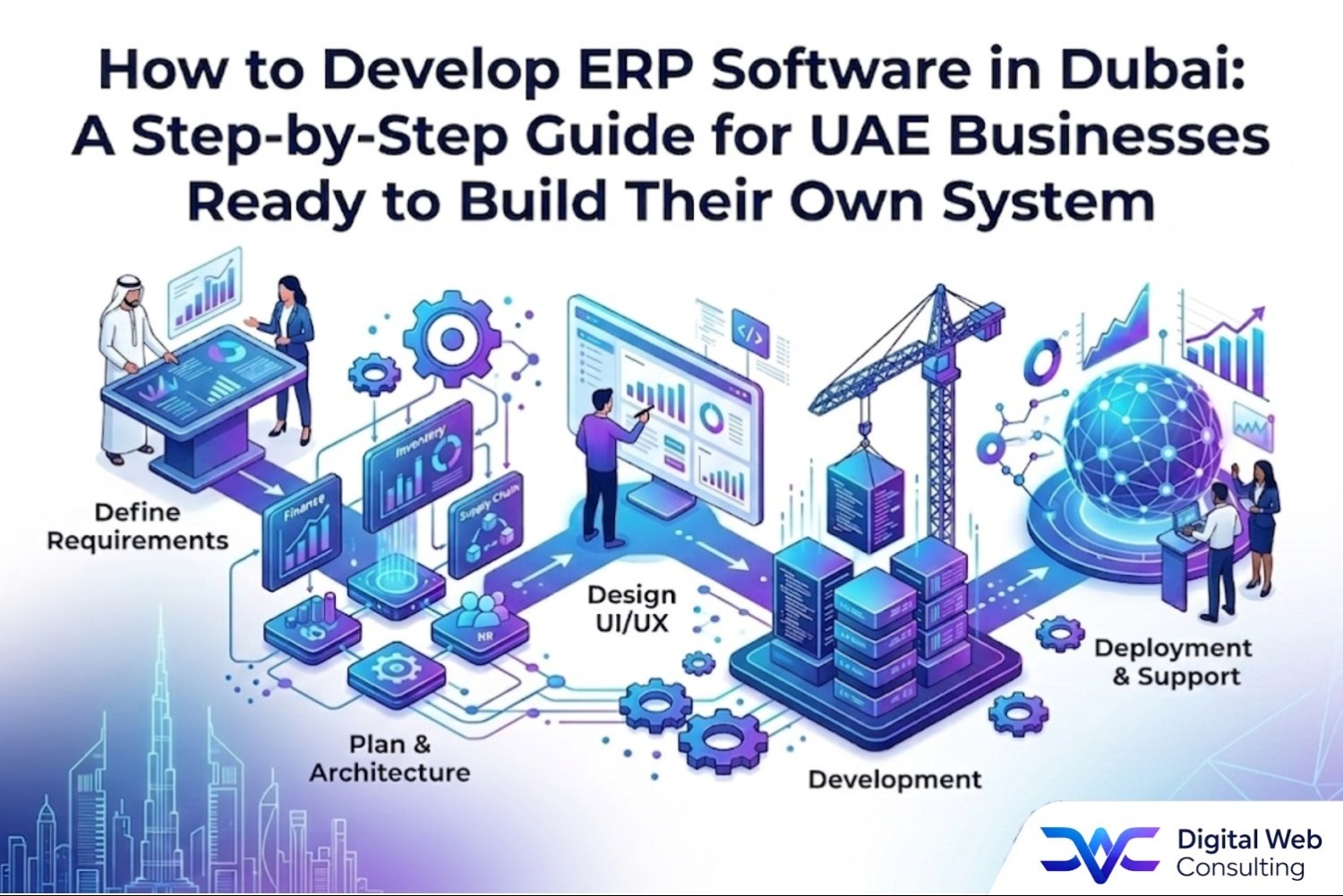
This guide walks through every stage of the ERP development process in the order it should happen, not in the order it feels most intuitive, which is often the order that creates the most problems.
STEP 1: Business Analysis and Requirements Mapping
Business analysis is the process of documenting exactly what the ERP needs to do, not in technical terms, but in operational ones. What processes does it need to support? What data does it need to hold? What rules does it need to enforce? What does each department need to see, update, and report on?
This phase involves direct engagement with the people who will use the system daily, not just their managers. Finance teams know their reconciliation process better than the CFO. Warehouse staff know their receiving workflow better than the operations director. The requirements that emerge from ground-level engagement are consistently more accurate and more complete than those produced top-down.
- Process documentation: Every operational process that the ERP will support is mapped in detail, inputs, outputs, decision points, exceptions, and the people responsible for each stage. This documentation becomes the blueprint against which the built system is validated.
- Gap identification: Current systems and processes are audited to identify where data is lost, where manual steps are introduced, and where the absence of a feature creates workarounds. Each gap becomes a requirement the ERP must address.
- Data requirements: Every data point the business needs to store, retrieve, and report on is identified and structured. This includes existing data that needs to be migrated, new data the ERP will generate, and the relationships between data entities across modules.
- Compliance requirements: For UAE businesses, this specifically includes VAT data structures, FTA reporting formats, WPS payroll requirements, UAE Labour Law provisions, and any industry-specific regulatory obligations. These are non-negotiable design constraints, not optional additions.
Requirements mapping is also the phase where integration requirements are identified. If the ERP needs to connect with an existing CRM, accounting platform, or logistics tool, those connections need to be scoped as part of the requirements phase rather than discovered mid-development. Our ERP Integration Services are frequently scoped alongside ERP development projects for exactly this reason.
A well-documented requirements phase typically takes two to four weeks for a UAE business of moderate complexity. Businesses that rush this phase to save time consistently spend significantly more time correcting misalignments during the build and after go-live.
STEP 2: Architecture Design and Technology Selection
Once requirements are clear, the system architecture is designed, the structural decisions that determine how the ERP is built, how it performs at scale, and how easily it can be extended as the business grows.
These decisions are made once and are expensive to reverse. Getting them right at this stage is worth the investment of time and expertise.
- Technology stack selection: The programming languages, frameworks, and database technologies used to build the ERP determine its performance characteristics, the talent pool available to support it, and its long-term maintainability. For UAE businesses, the stack should be chosen for stability, scalability, and the availability of local development expertise, not for what is newest or most fashionable.
- Database architecture: The structure of the database, how entities relate to each other, how transactions are recorded, how historical data is stored, is the backbone of the entire system. A well-designed database supports accurate reporting, fast queries, and reliable data integrity. A poorly designed one creates performance problems and data anomalies that compound with every month of use.
- Module structure and dependencies: How modules relate to each other, which data is shared between them, which triggers cross-module events, which can function independently, is defined in the architecture phase. This determines how the system is built in sequence during the development phase.
- API design for external integration: The interfaces through which the ERP will communicate with external systems are defined architecturally before they are built. This ensures the integration layer is designed for the systems it needs to connect with rather than adapted after the fact.
- Security architecture: Role-based access control, data encryption, audit logging, and session management are architectural decisions, not features added at the end. For UAE businesses handling financial data and personal information, security architecture must meet both operational and regulatory standards from day one.
“ Architecture decisions made in week two of a project determine what is possible in year three. A system designed for the business's current scale that cannot grow with it is not a long-term asset, it is a temporary fix with a countdown. ”
For businesses developing ERP software for logistics in UAE specifically, the architecture phase must account for real-time data flows between fleet management, customer records, and billing systems, a level of event-driven integration that needs to be designed into the system from the start, not retrofitted later.
STEP 3: Phased Module Development and Team Feedback
Development happens in phases, with working modules delivered to the business team for review and feedback at regular intervals. This is the approach that consistently produces the best outcomes in ERP software development, and it is worth understanding why the alternative, building everything before showing anything, so reliably produces problems.
When a complete ERP is delivered after months of development without interim review, two things almost always happen. First, requirements that seemed clear at the start turn out to have been interpreted differently by the development team and the business. Second, the business's needs have evolved during the development period and the delivered system no longer fully reflects current requirements. Both problems are significantly more expensive to fix after delivery than they would have been to address during development.
- Finance module first: The financial management module, chart of accounts, transaction recording, VAT handling, bank reconciliation, is almost always built first. It is the module every other part of the business depends on, and it contains the compliance-critical logic that needs the most thorough testing before other modules build on top of it.
- Inventory and procurement second: Stock management and procurement workflows connect directly to the finance module and represent the second-highest operational dependency for most UAE businesses. Building these second allows the integration between financial and operational data to be validated early.
- Sales and customer management third: The customer-facing layer of the ERP, quotation, order management, delivery, invoicing, builds on the inventory and finance foundation. Deploying this module in phase three means the business starts realising operational benefit while the HR and reporting modules are still in development.
- HR, payroll, and reporting last: These modules are important but have fewer dependencies on each other and on the core operational modules. Building them last means the team is providing feedback on the most business-critical functionality first, and the system is generating real operational value before the full build is complete.
The phased approach also allows the business to validate that each module meets its requirements before the next module is built on top of it. This is particularly important for UAE businesses with complex ERP software development for logistics requirements, where the connections between fleet management, customer records, and billing need to be validated at each phase rather than discovered broken at go-live.
Feedback cycles during phased development should be structured, specific questions, specific scenarios, specific validation criteria, rather than open-ended reviews. Structured feedback produces actionable improvements. Open-ended feedback produces scope creep.
STEP 4: Integration, Testing, and Data Migration
The period between the completion of module development and go-live is where the most underestimated work happens. Integration, testing, and data migration each carry risks that, if not managed carefully, can turn a well-built system into a failed implementation.
- System integration: Connecting the ERP to external platforms, CRM, accounting software, logistics tools, banking systems, is completed and validated during this phase. Each integration is tested against real data scenarios, not synthetic test cases, to confirm it handles the actual data volumes and formats the business works with daily.
- Functional testing: Every module is tested against the documented requirements to confirm the system does what it was specified to do. Test cases are written from the requirements documentation, if a requirement was documented, there is a test case for it.
- Performance testing: The system is tested under realistic load conditions to confirm it performs acceptably when all users are active simultaneously. For UAE businesses with high transaction volumes, particularly in trading and logistics, performance testing at scale is non-negotiable.
- User acceptance testing: Business users test the system against real operational scenarios before go-live. This is the most important testing phase because it validates that the system works in the way actual users need it to, not just in the way the development team built it.
- Data migration: Historical data from existing systems is extracted, cleaned, transformed to match the new ERP's data structure, and imported. Data migration is consistently the most underestimated task in ERP implementations, the volume of data quality issues that emerge during migration is almost always higher than expected, and each one needs to be resolved before the data can be loaded into the new system.
Data migration deserves its own project plan, its own timeline, and its own owner from the business side. The businesses that treat data migration as a technical task rather than a business-critical process are the ones that discover data quality problems after go-live, when they are most expensive to fix.
STEP 5: Go-Live, Training, and Post-Launch Support
Go-live is not the finish line. It is the beginning of the period when the system faces its most demanding test, real operations, real users, real data, and real edge cases that no testing environment fully anticipated.
- Planned go-live approach: The cut-over from the old system to the new ERP is planned in detail, which data is final-migrated and when, which users go live in which sequence, what the rollback plan is if a critical issue emerges, and who is responsible for each decision during the go-live window. A well-planned go-live minimises disruption. An unplanned one creates it.
- Role-based training: Training is delivered by role, finance teams are trained on the financial modules relevant to their daily work, warehouse staff on the inventory and receiving workflows, sales teams on the order and customer management modules. Generic system overviews produce low adoption. Role-specific training that uses real operational scenarios produces teams that are confident and productive from day one.
- Hypercare period: The first two to four weeks after go-live are the highest-risk period for any ERP implementation. A hypercare plan, with dedicated support available during working hours, a clear escalation path for critical issues, and daily check-ins between the business and the development team, addresses the issues that inevitably emerge when a system moves from testing to live operations.
- Post-launch optimisation: As the system is used in real conditions, improvement opportunities emerge that were not visible during development or testing. A structured post-launch review at thirty, sixty, and ninety days identifies these opportunities and produces a prioritised list of enhancements for the first development cycle after go-live.
For businesses that also need ongoing technical capacity to manage and extend the ERP after go-live, our Hire Dedicated Software Developers service provides senior development expertise that works as an extension of your internal team, without the fixed cost of full-time employment.
The quality of post-launch support determines whether the investment in ERP development compounds over time or stagnates. A system that is actively maintained, optimised, and extended as the business grows delivers increasing returns. One that is left static after go-live delivers diminishing ones.
The ERP Software Features UAE Businesses Must Prioritise
The ERP software features that matter most for UAE businesses are determined by the specific regulatory, operational, and market requirements of this environment. These five should be treated as design requirements rather than optional additions:
- ✔ VAT compliance and FTA-ready reporting: Every transaction recorded in the ERP must carry the tax data required for accurate VAT calculation and FTA filing. This includes tax group management, tax invoice formatting to UAE standards, and the ability to generate VAT return data directly from the system without manual extraction or reformatting.
- ✔ Multi-currency and multi-entity support: UAE businesses routinely transact in multiple currencies and may operate through multiple legal entities. The ERP must handle currency conversion at transaction-level, maintain separate entity accounts, and produce consolidated reporting across entities without manual data combining.
- ✔ Arabic and English bilingual document generation: Customer invoices, delivery notes, purchase orders, and financial statements need to be generated in both Arabic and English with correct right-to-left formatting for Arabic content. This is a structural requirement for the document generation layer, not a translation add-on.
- ✔ WPS payroll and UAE Labour Law compliance: The payroll module must generate WPS-formatted salary transfer files, calculate end-of-service gratuity correctly under UAE Labour Law, and handle the specific leave entitlement and overtime rules that apply in the UAE, not in the default jurisdiction the ERP framework was built for.
- ✔ Real-time dashboards built around actual KPIs: The reporting layer should present the metrics leadership actually uses to manage the business, not the default reports the framework includes. For a trading company, that might be margin by product category. For a logistics company, it might be on-time delivery rate by route. For a real estate developer, it might be collection rate by project phase. The dashboards should reflect the business, not the software.
For businesses looking to extend ERP reporting into more sophisticated analytics, our Power BI Dashboard Development service builds interactive business intelligence dashboards that connect ERP data with data from every other system in the business, giving leadership a genuinely complete operational picture.
The difference between an ERP built for UAE businesses and one adapted for them shows most clearly in these five feature areas. Getting them right from the design phase eliminates the compliance gaps, reporting limitations, and workflow frustrations that emerge when they are treated as afterthoughts.
Building ERP Software Is a Process, Not an Event
The businesses that successfully develop ERP software in Dubai are not the ones with the largest budgets or the most sophisticated technology requirements. They are the ones that treat every stage of the process with the discipline it deserves, from requirements mapping through architecture design, phased development, rigorous testing, and structured go-live.
ERP software development in UAE is one of the most significant operational investments a business can make. When it is done well, it produces a system the business depends on and improves continuously for years. When it is rushed, it produces a system the business works around, which is exactly the problem it was supposed to solve.
The guide above gives you the roadmap. The next step is a conversation about what that roadmap looks like specifically for your business, your processes, your data, your compliance requirements, and your growth plans.
“ The right ERP is not the most feature-rich one available. It is the one built most accurately for the business that will use it, and building it accurately starts with the conversation before the first line of code. ”
Ready to begin your ERP software development journey with a team that understands the UAE market? Start the conversation with Digital Web Consulting through our ERP Software Development page →
[ERP software development UAE , ERP software company Dubai , enterprise software development UAE , ERP solution provider Dubai , how to develop ERP software Dubai , ERP software features UAE , ERP software development for logistics UAE ]