

Why Readiness Matters More Than Enthusiasm
Some of the most expensive digital transformation failures in the UAE have not been caused by the wrong technology, the wrong consultant, or the wrong budget. They have been caused by starting too early. A business that begins a transformation programme before its processes are standardised, its leadership is genuinely committed, its data is accessible, and its team has the capacity to absorb change will consistently produce a more expensive and less effective outcome than one that waits until those conditions are in place.
Readiness for digital transformation is not about the sophistication of the current technology. A business running simple accounting software and basic spreadsheets can be highly ready for transformation if its core processes are consistent, its leadership is aligned, and its team is capable of changing how it works. A business running an ERP with dozens of integrations can be completely unready if its processes are inconsistent, its data is unreliable, and its leadership is not prepared to change how decisions are made.
Digital transformation consulting services in UAE that are honest about readiness serve their clients better than those that rush every business into a programme regardless of where it is starting from. This assessment gives any UAE business a structured, honest picture of where it stands across the four dimensions that determine transformation readiness and what to do based on that picture.
Starting a transformation programme before the business is ready is not a bold move. It is an expensive one. The businesses that achieve the best transformation outcomes are almost always the ones that spent time on preparation before spending money on technology.
This assessment is designed to be completed honestly, not optimistically. The value of the exercise is in the accurate picture it produces, not in the score it generates. A business that completes it honestly and discovers it is not yet ready has received more value from the exercise than one that answers aspirationally and starts a programme it is not equipped to sustain.
The Four Dimensions of Transformation Readiness
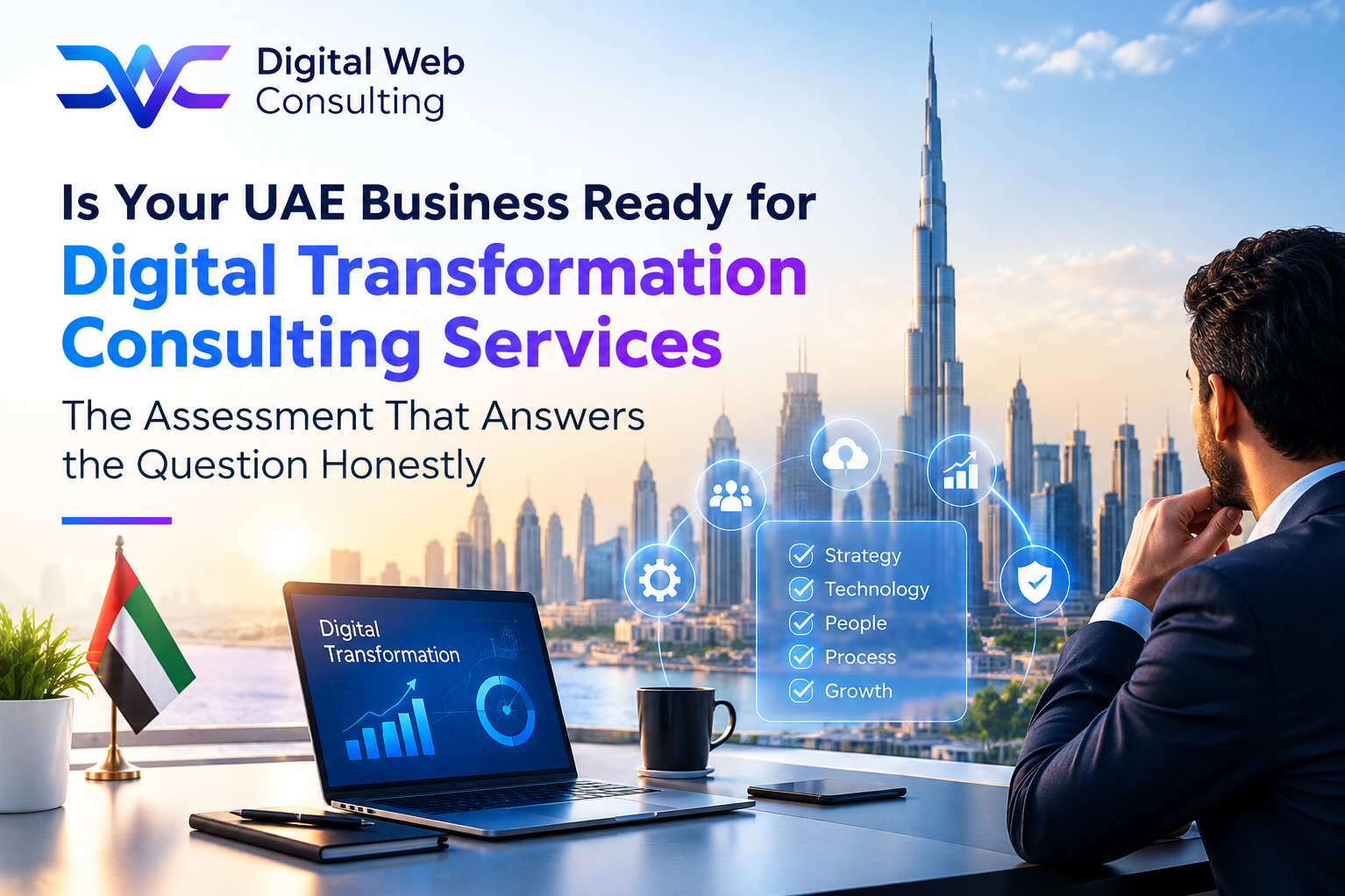
Transformation readiness is not a single condition. It is the intersection of four distinct dimensions, each of which can independently limit the outcome of a transformation programme if it is insufficiently developed. A business can be highly ready on three dimensions and significantly unready on the fourth. The fourth dimension will determine the programme's result more than the other three combined.
Leadership Readiness
Leadership readiness is the most consequential dimension and the one most frequently overstated. It is not measured by whether the managing director thinks digital transformation is a good idea. It is measured by whether leadership is prepared to visibly change how it works, prioritise the transformation alongside revenue and operational pressures, make decisions about process changes when those decisions are uncomfortable, and hold the organisation accountable to adoption targets with the same rigour it applies to financial targets.
A leadership team that is enthusiastic about the idea of transformation but unwilling to change its own behaviour will produce an organisation that installs systems rather than transforms operations. The systems will be there. The transformation will not.
Data and System Readiness
Data and system readiness describes whether the business has the operational data infrastructure that transformation can build on. This does not mean having sophisticated systems. It means having at least one functioning accounting platform with consistent records, at least one operational system that captures the core business activity reliably, and data that is clean enough to be the basis for accurate reporting and decision-making.
A business whose primary operational data lives in inconsistent spreadsheets, whose accounting records have unresolved discrepancies, or whose core business transactions are not captured in any system at all is not ready for transformation. It needs data infrastructure before it needs transformation consulting.
Process Readiness
Process readiness describes whether the key operational processes in the business are consistent enough to be automated or improved through technology. A process that is done differently by different team members, or differently on different days, cannot be effectively automated. Automating an inconsistent process produces automated inconsistency.
Process readiness does not require perfect processes. It requires processes that are standardised enough that the business can describe them clearly, that the team follows them consistently, and that automating them would produce the same outcome that the manual version produces when done correctly.
People and Culture Readiness
People and culture readiness describes whether the organisation has the capacity and the willingness to change how it works. This includes whether team members have the baseline digital literacy to use new systems, whether the organisation's culture supports the kind of direct feedback and process change that transformation requires, and whether there is enough trust between leadership and the team that a significant operational change can be communicated, understood, and adopted rather than resisted.
For businesses whose readiness assessment reveals significant gaps in any of these four dimensions, our IT Consulting Services include readiness preparation engagements that address the specific gaps identified before a full transformation programme is commissioned.
The Self-Assessment : Twelve Questions With Honest Answers
Score one point for each yes answer. Answer honestly based on the current state of the business, not on where you plan to be or where you believe you should be.
Leadership Readiness Questions
Is there a senior leader in the business whose primary professional priority for the next twelve months is the success of this transformation programme — not as a side responsibility alongside their existing role, but as their primary accountability?
If yes: Score one point. A named, committed internal owner is the single most reliable predictor of transformation programme success.
If no: Do not score. A transformation programme without a dedicated internal owner consistently underperforms regardless of consultant quality or technology investment.
Is the managing director or business owner prepared to visibly use the new systems and change their own daily information habits, rather than continuing to request manual reports alongside the new dashboards?
If yes: Score one point. Leadership behaviour is the most powerful adoption signal the organisation receives. If leadership changes its habits, the team changes its habits.
If no: Do not score. Leadership that continues to request manual reports alongside new systems signals to the team that the old way still works, which is the most consistent cause of low adoption after go-live.
Has the leadership team agreed on three to five specific, measurable outcomes that will define whether this transformation programme succeeded — before any technology decision has been made?
If yes: Score one point. Defined success criteria before the programme starts is the foundation of accountability for the outcomes.
If no: Do not score. A programme without pre-agreed success criteria cannot be held accountable to outcomes. It can only be held accountable to deliverables, which is a significantly weaker standard.
Data and System Readiness Questions
Does the business have at least one functioning accounting platform with records that are reconciled and consistent for the last twelve months?
If yes: Score one point. Financial data is the foundation of almost every transformation initiative. A clean, consistent financial record is the minimum data infrastructure requirement.
If no: Do not score. Transformation programmes built on top of unreconciled or inconsistent financial data produce analytics and reporting that the business cannot trust, which undermines adoption of the systems that depend on it.
Are the business's core operational transactions — sales orders, purchase orders, inventory movements, or service records, depending on the business model — captured in a system rather than managed primarily through email, WhatsApp, and spreadsheets?
If yes: Score one point. Operational data that is not captured in a system cannot be connected to transformation analytics or automation tools.
If no: Do not score. If core operational data does not yet exist in a structured system, the first transformation priority is creating that data infrastructure, not building analytics and automation on top of the absence of it.
Can the business describe, with reasonable confidence, where its most important business data lives and how current and accurate it is?
If yes: Score one point. Data visibility is a prerequisite for data-driven transformation. A business that cannot describe its data landscape cannot plan a transformation programme that connects to it accurately.
If no: Do not score. A data audit should be the first step of any consulting engagement for a business that cannot answer this question. The audit produces the data landscape map that the transformation programme needs to design against.
Process Readiness Questions
Are the three to five most important operational processes in the business documented and followed consistently by everyone responsible for them, rather than varying by individual or by circumstance?
If yes: Score one point. Process consistency is the prerequisite for process automation. What cannot be described consistently cannot be automated reliably.
If no: Do not score. Process standardisation is the most common preparation requirement identified in transformation readiness assessments for UAE businesses. It is typically a four to eight week exercise that pays back many times over in the quality of the transformation programme that follows.
Has the business identified the two or three specific operational processes that create the most friction, consume the most management time, or produce the most errors, and does it have a clear sense of what the standardised version of those processes should look like?
If yes: Score one point. A clear problem definition before a transformation programme starts is the factor most consistently associated with successful outcomes.
If no: Do not score. Starting a transformation programme without a clear problem definition consistently produces programmes that deliver technology without changing operations.
Would the business be willing to stop using a current process entirely once the replacement system is live, rather than running both the old and the new process in parallel indefinitely?
If yes: Score one point. The willingness to discontinue old processes is a measure of the organisation's actual commitment to change rather than its stated commitment to it.
If no: Do not score. Organisations that run old and new processes in parallel indefinitely never fully adopt the new system. The old process provides a comfort fallback that prevents the new system from becoming the operational standard.
People and Culture Readiness Questions
Do the majority of team members who will use the new systems have the baseline digital literacy to learn a new software platform with structured training and a reasonable learning curve?
If yes: Score one point. Baseline digital literacy in the team is the prerequisite for technology adoption. Training can build on existing literacy. It cannot create it from zero.
If no: Do not score. A digital literacy development programme should precede the transformation programme for businesses where this is a significant gap. Attempting transformation without it produces systems that are technically installed and practically unused.
Is the organisation's culture one where leadership communicates openly about business changes, where team members feel safe to raise concerns and ask questions, and where processes can be changed without significant informal resistance?
If yes: Score one point. Organisational culture determines how quickly and completely the team adapts to operational change. A culture of open communication and psychological safety produces faster, more complete adoption.
If no: Do not score. Cultural readiness gaps are the most difficult to address quickly and the most important to acknowledge honestly. A change management approach that is designed for the actual culture rather than the ideal culture produces better outcomes than one that assumes a culture the organisation does not yet have.
Has the business communicated to the team that a significant operational change is being planned, and has the team's initial response been predominantly supportive or at least neutral rather than strongly resistant?
If yes: Score one point. Early communication about planned change, and the team's response to it, is a reliable leading indicator of adoption quality after go-live.
If no: Do not score. Strong resistance before a transformation programme has begun indicates either a communication gap that needs to be addressed or a cultural readiness gap that needs specific change management design.
What Your Score Means
Add up your yes answers across all twelve questions. The score range below gives an honest assessment of where the business stands and what the appropriate next step is.
10 to 12 points: Ready to start now.
The business has the leadership commitment, data infrastructure, process consistency, and cultural readiness to commission and benefit from a transformation consulting engagement immediately. The appropriate next step is a structured discovery conversation with a consulting partner to define the specific transformation scope and priorities.
7 to 9 points: Ready with minor preparation.
The business is broadly ready but has specific gaps in one or two dimensions that should be addressed before or alongside the transformation programme. The gaps are unlikely to prevent the programme from starting but may limit its pace or scope in the early phases. The appropriate next step is a readiness conversation with a consulting partner that identifies the specific gaps and agrees a preparation timeline before the main programme begins.
4 to 6 points: Needs foundational work first.
The business has meaningful readiness gaps across multiple dimensions that would significantly limit the effectiveness of a transformation programme if it began now. Attempting a full programme at this stage risks producing expensive technology that the business cannot use effectively. The appropriate next step is a focused preparation engagement that addresses the most critical gaps before the transformation programme proper is commissioned.
0 to 3 points: Not yet ready — preparation is the programme.
The business is at an early stage of operational maturity in multiple dimensions that are prerequisites for successful transformation. This is not a negative assessment. It is an honest one that saves the business from an investment it is not yet equipped to realise. The appropriate next step is a conversation about what foundational work would bring the business to readiness, and what that work involves in practical terms.
A low score in this assessment is not a reason to avoid digital transformation. It is a map of the preparation required to make transformation work. The businesses with the best transformation outcomes are often those that took readiness seriously before starting, regardless of where their initial score placed them.
The Most Common Readiness Gaps in UAE Businesses
Three readiness gaps appear with far greater frequency than any others in transformation readiness assessments conducted with UAE businesses. Understanding what each gap means in practice and what addressing it looks like makes the preparation phase feel less abstract and more manageable.
Process Standardisation
The most common gap by a significant margin is process standardisation. The majority of growing UAE businesses have core operational processes that are performed differently by different team members, in different sequences, with different documentation practices, and with different quality standards depending on who is doing the work and when.
Addressing this gap means sitting down with the team members who perform each key process, mapping the steps as they are actually done rather than as they are supposed to be done, identifying the variations and the reasons for them, and agreeing on a single standardised version of each process that the whole team will follow. This exercise typically takes four to eight weeks for a business with three to five core processes. It produces process documentation that the transformation programme uses as the specification for automation and system configuration.
Data Quality
The second most common gap is data quality. Most UAE businesses have more data quality problems than they realise before a readiness assessment surfaces them. Duplicate customer records, inconsistently applied account codes, transactions that have never been categorised, inventory records that have drifted from physical reality, and historical records from legacy systems that were never cleaned before being carried forward are all common findings.
Addressing data quality gaps before a transformation programme begins rather than after is significantly less expensive and less disruptive. Data cleaning in a legacy system before migration takes a fraction of the time and cost of correcting data quality problems in a live new system while the team is simultaneously learning to use it.
Leadership Commitment
The third most common gap is the gap between stated leadership commitment and demonstrated leadership commitment. The managing director who says the transformation is a priority but is unavailable for the discovery sessions, who continues requesting manual reports rather than using the new dashboards, and who does not hold the team accountable to adoption targets is not actually committed to the programme, regardless of what the stated position is.
Addressing this gap requires an honest conversation between the consulting partner and the senior leadership team about what the programme actually requires from leadership, what behaviours signal genuine commitment, and what the consequences are for the programme if that commitment is not demonstrated in practice. A consulting partner who does not have this conversation before the programme begins is either unaware of the risk or unwilling to address it.
For businesses whose readiness assessment identifies process standardisation or data quality as the primary preparation requirement, our Digital Transformation Consulting service includes a preparation phase engagement that addresses these specific gaps as structured work rather than as prerequisites the business is expected to complete independently.
How a Good Consulting Service Handles Businesses That Are Not Fully Ready
A consulting service that tells every business it is ready to start a transformation programme, regardless of its actual readiness, is optimising for contract signature rather than for client outcomes. The short-term revenue from starting a programme early is significantly outweighed by the long-term reputational cost of a programme that disappoints because the business was not prepared to sustain it.
What a Good Consultant Does When Readiness Gaps Exist
A good consulting service conducts a readiness assessment as the first structured step of every client relationship, before any programme scope is agreed or any implementation investment is committed. When gaps are identified, the consultant describes them specifically, explains the risk each gap creates for the programme, and recommends a preparation approach with a realistic timeline and cost before the main programme begins.
This approach sometimes means telling a prospective client that they are not yet ready to start and that beginning the programme now would not serve their interests. That conversation is difficult commercially and important professionally. A consulting service willing to have it is one worth engaging.
The Difference Between a Consultant Who Rushes and One Who Prepares
The consultant who rushes a business into a programme before it is ready produces a faster contract signature and a slower programme outcome. The first six months of the programme are consumed by the readiness gaps that should have been addressed before kickoff: processes are being standardised during the configuration phase rather than before it, data quality problems are being discovered during migration testing rather than before it, and leadership commitment is being re-established after early adoption failures rather than being in place from the start.
The consultant who prepares a business before starting the main programme produces a slower contract signature and a faster programme outcome. The preparation phase, typically four to eight weeks, is recovered many times over in the accelerated delivery and adoption that follow when the foundation is right.
Why the Preparation Phase Is Part of the Service
The most effective transformation consulting services do not separate readiness preparation from programme delivery. They treat preparation as the first phase of the same engagement, designed and priced transparently, with defined outcomes that determine when the business is ready to move into the main implementation phase.
This approach aligns the consultant's incentives with the client's outcomes. A consultant who is accountable for both the preparation and the implementation has every reason to ensure the preparation is thorough enough that the implementation succeeds. A consultant who treats preparation as the client's problem and implementation as their product has a different set of incentives that are less consistently aligned with the client's long-term interests.
Readiness is a preparation target, not a fixed state. Every business that is not yet ready for digital transformation consulting can become ready. The question is not whether readiness is achievable. It is whether the business is honest about where it is starting from and willing to do the preparation that the starting point requires.
Readiness Is a Preparation Target, Not a Fixed State
The twelve questions in this assessment do not determine whether a UAE business should pursue digital transformation. They determine whether it should pursue it now or after a period of preparation. Both answers are productive. Both lead to the same destination. The difference is in how much of the investment is consumed by avoidable problems that preparation would have prevented.
Digital transformation consulting services in UAE that begin with an honest readiness assessment, address gaps transparently, and design the preparation phase as carefully as the implementation phase consistently produce better outcomes than those that assume readiness and discover its absence mid-programme. The businesses that benefit most from transformation are the ones that took that honesty seriously before they started spending.
If this assessment has identified gaps in your business's readiness, the most useful next step is a structured conversation about what addressing those gaps involves, how long it takes, and what the transformation programme looks like once the preparation is complete. That conversation is where the real work of successful transformation begins.
Ready to have an honest readiness conversation before committing to a digital transformation programme? Start with Digital Web Consulting through our Digital Transformation Consulting Services page
[digital transformation consulting services in UAE , digital transformation services Dubai , transformation consulting UAE , digital consulting UAE]