

When Your Business Tools Work Against Each Other
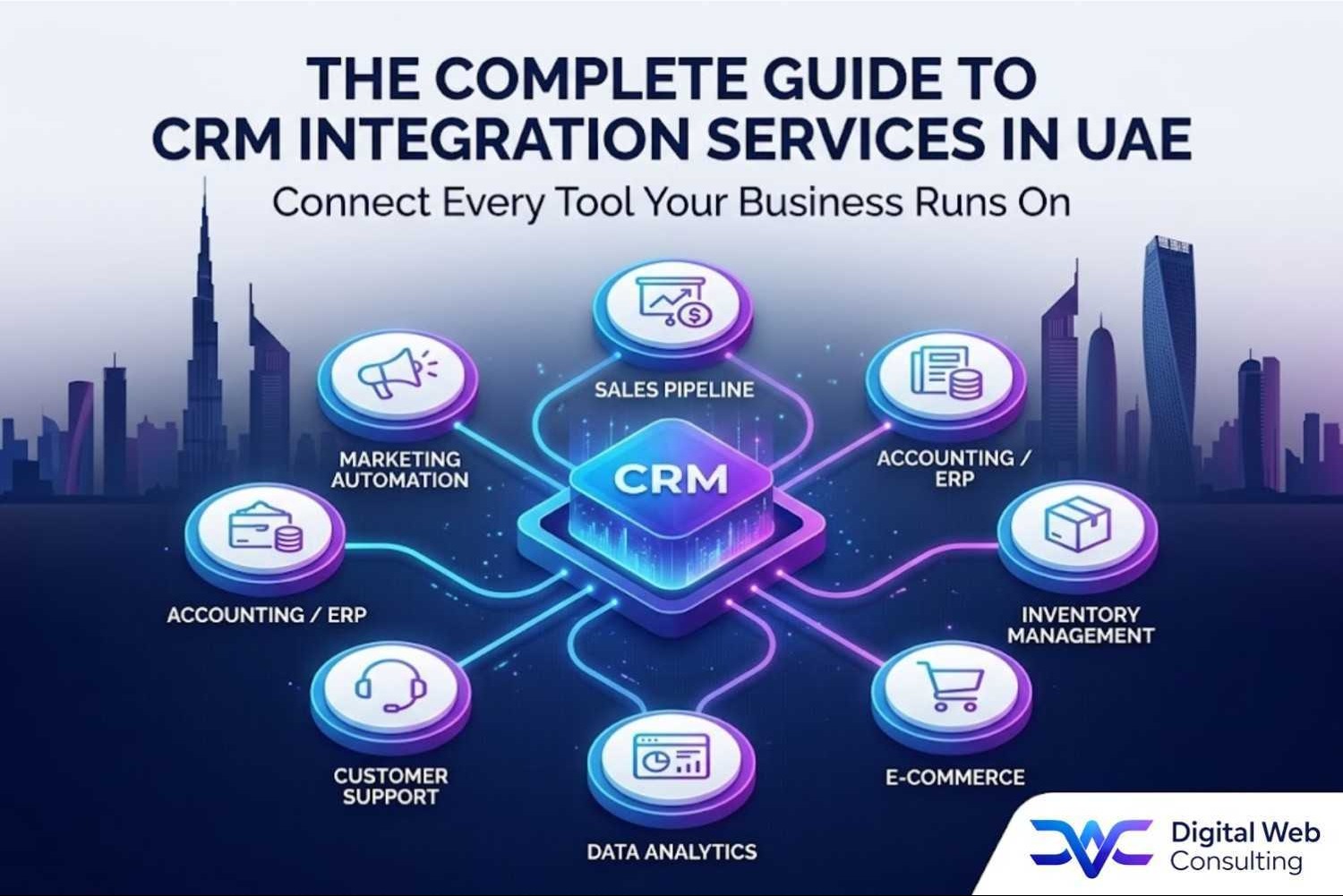
Picture a typical working day for a sales manager in a Dubai trading company. A lead comes in through the website. It gets manually entered into the CRM. The team follows up, the deal progresses, and eventually a quote is sent from the accounting software. When the order is confirmed, someone in operations manually updates the ERP. Finance creates the invoice separately. The customer follows up on WhatsApp, and that message sits outside every system the business uses.
At no point does one system automatically know what the others are doing. Every handoff is manual. Every update requires a person to move information from one place to another. Every gap between systems is a moment where data gets lost, delayed, or entered incorrectly.
Over 60% of business data never makes it from one system to another, it is re-entered manually, approximated, or simply lost between tools.
This is the reality of the disconnected business, and it is far more common than most organisations acknowledge. CRM integration services in UAE exist specifically to solve this. Not by replacing the tools your business already depends on, but by connecting them so that data flows automatically, accurately, and in real time between every system in your operation.
“ A business running five disconnected tools is not running one operation, it is running five separate ones and paying people to manually bridge the gaps between them. ”
The cost of disconnection shows up in places that are easy to overlook individually but significant in aggregate, duplicate data entry, decisions made on stale information, deals lost because follow-ups fell through the cracks between systems.
What Breaks When CRM Integration Is Done Poorly
Integration done well is invisible, data flows, teams work from accurate information, and no one notices the technical layer making it happen. Integration done poorly, however, creates a specific set of problems that are often worse than no integration at all:
- Data duplication: When sync logic is not carefully designed, the same record gets created multiple times across connected systems. A customer who exists twice in the CRM and three times in the ERP is a data integrity problem that compounds with every transaction until someone manually cleans it up.
- Sync conflicts and data overwrites: Without proper conflict resolution logic, integrations can overwrite newer data with older data when both systems update a record simultaneously. A sales rep updates a phone number in the CRM; the integration pulls the old number back from the ERP and overwrites the correction. These conflicts erode trust in the data and push teams back to manual management.
- Security gaps in data transfer: Poorly built integrations sometimes transfer data through unsecured channels or store credentials insecurely. For businesses handling customer financial data or personal information, these gaps represent real compliance and reputational risk.
- Broken workflows after system updates: Both connected systems will release updates over their lifetime. If the integration was built without proper error handling and version management, a routine platform update can silently break data flows, often going undetected until someone notices the data is wrong.
- Higher long-term costs: The businesses that spend the least on integration upfront almost always spend the most on integration support over time. Fixing data problems, rebuilding broken connections, and managing the downstream consequences of unreliable data flows consistently costs more than building the integration properly from the start.
For businesses that have already experienced integration failures and are looking to rebuild on a more reliable foundation, this is exactly the kind of problem our CRM Software Development and integration services are designed to address, starting with an honest assessment of what is currently broken and why.
The measure of a good integration is not whether it works on day one. It is whether it is still working accurately twelve months later, through platform updates, data volume growth, and business process changes.
What a CRM Integration Project Looks Like Step by Step
A well-run CRM integration project follows a structured process that prevents the common failure points described above. Here is what that process looks like in practice:
- Discovery and data mapping: Before any technical work begins, every system in scope is audited, what data it holds, how that data is structured, what fields exist, and which of those fields need to flow between systems. This mapping exercise also identifies conflicts, duplicates, and data quality issues in the source systems that would cause problems if not resolved before integration begins.
- Integration design and architecture: The data flow is designed in detail, which system is the source of truth for each data type, how conflicts are resolved, how frequently data syncs, how errors are handled, and how the integration will behave when either connected system is unavailable. This design is documented and reviewed before any code is written.
- Build and configuration: The integration is built according to the agreed design. For API integrations, this involves writing the connection logic, authentication handling, data transformation rules, and error management. For middleware-based integrations, it involves configuring the flows, mapping the fields, and testing the logic against real data scenarios.
- Testing across live scenarios: Integration testing uses real data from your actual systems, not synthetic test data, to validate that the connection behaves correctly under real conditions. Edge cases, error states, and high-volume scenarios are all tested before go-live.
- Monitoring and ongoing maintenance: Post-deployment, the integration is monitored for errors, sync failures, and data anomalies. When either connected platform releases an update that affects the integration, it is reviewed and adjusted proactively rather than reactively.
For businesses looking to extend this connected approach beyond CRM to their full enterprise technology stack, our ERP Integration Services and Digital Transformation Consulting cover how integrated data flows support better decisions across every department.
The difference between an integration project that delivers lasting value and one that creates ongoing problems almost always comes down to the quality of the discovery and design phases, not the technical build itself.
A Connected Business Is a Faster Business
Every manual data transfer your team performs is a tax on productivity, paid in time, attention, and accuracy. Multiply it across every department, every day, and the total cost of disconnected systems becomes one of the largest hidden expenses in any growing UAE business.
CRM integration services in UAE eliminate that tax. Not by simplifying your technology stack, but by making the tools you already depend on work together as a single, connected operation, sharing data automatically, updating records in real time, and giving every team the accurate information they need without having to ask someone else for it.
The result is not just time saved. It is decisions made faster, customer relationships managed more consistently, and a business that can scale its operations without scaling its administrative overhead at the same rate.
“ Integration is not a technical project. It is an operational decision, one that determines whether your business data works for you or against you every single day. ”
Ready to connect the tools your business runs on and eliminate the manual gaps between them? Explore what is possible with Digital Web Consulting through our CRM Integration Services page →
[CRM integration services UAE , CRM API integration UAE , third-party CRM integration Dubai , CRM system connectivity , how to integrate CRM with ERP in UAE , CRM WhatsApp integration Dubai , CRM integration with accounting software]