

The ERP Illusion: When Having a System Is Not the Same as Having Integration
There is a version of ERP adoption that looks like success from the outside. The system is live. Staff are logging in. Transactions are being recorded. Leadership believes the business now has a single source of operational truth.
Then someone asks a straightforward question, how much stock is available against open customer orders right now?, and it turns out the answer requires pulling data from the ERP, checking a separate spreadsheet that the warehouse team maintains, and calling the sales manager to confirm what has been committed but not yet entered into the system.
This is not a data problem. It is an integration problem. The ERP is recording transactions, but it is not connected to the other systems and processes that generate the data it needs to provide a complete picture. And this gap between having an ERP and having an integrated ERP is far wider, and far more common, than most UAE businesses realise until they try to answer a question the system cannot.
84% of businesses report that data silos, caused by disconnected systems, directly prevent them from getting an accurate real-time view of operations., MuleSoft Connectivity Benchmark Report, 2024
“ Running an ERP without integration is like installing a switchboard that is not connected to any of the phones. The infrastructure is there. The conversations are not happening. ”
The gap between an isolated ERP and a properly integrated one is not a technical gap, it is an operational one. Every manual step between systems is a place where data slows down, accuracy degrades, and decisions get made on incomplete information.
What ERP Integration Actually Involves: Explained Without the Jargon
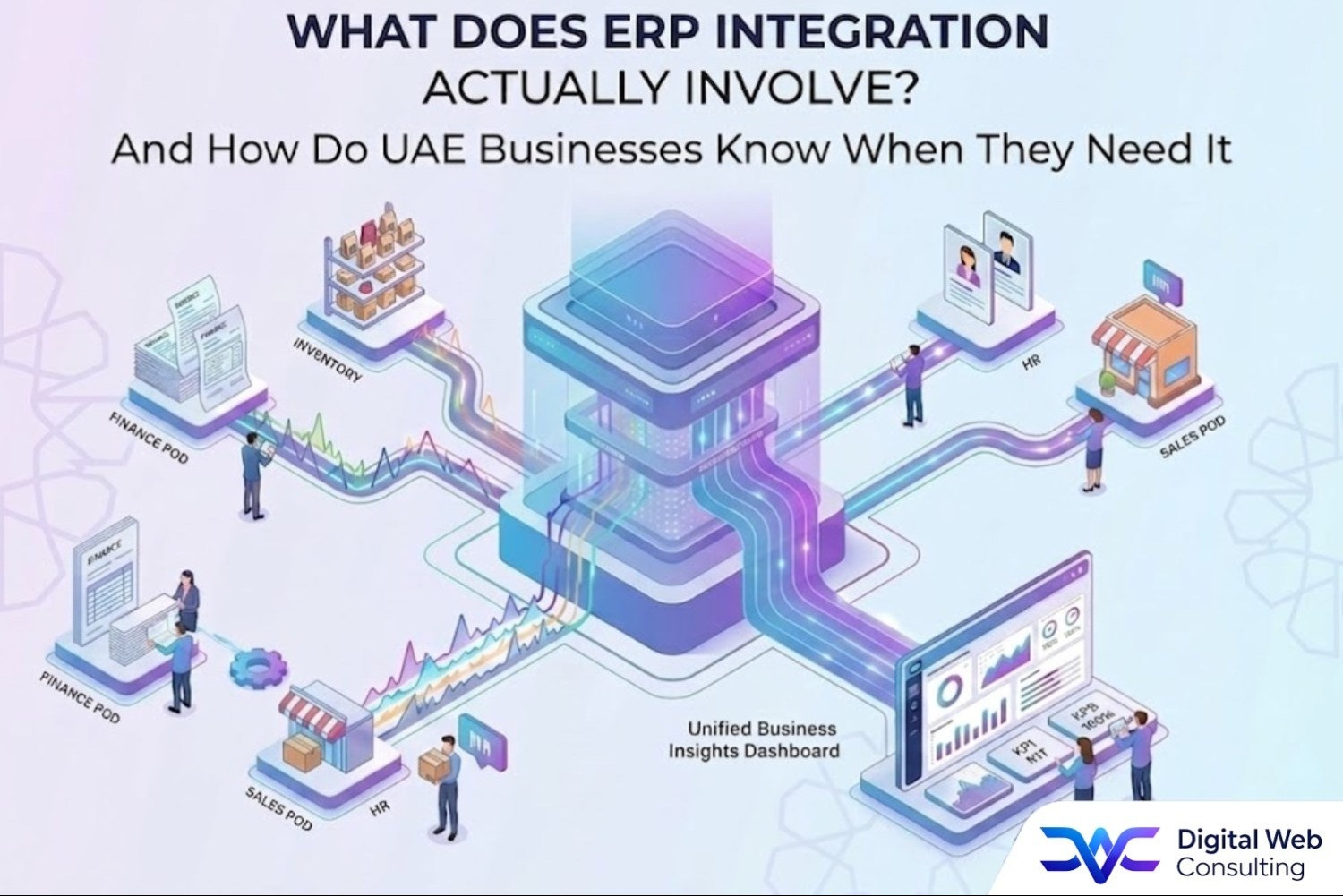
ERP integration is the process of connecting your ERP system to other software platforms your business uses, so that data moves between them automatically, accurately, and in the right direction without anyone manually transferring it. When an event occurs in one system, the connected systems are updated accordingly.
Three levels of data connection are worth understanding clearly, because they are not the same thing and they do not deliver the same operational value:
- One-way sync: Data flows from one system to another in a single direction. For example, new customer records created in the CRM are pushed to the ERP automatically. The ERP does not send anything back. This is the simplest form of integration and appropriate for specific, limited use cases where bidirectional data flow is not needed.
- Two-way sync: Data flows in both directions between connected systems. A customer record updated in the ERP reflects in the CRM, and vice versa. This is the standard requirement for most business system integrations and prevents the data conflicts that arise when teams update records independently in different systems.
- Real-time event-driven integration: Instead of syncing data on a schedule, every hour, every night, real-time integration triggers updates the moment an event occurs. A confirmed sales order immediately updates inventory. A payment received immediately reflects in the customer account. For fast-moving UAE businesses, real-time integration is often the difference between operational agility and operational lag.
Understanding which level of integration each business relationship requires is one of the first decisions in any ERP integration project in UAE. Not every connection needs real-time sync. Not every connection can be one-directional. Getting this mapping right at the start prevents both over-engineering and under-delivering.
The technical complexity of ERP integration varies significantly depending on the systems being connected, the volume of data being transferred, and the business rules that govern how conflicts are resolved. What remains constant is the operational benefit, fewer manual steps, better data accuracy, and faster decisions.
The Six Systems UAE Businesses Most Commonly Integrate With Their ERP
The value of ERP system connectivity in UAE depends entirely on which systems are connected and what that connection enables. These six integrations consistently deliver the highest operational impact for UAE businesses:
- CRM integration: Connecting your ERP to your CRM gives the sales team visibility into customer credit limits, order history, outstanding invoices, and account status, directly within the CRM interface. It eliminates the finance-to-sales information request cycle and ensures sales reps never quote or commit to a customer whose account has a problem the ERP already knows about.
- E-commerce platform integration: For businesses selling online, ERP integration with platforms like Shopify, WooCommerce, or a custom storefront ensures orders flow directly into the ERP, inventory updates in real time as orders are fulfilled, and customer records sync without manual re-entry. The gap between a customer clicking buy and the warehouse knowing about it shrinks from hours to seconds.
- Accounting and banking integration: Connecting the ERP to accounting software or directly to banking platforms automates bank reconciliation, payment matching, and cash flow reporting. For UAE businesses managing VAT compliance, this integration also ensures financial data flows in a format that supports accurate FTA filing without manual extraction and reformatting.
- Logistics and shipping tools: Integrating delivery and freight platforms with the ERP means shipment status updates automatically in the customer record, delivery confirmation triggers invoice generation, and logistics cost data flows into the ERP for accurate landed cost calculations, without anyone manually moving that information between systems.
- HR and payroll platforms: When HR systems connect to the ERP, attendance data flows directly into payroll calculations, headcount costs update financial forecasts automatically, and WPS payroll submissions are generated from data that is already accurate in the source system rather than re-entered from a separate HR tool.
- Reporting and business intelligence tools: Connecting Power BI or other BI platforms directly to the ERP means dashboards and reports draw from live operational data rather than from exports that are already outdated by the time they are analysed. Leadership sees the real position, not last night's position.
For businesses already using Power BI and looking to connect it more deeply to their ERP data, our Power BI Consulting Services cover the full scope of live ERP data integration with interactive business intelligence reporting.
Each integration above addresses a specific operational gap. The businesses that benefit most from ERP integration are not the ones that connect everything at once, they are the ones that identify the highest-cost manual handoffs and eliminate them first.
Seven Signs Your UAE Business Needs ERP Integration Right Now
ERP integration is rarely something businesses seek out proactively. More often, the need becomes apparent through a pattern of operational friction that has become so familiar it is accepted as normal. These seven signs indicate that the friction has a specific, addressable cause:
- Sign 1, You are re-entering data between systems manually: If your team copies information from the ERP into another system, or from another system into the ERP, as a regular part of their workflow, that manual step is both a time cost and an accuracy risk. Every manual transfer is a moment where data can be entered incorrectly, incompletely, or simply forgotten.
- Sign 2, Reports take hours or days to compile: When producing a management report requires someone to extract data from the ERP, cross-reference it with data from another system, and manually combine the two in a spreadsheet, the report is already outdated before it reaches the person who needs it.
- Sign 3, Departments are working from different versions of the truth: When the sales team's view of customer status differs from finance's view, or when the warehouse's stock count differs from what the ERP shows, the systems are not connected accurately, and decisions made from each version create downstream conflicts.
- Sign 4, Customer orders fall through gaps between systems: When a confirmed order exists in the CRM but has not been transferred to the ERP, or when a shipment has gone out but the customer account has not been updated, the gap between systems is causing fulfilment and billing failures that directly affect customer experience.
- Sign 5, Finance is always chasing operations for data: If the finance team regularly needs to contact operations, sales, or warehouse teams to get information that should already be in the financial system, the data is living in disconnected operational systems that do not feed the ERP automatically.
- Sign 6, Inventory mismatches cause fulfilment failures: When the ERP shows stock that the warehouse does not have, because receipts or adjustments were recorded in one place but not the other, the integration gap is directly causing customer-facing failures.
- Sign 7, Management decisions are delayed by inaccessible data: When leadership asks for a current operational picture and the honest answer is that it will take until tomorrow to pull together, the systems are not integrated in a way that supports timely decision-making.
If three or more of the above signs are present, the operational cost of disconnected systems is already significant. Our ERP Integration Services begin with a systems audit that maps exactly where the gaps are and what each one is costing the business before any integration work begins.
“ The businesses that benefit most from ERP integration are rarely the ones with the most complex technology stacks. They are the ones that have clearly identified where their manual handoffs are, and have decided the cost of leaving them in place is higher than the cost of fixing them. ”
The seven signs above are operational symptoms. ERP integration is the structural fix. And unlike most operational improvements, it delivers compounding returns, every automated data flow saves time on every future transaction, indefinitely.
How ERP Integration Is Built: The Technical Reality Without the Complexity
The technical layer of ERP integration does not need to be complicated to understand. Here is what the main approaches actually involve and when each one is appropriate:
API-based integration, the most reliable approach for UAE business requirements:
- What it is: An API (Application Programming Interface) is a defined channel through which two systems can exchange data. API-based integration uses these channels to build direct, controlled connections between your ERP and each system it needs to communicate with.
- Why it is preferred: API integrations handle complex business logic, high data volumes, and custom data transformation rules accurately. They are built specifically for your systems and your requirements, not approximated from a generic template. For UAE businesses with specific data structures, VAT requirements, and multi-currency logic, API integration is almost always the appropriate choice.
- The trade-off: API integrations require development work to build and ongoing maintenance as connected systems update. They are more expensive to create than middleware solutions but deliver significantly better reliability, performance, and long-term value.
Middleware platforms, when they work and when they do not:
- What they are: Middleware platforms like Zapier, Make, or Boomi sit between systems and route data based on configured rules. They require no custom code for standard use cases and can be set up relatively quickly.
- Where they work well: Simple, low-volume data flows between widely-used platforms, for example, pushing new leads from a web form into the ERP, are handled adequately by middleware. For straightforward connections that follow standard logic, middleware is a cost-effective starting point.
- Where they break down: When business logic is complex, data volumes are high, or the systems being connected have custom data structures, middleware platforms reach their limits quickly. They also introduce vendor dependency, if the middleware provider changes its pricing or discontinues a connector, the integration fails.
Data mapping, transformation, and conflict resolution:
- Data mapping: Before any integration is built, the data fields in each connected system need to be mapped to each other. A customer record in the CRM may have different field names, formats, and structures than the corresponding record in the ERP. The integration layer translates between them accurately.
- Data transformation: Some data needs to be transformed as it moves between systems, currency conversions, date format standardisation, code translations between different classification systems. This transformation logic is defined and built into the integration layer.
- Conflict resolution: When the same record is updated in two connected systems simultaneously, the integration needs a defined rule for which version takes precedence and how the conflict is logged. Without this logic, integrations can silently overwrite correct data with outdated data.
For businesses evaluating ERP integration alongside a broader enterprise technology review, our IT Consulting Services include structured integration assessments that identify the right technical approach for each connection before any development investment is committed.
The technical approach to ERP integration should be chosen based on the specific systems being connected and the business logic they need to share, not based on what is fastest or cheapest to set up. A poorly architected integration that breaks regularly costs significantly more over time than one built correctly from the start.
What a Well-Integrated ERP Environment Looks Like After Go-Live
The most useful way to understand what ERP integration delivers is to describe what daily operations actually look and feel like once the connections are working properly, because the contrast with the pre-integration state is where the value becomes tangible.
- Daily operations run without manual data transfer: The team stops copying data between systems. Transactions recorded in one place automatically update every connected system. The administrative layer that existed purely to move information between tools disappears, and the time it consumed returns to productive work.
- Every department works from the same data: Sales, finance, operations, and warehouse teams access the same customer records, the same stock levels, and the same financial position, updated in real time as events occur. The version-of-truth conflicts that previously generated inter-departmental friction simply stop happening.
- Leadership has live visibility without requesting reports: Management dashboards show the current operational position, pipeline value, stock levels, cash flow, outstanding orders, payroll status, drawn directly from integrated live data rather than from compiled reports that are always slightly out of date by the time they arrive.
- Customer experience improves without additional effort: Orders are fulfilled faster because the warehouse knows about them immediately. Invoices are accurate because billing data comes directly from the ERP without manual re-entry. Customer queries are answered in real time because service teams can see the complete account history across all connected systems.
- The maintenance picture is predictable and manageable: A well-built ERP integration includes monitoring that alerts the team when a sync fails, when data volumes exceed expected ranges, or when a connected system update affects the integration. Problems are caught and corrected proactively rather than discovered when a team member notices the data is wrong.
For businesses looking to extend their integrated ERP environment with fully custom enterprise systems built around their specific operational requirements, our Custom ERP Development Services and Web ERP Development services cover what building a fully connected enterprise platform from the ground up looks like.
A well-integrated ERP does not feel like a technology upgrade. It feels like an operational one, because the friction that teams accepted as normal simply stops being part of the working day. That is the most reliable measure of whether an ERP integration has delivered what it should.
Integration Is Not a Technical Luxury: It Is an Operational Necessity
An ERP system that is not connected to the other tools your business runs on is not delivering its full value. It is recording transactions in one place while the rest of the business manages data in other places, and the gap between those places is filled by manual effort, duplicated records, and decisions made on information that is never quite current.
ERP integration services in UAE close that gap. They connect the systems your business already depends on, eliminate the manual handoffs between them, and give every team the accurate, real-time data they need to do their jobs without asking someone else to provide it. The result is not just a more efficient operation, it is a more informed one, where decisions are made faster, errors surface sooner, and the data the business generates actually gets used.
If any of the seven signs in this guide resonated with how your business currently operates, the integration gap is already costing you more than you are measuring. The question is not whether to address it, it is where to start.
“ The businesses that compete most effectively are not the ones with the most systems. They are the ones whose systems talk to each other, and whose people spend their time on work that matters rather than moving data between tools. ”
Ready to identify where ERP integration can eliminate your biggest operational gaps? Start with Digital Web Consulting through our ERP Integration Services page →
[ERP integration services UAE , ERP API integration UAE , ERP third-party integration Dubai , ERP data integration , how to integrate ERP with CRM in UAE , ERP integration with ecommerce Dubai , ERP system connectivity UAE]