
The Module Confusion Problem
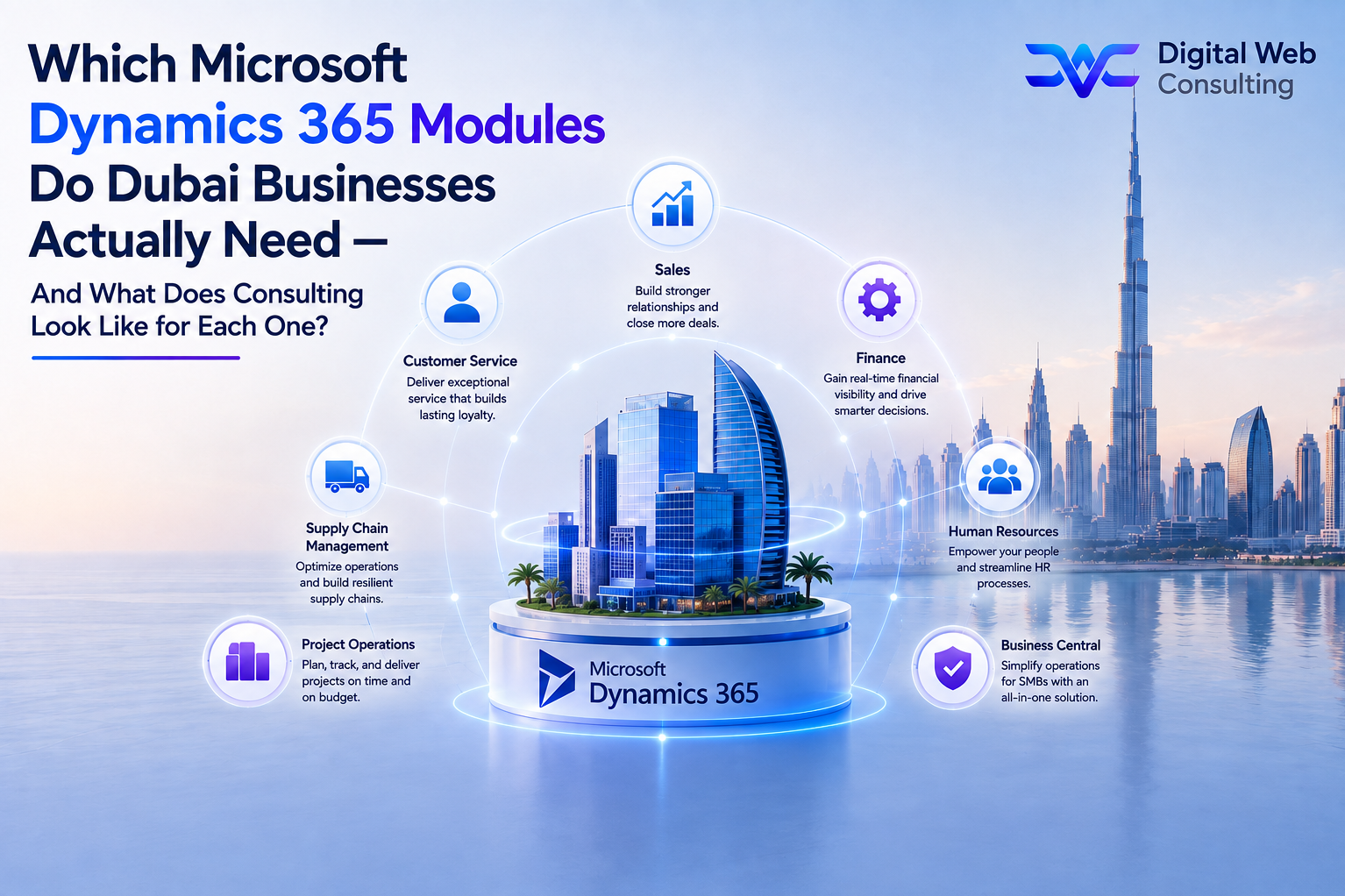
The Microsoft Dynamics 365 catalogue lists more than a dozen distinct applications. Business Central. Sales. Customer Service. Finance. Supply Chain Management. Field Service. Marketing. Project Operations. Human Resources. Commerce. Each carries its own pricing, its own implementation requirements, and its own set of features that overlap in ways that are not immediately obvious to a buyer approaching the platform for the first time.
The result is predictable. Dubai businesses either purchase a bundle that includes applications they will never use, or they buy the wrong module for the problem they are trying to solve, or they under-buy and discover later that the functionality they needed sat in a different application they did not license. Each of these outcomes is avoidable. All of them are more common than they should be.
Microsoft Dynamics 365 consulting in Dubai at its most valuable happens before licensing is purchased, not after. A structured module selection conversation identifies which applications address the business's actual operational problems, which can be added later as the business grows, and which are irrelevant to the current operational context. This guide covers the modules most relevant to Dubai businesses, what consulting looks like for each one, and how to make the selection decision correctly.
Most Dynamics 365 buyers approach the licensing decision as a product selection exercise. The right approach is to treat it as a business requirements exercise that ends in a product recommendation. The difference between these two approaches determines whether the implementation solves the right problems.
This guide focuses on the five Dynamics 365 applications most commonly implemented by Dubai businesses. It does not cover every module in the Microsoft catalogue, as several are either market-specific or address operational contexts that are not common in the UAE.
Dynamics 365 Business Central: The Right Starting Point for Most Dubai Businesses
What It Covers
Business Central is an all-in-one ERP application built specifically for small and medium businesses. It covers financial management, purchasing and payables, sales and receivables, inventory management, project management, and basic CRM functionality within a single connected platform. It is the natural replacement for a business running separate accounting software, inventory spreadsheets, and disconnected sales tracking tools.
For most Dubai businesses with annual revenues between AED 5 million and AED 300 million and team sizes between twenty and three hundred employees, Business Central is the most appropriate starting point in the Dynamics 365 catalogue. It addresses the widest range of operational problems within a single licensing tier and avoids the complexity of assembling multiple Dynamics 365 applications for a business that does not yet need that level of specialisation.
Who It Is For and Who It Is Not For
Business Central is well suited to trading companies, professional services firms, project-based businesses, and distributors whose primary operational needs are integrated finance, inventory, purchasing, and sales management. It is not well suited to large enterprises with complex multi-entity structures, businesses requiring deep manufacturing production management, or organisations with regulatory reporting requirements that sit above what a mid-market ERP addresses.
What Consulting Looks Like for Business Central
A Business Central consulting engagement for a Dubai business follows a structured sequence. The discovery phase maps current financial processes, identifies the chart of accounts structure, documents purchasing and inventory workflows, and establishes the sales order management requirements. Configuration covers the chart of accounts setup, UAE VAT group configuration, WPS payroll structure, document template design for bilingual Arabic and English output, and the dimension structure used for departmental and project cost tracking.
Data migration brings the opening balance sheet, customer master records, supplier master records, and product or service catalogue from legacy systems into Business Central. Integration work connects Business Central to any external systems the business runs alongside it, most commonly a CRM, a bank feed for automatic reconciliation, or an e-commerce platform for direct order import.
UAE-Specific Configuration Requirements
• VAT configuration: Tax groups, tax posting setups, and tax calculation logic must be configured in alignment with UAE Federal Tax Authority requirements. Business Central does not arrive pre-configured for UAE VAT. This configuration is a core consulting deliverable, not an optional enhancement.
• WPS payroll: Salary records and payroll output need to be structured for Wages Protection System submission. Business Central's payroll module requires UAE-specific configuration to produce WPS-formatted files.
• Bilingual document output: Customer invoices, purchase orders, delivery notes, and statements need to be generated in Arabic and English with correct right-to-left formatting for Arabic content. Document template design is a consulting deliverable that most generic Business Central implementations do not include adequately.
• Multi-currency handling: Businesses transacting in AED alongside USD, EUR, or other currencies need the multi-currency module configured with exchange rate sources and functional currency reporting set correctly from the first transaction.
For businesses running Business Central alongside a dedicated CRM platform, our ERP Integration Services cover the API connections that keep Business Central and the CRM in sync without manual data transfer between systems.
Business Central is not a permanent ceiling. It is a scalable foundation. Businesses that outgrow Business Central can migrate to Dynamics 365 Finance and Supply Chain Management, which shares Microsoft's data infrastructure and reduces the migration effort compared to switching to a different platform entirely.
Dynamics 365 Sales: When CRM Is the Priority
What It Covers Beyond Basic Contact Management
Dynamics 365 Sales is a full CRM platform covering lead and opportunity management, account and contact records, activity tracking, sales pipeline visualisation, forecasting, and sales team performance analytics. It integrates natively with Outlook and Microsoft Teams, logging emails, meetings, and calls against contact and deal records without requiring manual CRM updates from the sales team.
The distinction between Business Central's sales functionality and Dynamics 365 Sales is important for Dubai businesses deciding which to use. Business Central handles the transactional side of sales: quotations, sales orders, invoicing, and customer account management. Dynamics 365 Sales handles the relationship and pipeline side: lead tracking, opportunity progression, sales activity management, and revenue forecasting. Businesses with active sales teams managing relationship-driven deal cycles need Dynamics 365 Sales. Businesses whose sales process is primarily transactional order management can often work within Business Central's native sales functionality without adding a separate CRM application.
What Consulting Looks Like for a Dynamics 365 Sales Implementation
A Dynamics 365 Sales consulting engagement for a Dubai business starts with sales process mapping. The consultant documents how leads enter the business, how they are qualified, what stages the opportunity moves through, how the team communicates with prospects, and what data is captured at each stage. This process map becomes the configuration specification for the pipeline stages, opportunity fields, activity types, and automation rules that make the CRM reflect how the team actually sells rather than a generic sales process template.
Configuration covers the entity structure, custom fields for UAE-specific data requirements such as trade licence numbers and visa expiry dates relevant to B2B relationship management, sales process workflow automation, role-based dashboard setup, and the Outlook and Teams integration that enables email and meeting logging without manual CRM entry.
Integration with Outlook, Teams, and LinkedIn
The native Microsoft ecosystem integration is one of the strongest arguments for Dynamics 365 Sales over competing CRM platforms for Dubai businesses already running Microsoft 365. The Dynamics 365 Sales app within Outlook allows sales team members to view CRM context, log emails, and update opportunity records without leaving their email client. The Teams integration surfaces CRM data within meeting and channel contexts. The LinkedIn Sales Navigator integration, where licensed, connects LinkedIn relationship data to CRM contact records.
For businesses implementing Dynamics 365 Sales alongside Business Central to create a fully integrated commercial and operational platform, our Microsoft Dynamics 365 Consulting service covers the bi-directional data connection between Sales and Business Central that keeps customer records, order history, and account status consistent across both applications.
Dynamics 365 Sales is licensed per user at a different price point from Business Central. Not every employee needs a Dynamics 365 Sales licence. A common and cost-effective approach for Dubai SMEs is to license Dynamics 365 Sales for the sales team and Business Central for finance and operations, connecting the two via integration rather than applying a single licence to all staff.
Dynamics 365 Customer Service: For Businesses Managing High Service Volume
What It Covers and What Problems It Solves
Dynamics 365 Customer Service is a structured case management platform covering service request intake, case routing and assignment, SLA tracking, knowledge base management, customer communication logging, and service performance analytics. It is designed for businesses that manage a significant volume of customer queries, complaints, service requests, or support interactions, where tracking those interactions systematically produces better customer outcomes and reduces the cost of service delivery.
The distinction between Dynamics 365 Sales and Dynamics 365 Customer Service reflects a meaningful operational difference. Sales manages the pre-sale relationship. Customer Service manages the post-sale one. For businesses where the post-sale relationship is a primary driver of retention and referral, structured case management produces better outcomes than managing service interactions through email and WhatsApp without a system of record.
When Customer Service Is Needed Alongside Sales
The combination of Dynamics 365 Sales and Dynamics 365 Customer Service is most valuable for Dubai businesses in professional services, logistics, and B2B product distribution, where the quality of ongoing service delivery is as important to customer retention as the initial sale. The integrated view of a customer's sales history alongside their service history changes how account managers engage with renewal conversations and how service teams prioritise their responses.
UAE-Specific Service Management Considerations
Dubai businesses managing customer service interactions across Arabic and English, and across channels including email, WhatsApp, and phone, face specific configuration requirements that a standard Dynamics 365 Customer Service implementation may not address by default. The consulting engagement for this module in a UAE context needs to account for WhatsApp Business integration into the case management workflow, bilingual email template configuration, and SLA definitions that account for UAE public holidays and the working week structure.
Dynamics 365 Finance and Supply Chain Management: The Enterprise Tier
How Finance and Supply Chain Differ from Business Central
Dynamics 365 Finance and Dynamics 365 Supply Chain Management are the enterprise-tier applications in the Microsoft ERP stack. They address operational complexity that sits above what Business Central is designed to handle: multi-legal-entity financial consolidation with intercompany transactions, complex manufacturing production management with bill of materials and production floor integration, advanced warehouse management with location and licence plate tracking, and sophisticated financial reporting with multi-dimensional analysis.
The functional boundary between Business Central and the enterprise applications is not always immediately clear to buyers, which makes the consulting conversation about module selection particularly important. A business that genuinely needs multi-entity consolidation across five legal entities with different functional currencies and intercompany eliminations needs Dynamics 365 Finance. A business that has two entities and wants a combined P&L view for management reporting can often achieve that requirement within Business Central with appropriate configuration.
When a Dubai Business Needs the Enterprise Tier
Three operational characteristics consistently indicate that a Dubai business has outgrown what Business Central can support and requires the enterprise tier of Dynamics 365.
• Multi-entity complexity with intercompany transactions and consolidation requirements that exceed Business Central's entity management capability
• Manufacturing operations requiring production orders, bill of materials management, capacity planning, and production floor data integration
• Advanced warehouse management with sub-location tracking, wave picking, cross-docking, or third-party logistics integration at a scale and complexity that exceeds Business Central's warehousing capability
What Consulting Looks Like at This Level
Dynamics 365 Finance and Supply Chain implementations are substantially more complex than Business Central engagements. The implementation team typically includes a functional consultant for finance, a functional consultant for supply chain or warehousing, a technical developer for customisation and integration, a project manager, and a data migration specialist. The timeline for a full Finance and Supply Chain implementation for a Dubai business of meaningful complexity is typically six to twelve months, with a phased go-live approach that deploys finance functionality first before adding supply chain capabilities.
For businesses evaluating whether they need the enterprise tier or whether Business Central can be configured to meet their requirements, our IT Consulting Services include structured platform assessments that map current and planned operational requirements against the capabilities of each Dynamics 365 tier before any licensing investment is committed.
Dynamics 365 Finance and Supply Chain Management carry significantly higher per-user licensing costs than Business Central. A business that implements the enterprise tier when Business Central would have met its requirements is paying a meaningful premium for capability it does not need. The module selection conversation is one of the highest-return consulting investments available to any business considering Dynamics 365.
How to Decide Which Modules Your Dubai Business Actually Needs
The Three Questions That Drive the Right Module Selection
Before any Dynamics 365 licensing discussion, three questions need clear answers. The quality of the module selection decision depends on the honesty and specificity of the answers to all three.
• What operational problems are you trying to solve: Not what features you want, but what specific operational friction points the system needs to address. Finance that takes too long to close. Sales pipeline that is invisible to leadership. Customer service that is managed informally through email and WhatsApp. Inventory levels that are only known after a physical count. Each specific problem maps to a specific module or combination of modules.
• What does your current technology stack look like: What systems are you replacing and what systems will Dynamics 365 need to integrate with. A business replacing standalone accounting software and inventory spreadsheets has different module requirements from one integrating with an existing e-commerce platform or a field service management tool.
• What does your team capacity look like for implementation and adoption: Business Central can be implemented and adopted by a team of ten with one part-time internal project sponsor. Dynamics 365 Finance requires significantly more internal capacity. The right module selection accounts for what the business can realistically implement and adopt, not just what it would ideally have.
The Most Common Wrong Combinations Dubai Businesses Choose
• Dynamics 365 Sales without Business Central: A business that implements Dynamics 365 Sales as a standalone CRM without connecting it to a finance system creates a pipeline management tool that is disconnected from the commercial reality of the business. Sales teams manage deals in the CRM while finance manages orders in a separate system, producing the same data fragmentation problem the CRM was supposed to solve.
• Dynamics 365 Finance when Business Central would suffice: A business with one legal entity, standard inventory requirements, and straightforward financial reporting that implements Dynamics 365 Finance is paying enterprise licensing costs for Business Central-level operational complexity. The implementation is more expensive, the timeline is longer, and the team needs more training for features they will never use.
• The full suite purchased before any modules are configured: Microsoft and its reseller partners sometimes sell comprehensive Dynamics 365 bundles. A business that purchases a bundle covering Sales, Customer Service, Marketing, and Business Central before defining which modules it actually needs consistently finds itself paying for applications that never go live and diverting implementation energy toward an unnecessarily broad scope.
Why the Consulting Conversation Should Happen Before Licensing
The most expensive mistake in any Dynamics 365 procurement is purchasing the wrong modules and discovering the error after the licensing has been committed. Microsoft's licensing terms make switching modules or adjusting tier levels mid-implementation commercially complex and sometimes costly. A structured consulting engagement before licensing is purchased costs a fraction of the licensing itself and produces a module selection recommendation backed by a documented requirements analysis rather than a sales conversation.
Our Dynamics 365 Implementation Partner service begins every engagement with a pre-licensing requirements assessment that confirms the right module combination, the right licensing tier, and the right implementation sequence before any procurement commitment is made.
The Phased Approach That Protects Budget and Adoption
The right module selection for a Dubai business is almost never everything at once. A phased approach that goes live with the highest-impact module first, achieves adoption, and then extends the platform produces significantly better outcomes than a full suite implementation that attempts to change everything simultaneously.
For most Dubai businesses, the sequence is Business Central first for financial and operational management, followed by Dynamics 365 Sales when the CRM requirement becomes the primary priority, followed by Customer Service when post-sale service management becomes a structured need. This sequence is not a compromise. It is the implementation path that produces the fastest time to value and the highest adoption at each phase.
The right modules implemented correctly and adopted fully deliver more operational value than the full Dynamics 365 suite implemented ambitiously and used partially. Scope discipline in module selection is not a constraint on what is possible. It is the discipline that makes the possible achievable.
The Right Modules Implemented Correctly Beat the Full Suite Implemented Badly
Microsoft Dynamics 365 is a powerful platform precisely because it covers such a broad range of business functionality. That breadth is also what makes module selection one of the most consequential decisions in the entire implementation journey. A business that starts with the right modules, configured correctly for UAE operational requirements, adopted fully by the team, and extended in a planned sequence as the business grows will consistently outperform one that purchased more broadly and implemented less carefully.
Microsoft Dynamics 365 consulting in Dubai at the module selection stage is not about recommending the most comprehensive implementation. It is about identifying the combination that solves the actual business problems, fits the team's current capacity to implement and adopt, and leaves a clear path for extension as those problems evolve. That conversation, held before licensing rather than after it, is one of the most cost-effective investments any Dubai business can make in its Dynamics 365 journey.
The modules described in this guide cover the needs of the large majority of Dubai businesses considering Dynamics 365. The right starting point for your specific business depends on the three questions in the section above. The most useful next step is a conversation that answers those questions with the operational specificity they require.
Ready to identify which Dynamics 365 modules are right for your Dubai business before committing to any licensing? Start the conversation with Digital Web Consulting through our Microsoft Dynamics 365 Consulting page
[microsoft dynamics 365 consulting in dubai , Dynamics 365 consultant Dubai , D365 consulting Dubai , Microsoft Dynamics Dubai , Dynamics 365 modules Dubai businesses , which D365 module UAE , Dynamics 365 Business Central Dubai]