


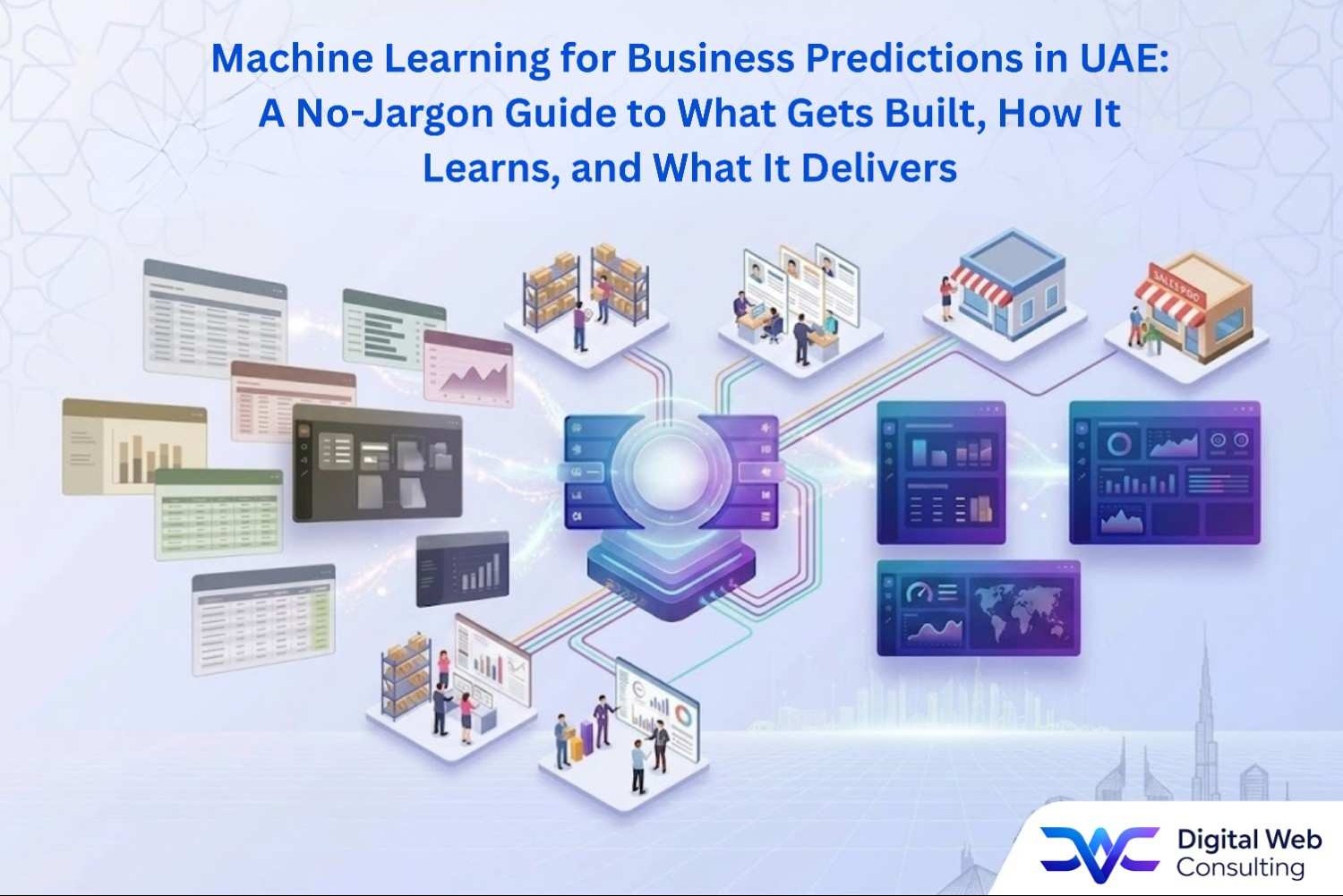
What Machine Learning Actually Is: Without the Technical Noise
If you have tried to understand machine learning through technical explanations, you have probably encountered a wall of terminology, algorithms, neural networks, training loops, feature vectors, that explains the mechanics without explaining the point. So here is the point, stated in plain business language:
Machine learning is software that finds patterns in historical data and uses those patterns to make predictions about future events.
That is it. No magic. No artificial consciousness. No technology that thinks for itself. It is pattern recognition at a scale and speed that human analysts cannot match, applied to the specific question a business needs answered.
To make it concrete: your business has been recording transactions for years. Every sale, every return, every late payment, every stockout, every customer who left and every one who stayed, all of that is pattern data. Machine learning takes that historical record and builds a model that can answer questions like: which customers are most likely to stop buying in the next ninety days? Which products will run out of stock before the next replenishment if we do not reorder this week? Which leads in the pipeline are most likely to close this quarter?
3x businesses that deploy predictive analytics through machine learning are three times more likely to report significant improvement in decision-making speed compared to those relying on traditional reporting alone, Forrester Research, 2024
“ Machine learning does not tell you what to do. It tells you what is most likely to happen based on everything that has happened before, and that shift from reactive to predictive is where the business value lives. ”
The businesses that benefit most from machine learning in UAE are not the ones with the most sophisticated technology teams. They are the ones with the clearest business questions and the operational data to answer them. If you have both, you have the foundation for ML.
What Machine Learning Can Predict for a UAE Business Right Now
The range of what machine learning solutions in Dubai can predict is wide, but the highest-value applications for UAE businesses cluster around five specific business problems that are both common and costly when managed without predictive intelligence:
- Customer churn before it happens
Without ML: The business notices a customer has stopped buying after the relationship has already ended. Recovery attempts at this point succeed rarely.
With ML: The ML model scores every active customer daily on their churn probability, flagging accounts showing early behavioural signals of disengagement weeks before they go silent. The account management team intervenes at the right moment with the right offer.
- Demand and inventory levels by SKU and location
Without ML: Replenishment decisions are based on last month's sales or a buyer's experience. The result is overstock in slow lines and stockouts in fast ones, simultaneously.
With ML: The ML model predicts demand for each SKU at each location across the next four to twelve weeks, accounting for seasonality, promotions, and external signals. Replenishment quantities are calculated automatically from the predictions.
- Payment default risk by customer
Without ML: Credit decisions are made based on static credit limits set months or years ago. Late payments and bad debts are discovered after the fact.
With ML: The ML model scores each customer account daily on payment risk based on their payment history, order patterns, and account behaviour. Finance teams prioritise collections based on dynamic risk scores rather than overdue aging alone.
- Equipment failure before it causes downtime
Without ML: Maintenance is either scheduled at fixed intervals regardless of equipment condition, or reactive after a breakdown has already stopped production.
With ML: Sensor data from equipment feeds an ML model that detects deviation patterns associated with impending failure. Maintenance is triggered by the model before the failure occurs rather than after it does.
- Sales conversion probability by lead
Without ML: Sales teams work their pipeline based on recency or instinct, spending equal time on leads that will never convert and leads that are ready to close.
With ML: The ML model scores each lead on their probability of conversion based on firmographic data, engagement behaviour, and historical patterns from similar leads. Sales effort concentrates on the highest-probability opportunities automatically.
Each prediction above becomes more accurate over time as the model processes more data. An ML model built for your business does not plateau at its initial accuracy, it improves continuously as it learns from every new outcome it observes. For businesses exploring how predictive models in UAE connect to broader AI strategy, our AI Consulting Services identify which predictions are most valuable before any development investment is made.
The predictions above are not theoretical future capabilities. They are being implemented by UAE businesses right now, in trading, logistics, real estate, professional services, and manufacturing. The question is not whether ML predictions are possible. It is which ones are most valuable for your specific operation.
ML Development for Supply Chain in Dubai: A Real-World Example
Supply chain management is one of the highest-value applications of machine learning for UAE businesses. The reason is straightforward: supply chain decisions involve high frequency, high stakes, and high data volume, exactly the conditions where ML development for supply chain in Dubai delivers its clearest return.
Consider a UAE-based FMCG distributor managing five thousand SKUs across eight warehouse locations. The demand planning team currently produces weekly replenishment recommendations using a combination of last month's sales data, supplier lead times, and buyer experience. The process takes three days and produces recommendations that are wrong often enough to generate simultaneous overstock in some categories and stockouts in others every week.
An ML model built for this business changes the process fundamentally:
- Data inputs the model learns from: Historical sales by SKU and location, seasonality patterns, promotional history, pricing changes, competitor activity signals, weather data where relevant to demand, and supplier lead time variability, all feeding into a single model trained on two or more years of operational history.
- What the model produces: A daily replenishment recommendation for every SKU at every location, with a confidence interval that tells the planning team how certain the model is about each recommendation and which lines carry the highest demand uncertainty.
- What it replaces: Three days of manual analysis collapses to an automated daily output. Buyer experience remains valuable for overriding model recommendations where market knowledge justifies it, but the model handles the volume, and human judgment handles the exceptions.
- What it delivers: Inventory carrying costs reduce as overstock is eliminated in slow-moving lines. Stockouts reduce as fast-moving lines are replenished more accurately. The planning team redirects from spreadsheet work to supplier relationship management and exception handling.
“ The most valuable thing about a supply chain ML model is not what it predicts correctly. It is what it flags as uncertain, because those are the lines that need human attention, and the model identifies them automatically rather than letting them surface as surprises. ”
Supply chain is one of the faster ML applications to deliver measurable ROI because the impact shows up in inventory values and service levels within the first few replenishment cycles after deployment. For UAE businesses with high SKU counts and multi-location distribution, the return is typically visible within the first quarter of live operation.
What Gets Built in a Machine Learning Development Project
A machine learning development project produces more than a predictive model. It produces the complete technical infrastructure needed for the model to run reliably, integrate with your business systems, and improve over time. Here is what that infrastructure consists of:
- Data pipeline: The automated process that collects data from your source systems, ERP, CRM, sensors, external feeds, cleans it, transforms it into the format the model needs, and delivers it to the training and inference environment on a defined schedule. A reliable data pipeline is the foundation on which everything else depends.
- Feature engineering: The process of converting raw data into the specific inputs the model learns from. For a churn prediction model, raw data might be transaction records and support tickets. Features derived from that data might be days since last purchase, average order frequency trend, number of support interactions in the last thirty days. This transformation is where domain knowledge and data science intersect.
- Model selection and training: Choosing the type of model appropriate for the prediction task and training it on your historical data. The training process involves the model adjusting its internal parameters to minimise prediction error across the training dataset. This phase is iterative, different model types are tested and compared before the best-performing one is selected.
- Validation and accuracy testing: The trained model is tested against data it has never seen before, a held-out validation set, to confirm that its accuracy on new data reflects its accuracy during training. This step prevents the common problem of a model that performs well on historical data but poorly on new data.
- Integration with business systems: The model is connected to the systems that will consume its predictions, surfacing churn scores in the CRM, replenishment recommendations in the ERP, risk scores in the finance system. Integration determines whether the model's outputs actually change operational behaviour or sit in a dashboard that nobody checks.
- Monitoring and retraining: Once live, the model's prediction accuracy is monitored continuously. As the business environment changes, new products, new customer segments, new market conditions, the model is retrained on updated data to maintain its accuracy. An ML model that is not maintained degrades over time as the patterns it learned become less representative of current reality.
For businesses whose ML development project includes automating the actions that follow from model predictions, our AI Automation Solutions cover the workflow automation layer that converts model outputs into operational actions, closing the loop between prediction and response automatically.
The development timeline for a machine learning project depends most heavily on the data pipeline phase. Clean, accessible, well-structured data shortens this phase significantly. Fragmented, inconsistent data extends it, because the pipeline needs to handle every data quality issue before the model can learn from the data reliably.
What Your Data Needs to Look Like Before ML Development Begins
The most common concern UAE businesses have before starting a machine learning project is whether their data is good enough. The honest answer is that most businesses with two or more years of operational history have sufficient data for meaningful ML applications, but the quality and accessibility of that data varies significantly and needs to be assessed before development begins.
- Volume: Most prediction problems require a minimum of one to two years of historical data, with at least several hundred examples of the outcome being predicted. For churn prediction, that means hundreds of customer relationships that ended. For demand forecasting, it means hundreds of weeks of sales history per SKU. More data produces more accurate models, but the minimum threshold is lower than most businesses assume.
- Quality: ML-ready data is consistent in how it is recorded, complete enough that missing values are the exception rather than the rule, and accurate enough that the patterns it contains reflect real operational reality. Data that is heavily duplicated, inconsistently coded, or recorded differently across time periods or locations needs cleaning before it can be used for training.
- Accessibility: The data needs to be extractable from the systems that hold it in a structured format. Data locked in PDFs, handwritten records, or systems without export capability requires additional extraction work before it can feed an ML pipeline. Data held in an ERP or CRM with standard export capability is generally accessible without significant additional effort.
- Labelling: Supervised ML models learn from examples where the outcome is already known, these are called labelled examples. For churn prediction, labelled data means customer records where you know whether the customer eventually churned or not. For most business prediction problems, the labels already exist in operational data: payment records show who defaulted, sales records show which leads converted, stock records show when stockouts occurred.
A data readiness assessment is the right first step for any business considering ML development. Our AI Consulting Services include structured data audits that evaluate readiness across all four dimensions above and identify exactly what preparation is needed before development can begin effectively.
Data preparation consistently takes longer than businesses expect and longer than the model development itself in some cases. This is not a reason to delay, it is a reason to start the assessment early so that data quality issues are addressed in parallel with project planning rather than discovered at the start of development.
How Long It Takes and What It Costs: Honest Answers
Timeline and cost for machine learning development depend on three variables: the complexity of the prediction problem, the quality and accessibility of the available data, and the depth of integration required with existing business systems. Here is an honest breakdown:
- Proof of concept timeline: Four to eight weeks. A focused proof of concept tests whether the prediction is achievable with available data and at what accuracy level. It produces a working model on historical data that demonstrates the value before a full development investment is committed.
- Full production deployment timeline: Three to six months for most business prediction applications. This covers data pipeline development, model training and validation, integration with business systems, testing, and go-live. Complex multi-model applications or projects with significant data preparation requirements sit toward the longer end of this range.
- Development cost range: For UAE businesses, a focused single-prediction ML solution, churn prediction, demand forecasting, or payment risk scoring, typically costs between USD 25,000 and USD 80,000 to build to production quality, depending on data complexity and integration requirements. Multi-model applications with extensive integration cost more. Proof of concept engagements cost significantly less.
- What drives cost up: Poor data quality requiring extensive cleaning, fragmented data across many disconnected systems requiring complex pipeline work, deep integration with multiple business systems, and complex prediction problems with many interacting variables all extend timelines and increase cost.
- What keeps it manageable: Well-structured data in accessible systems, a single clearly defined prediction problem, integration with one or two primary business platforms, and a phased approach that starts with proof of concept before committing to full production development.
The ROI calculation for ML investments in UAE businesses typically focuses on one of three value drivers: cost reduction from better decisions, revenue uplift from better-targeted sales and retention activity, or risk reduction from earlier identification of financial and operational problems. For demand forecasting specifically, a reduction in inventory carrying costs of ten to twenty percent is a commonly achieved outcome, and for businesses managing significant stock values, that figure quickly justifies the development investment.
For businesses ready to explore the development investment in the context of their specific prediction problem and data situation, our Machine Learning Development service begins with a scoping conversation that produces a realistic timeline and cost estimate before any commitment is required.
The businesses that achieve the fastest ROI from machine learning development are the ones that start with the highest-value prediction problem their data can support, not the most ambitious one they can imagine. Proving value on a focused application builds the organisational confidence and data infrastructure that makes more ambitious applications possible later.
Machine Learning Is Not a Research Project: It Is an Operational Tool
The gap between how machine learning is discussed in the technology press and what it actually delivers in business operations is significant. In the press it is revolutionary. In practice it is operational, a tool that makes specific business decisions more accurately and more consistently than the manual processes it replaces.
Machine learning for business predictions in UAE is not about deploying artificial intelligence for its own sake. It is about identifying the operational decisions your business makes repeatedly, demand planning, credit assessment, lead prioritisation, customer retention, and replacing the manual judgement and guesswork behind those decisions with predictions that improve every time the model learns from a new outcome.
If your business has two or more years of operational data and at least one decision that gets made repeatedly based on incomplete information, you have the foundation for a machine learning application that delivers measurable value. The question is which decision to start with, and that is exactly what the scoping conversation is designed to answer.
“ Every business decision that relies on a best guess rather than a prediction is an opportunity for machine learning. The businesses building that capability now are the ones whose operational intelligence will compound over the next five years, while their competitors are still guessing. ”
Ready to find out what machine learning can predict for your specific business and data? Start the conversation with Digital Web Consulting through our Machine Learning Development page →
[machine learning development UAE , ML development company Dubai , machine learning solutions Dubai , custom ML development , machine learning for business predictions UAE , ML development for supply chain Dubai , predictive models UAE ]