
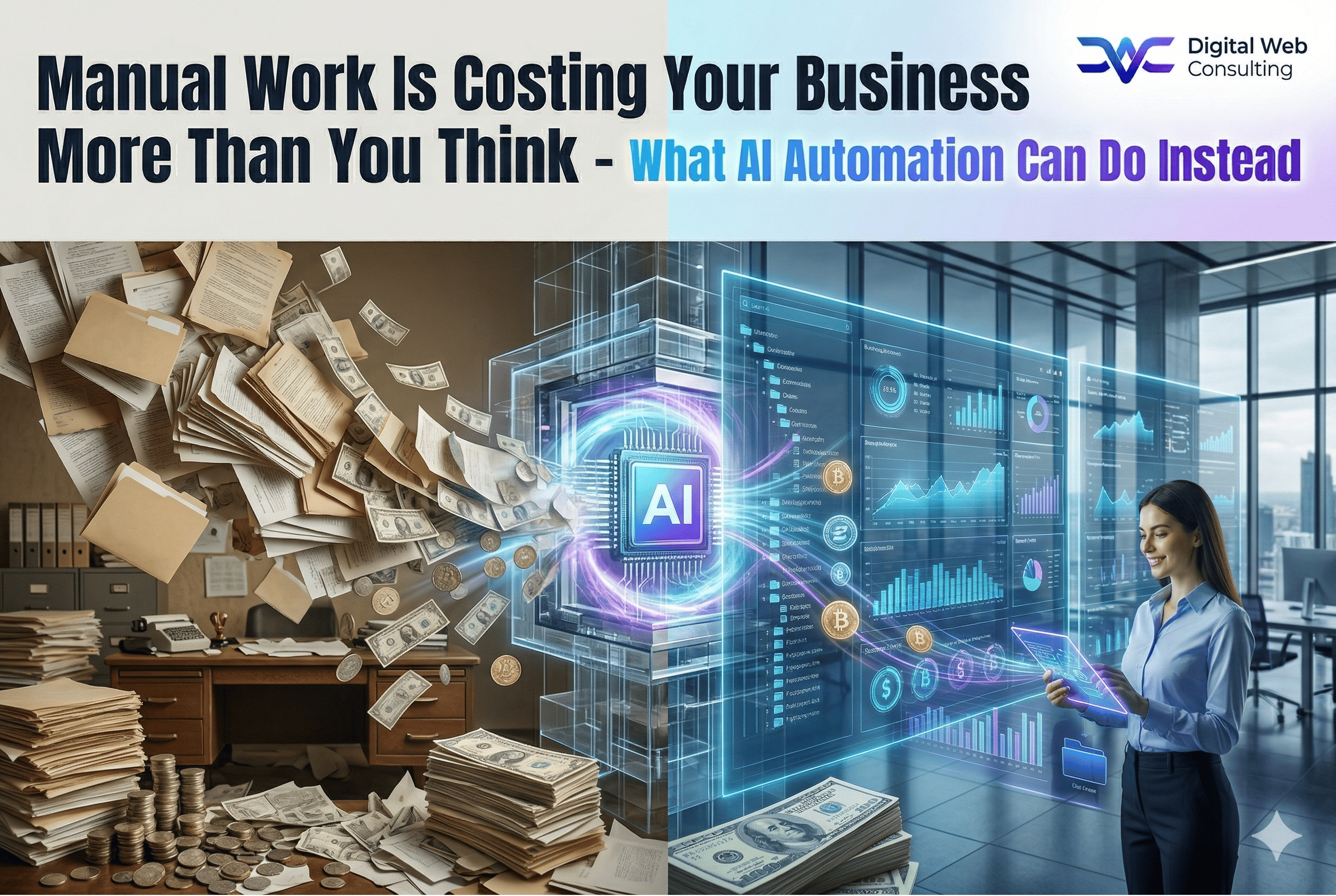
The Real Price of Doing Things Manually
Every business has manual processes. Some are obvious, data being copied from one spreadsheet into another, invoices being typed up by hand, follow-up emails sent one by one. Others are less visible, approval chains that stall because no one flagged the request, reports that take two days to compile, customer queries sitting unanswered because no one was notified.
The cost of all this is rarely calculated. Most businesses simply absorb it as the cost of doing business. But when you begin to add it up, hours lost per employee per week, errors caught and corrected, decisions delayed waiting for data that should already be available, the number is almost always larger than leadership expects.
Up to 30% of an average employee's working week is spent on tasks that could be automated, McKinsey Global Institute.
For businesses operating in the UAE, where operational speed and accuracy directly affect client relationships and competitive position, that number is not a statistic to note and forget. It is a daily drag on performance that compounds across every department, every week of the year.
AI automation solutions in UAE address this directly, not by hiring more people to manage the same manual load, but by replacing the manual load itself with intelligent systems that run reliably in the background.
The businesses winning in this market are not necessarily the ones with the largest teams. They are the ones with the most efficient operations, and efficiency today is built through automation, not headcount.
What AI Automation Actually Is: In Plain Terms
There is a lot of noise around artificial intelligence in business right now, and most of it overcomplicates something that is actually straightforward to understand at a practical level.
AI automation is the use of intelligent software to perform tasks that previously required a human to initiate, monitor, or complete. The key word is intelligent, meaning the system can recognise patterns, handle variability, make decisions based on rules your business defines, and improve its accuracy over time as it processes more data.
This is what separates AI automation from simpler tools like macros or basic workflow scripts. A macro runs the same fixed sequence every time. An AI-powered automation can read an incoming document, understand what type of document it is, extract the relevant data, route it to the right place, and flag exceptions, all without human involvement.
Three terms worth distinguishing clearly:
- Basic automation: Rule-based scripts that execute the same fixed action every time a trigger fires. Reliable for rigid, predictable processes but unable to handle variation or exceptions.
- Robotic Process Automation (RPA): Software bots that mimic human interactions with applications, clicking, copying, pasting, filling forms. Effective for structured, repetitive desktop tasks but brittle when processes change or inputs vary.
- AI automation: Combines automation with machine learning, natural language processing, and pattern recognition. Handles unstructured inputs, learns from outcomes, manages exceptions, and adapts to process changes without breaking.
“ AI automation does not just do what you tell it. It understands what needs to be done, and that distinction is what makes it genuinely transformative for business operations. ”
For businesses in the UAE handling multilingual documents, varied supplier formats, and complex multi-step approval processes, AI automation delivers a resilience that simpler automation tools simply cannot match.
The Five Business Areas Where UAE Companies Automate First
When businesses begin exploring AI business automation in Dubai, the question is always the same: where do we start? The answer depends on where the manual burden is highest and where the impact of automation will be most visible. These five areas consistently come up first:
- Finance and accounts: Invoice processing, expense categorisation, payment reminders, and bank reconciliation are among the highest-volume, most error-prone manual tasks in any business. Automating these reduces processing time from days to minutes and eliminates the errors that create downstream problems in reporting and cash flow management.
- Sales operations: Lead qualification, pipeline updates, follow-up email sequences, quote generation, and proposal dispatch can all be automated based on triggers your sales process already uses. The result is a sales team spending more time in conversations and less time in the CRM doing administrative work.
- HR and onboarding: New employee onboarding involves dozens of repetitive steps, document collection, system access provisioning, training assignment, and payroll setup. Automating the sequence means every new hire gets the same consistent experience without a member of HR manually managing each step.
- Customer service: First-response automation, query routing based on topic and urgency, FAQ handling, and ticket status updates can all be managed by intelligent automation. Customers get faster responses and agents focus on the queries that genuinely require human judgment.
- Supply chain and procurement: Purchase order generation, supplier communication, delivery tracking updates, and reorder triggers based on inventory thresholds are all high-frequency, low-complexity tasks that automation handles with greater consistency and speed than manual processes.
These five areas are a starting point, not a ceiling. As businesses build confidence with automation in one area, the approach naturally expands into others. Our Business Automation Solutions service covers the full scope of what intelligent automation looks like across an entire operation.
The businesses that see the fastest ROI from automation are the ones that start with the area of highest manual volume and build outward from there, not the ones that try to automate everything at once.
AI Automation vs. Traditional RPA: Why the Difference Matters in the UAE
Robotic process automation has been around for years and has a legitimate track record in structured, stable environments. For businesses with highly standardised processes and consistent data formats, RPA delivers real value. But the UAE business environment is rarely that uniform.
Consider what a typical trading company in Dubai manages on a given day:
- Supplier invoices: Arriving in different formats, different languages, and different levels of completeness, none of which a standard RPA bot handles gracefully.
- Customer communications: Coming through email, WhatsApp, and phone, often in Arabic and English simultaneously, requiring context-aware routing rather than fixed-rule sorting.
- Approval workflows: Involving multiple stakeholders across departments, where delays, exceptions, and escalations are the norm rather than the exception.
- Regulatory compliance: Where VAT requirements, document retention rules, and audit trails require accuracy that manual review often cannot guarantee at volume.
Traditional RPA breaks when any of these variables change. Intelligent process automation in UAE handles this variability natively. It reads intent, not just format. It routes based on context, not just keywords. It escalates based on risk, not just rules. For businesses operating in the complexity of the UAE market, that adaptability is not a nice-to-have, it is a requirement.
“ RPA does what you programme it to do. AI automation understands what needs to be done. For a market as dynamic as the UAE, that difference determines whether automation succeeds or creates new problems. ”
This is also why AI automation integrates more effectively with CRM and ERP systems, it can read data intelligently across platforms rather than relying on rigid interface mappings that break with every system update.
What to Expect From an AI Automation Implementation
One of the most common concerns businesses raise before starting is the fear that implementation will be disruptive, that systems will need to be replaced, teams will need extensive retraining, and months will pass before anything actually works. In practice, a well-run implementation looks quite different.
- Process audit and opportunity mapping: Before any automation is built, every manual process is mapped and assessed. How often does it happen? How long does it take? What is the error rate? What would the business gain if it ran automatically? This audit sets the priority order for implementation and prevents automating the wrong things first.
- Priority scoring: Not every manual task is worth automating immediately. The highest-value targets are those with high frequency, high volume, and high error rates, where automation delivers the fastest and most visible return. Lower-priority items are phased in as the programme matures.
- Build, test, deploy: Automation workflows are built, tested against real business scenarios, refined based on edge cases that emerge during testing, and then deployed into live operations. This phased approach prevents the disruption that comes from switching everything over at once.
- Monitor and optimise: AI automation is not a set-and-forget deployment. Performance is monitored, exception rates are tracked, and the system is tuned as processes evolve. This ongoing optimisation is what separates automation that delivers sustained value from automation that degrades over time.
For businesses that are also considering how automation fits into a broader technology modernisation programme, our Digital Transformation Consulting service looks at where AI automation sits within your overall operational and data strategy.
Most businesses see meaningful results within the first eight to twelve weeks of a focused automation programme, not in abstract metrics, but in hours returned to the team and errors visibly reduced in daily operations.
The Questions Most Businesses Ask Before They Start
These are the four questions that come up in almost every first conversation about AI automation, answered directly:
- Is my business too small for AI automation?: No. AI automation is not exclusively an enterprise technology. Many of the highest-impact implementations happen in businesses with teams of twenty to fifty people, where the manual burden per person is highest and the benefit of automation is felt immediately. The scale of the implementation should match the scale of the business, not the other way around.
- What if our processes are not yet standardised?: This is the right concern to raise, and the honest answer is that some process clarity is needed before automation can be effective. But standardisation does not need to be complete before starting. A good implementation partner will help you define the process clearly enough to automate it, which often produces the added benefit of better process design as a by-product of the automation project.
- How long before we see ROI?: It depends on what is being automated. Finance and accounts automation typically shows measurable ROI within the first month of operation, because the volume of transactions is high and the time saving is immediate. Sales automation takes slightly longer because the benefit accumulates across a pipeline cycle. A realistic expectation for most businesses is clear, measurable return within one quarter of go-live.
- Do we need to replace our existing tools?: In most cases, no. AI automation is designed to sit on top of your existing systems, connecting them, reading from them, and writing back to them without requiring replacement. The goal is to make what you already have work better together, not to add another system to the stack.
If your business is already running a CRM or ERP and you want to understand how automation can connect and extend those systems, explore our AI Automation Solutions and CRM Integration Services to see what the connected picture looks like.
Every question above has a practical answer. The businesses that delay the conversation because they feel not ready almost always find, when they do start, that they were more ready than they thought.
The Cost of Waiting Is Not Zero
Manual work does not stay still. As businesses grow, the volume of transactions increases, the number of systems multiplies, and the amount of data that needs to be moved, checked, and acted on grows faster than any team can scale to manage it manually.
Every month spent absorbing that manual load is a month of productivity lost, errors tolerated, and decisions made on incomplete information. AI-powered workflow automation in Dubai is not a future investment to plan for eventually. It is a present-tense operational decision with measurable returns that begin accumulating from the first automated workflow.
“ The question is no longer whether your business should automate. It is which processes to start with, and how quickly you can begin returning that time to the work that actually drives growth. ”
If your team is spending hours every week on tasks that should not require human attention, that is the starting point for a conversation about what automation can realistically change.
Ready to identify where AI automation can make the biggest difference in your operations? Start the conversation with Digital Web Consulting via our AI Automation Solutions page →
(AI automation solutions UAE, AI automation Dubai, intelligent process automation UAE, AI business automation Dubai, RPA solutions Dubai)