

When Your ERP Becomes a Location Dependency
A logistics company based in Dubai has its operations team at the main office, a warehouse team at Jebel Ali, and senior management travelling between client sites across the GCC. Every critical business decision, stock levels, pending orders, cash flow position, supplier payments, lives inside an ERP system that can only be accessed from workstations at the head office.
This means the warehouse team calls the office to check stock. Management requests reports by email and receives them hours later. Decisions that should take minutes are delayed by the simple fact that the data is locked to a location rather than available to the people who need it, when they need it.
This is not an edge case. It is a daily operational reality for a significant number of UAE businesses still running desktop-based ERP systems that were built for an era when everyone worked from the same building, on the same network, at the same hours. That era is over, and the ERP architecture that served it is now actively creating friction for businesses that operate across multiple locations, time zones, and devices.
73% of enterprise software users say they need access to business data outside of the office on a regular basis, yet fewer than 40% of desktop ERP users can do so without a VPN or remote desktop workaround., Panorama Consulting, 2024
“ An ERP system that only works in the office is not an enterprise resource planning tool. It is an office-based record system, and the distinction costs real money in delayed decisions and inaccessible data. ”
The shift to web-based ERP is not driven by a preference for modern technology. It is driven by a straightforward operational reality: businesses that need their data to be accessible should not be constrained by where their server physically sits.
What Web ERP Development Actually Means
The term web ERP gets used loosely, and the distinctions between related concepts matter when a business is evaluating its options. Understanding what each term actually means prevents expensive misalignments between expectation and delivery.
- Desktop ERP: Installed directly on workstation computers and accessed only from those machines or through a local network. Data lives on an on-premise server. Access outside the office requires a VPN or remote desktop connection, both of which introduce performance and security complexity.
- Hosted ERP: A desktop ERP application hosted on a remote server rather than on-premise. It looks and behaves like a desktop application but is accessed through remote desktop tools. The interface is the same; the hosting location has changed. This is not the same as a web ERP.
- SaaS ERP: A subscription-based ERP platform delivered through a browser. The vendor hosts the system, manages updates, and charges per user or per module. Examples include Oracle NetSuite and Microsoft Dynamics 365. The browser interface is genuine, but the architecture and data model belong to the vendor.
- Custom web ERP development: Building a browser-native ERP system from the ground up, or extending an open framework, specifically for a business's operational requirements. The system runs in a standard web browser on any device, the architecture reflects the business's actual processes, and the business owns the codebase and data completely.
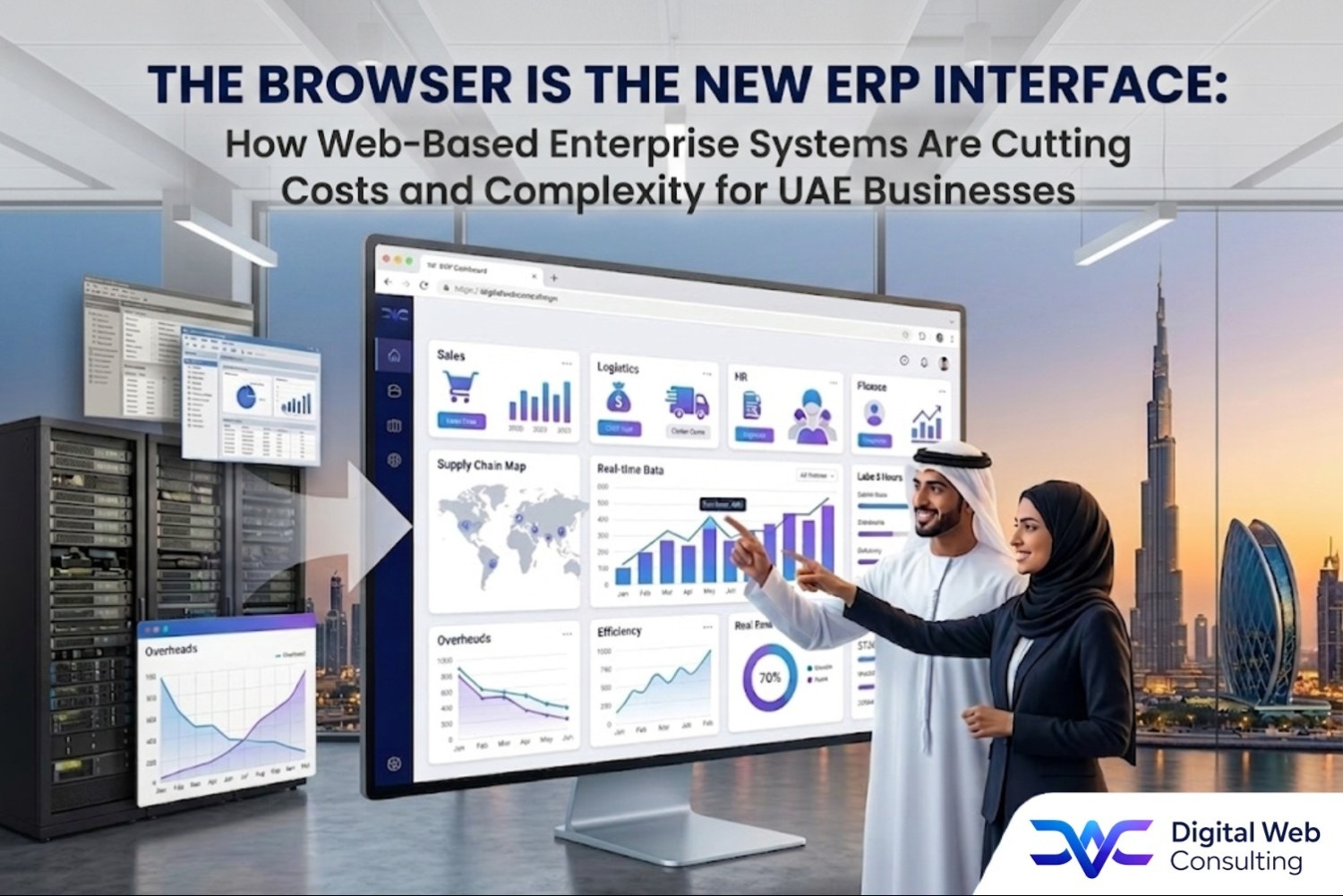
When we refer to web ERP development in UAE, we are specifically describing the last category, purpose-built, browser-native enterprise systems designed around the specific operational requirements of the business using them. This is distinct from subscribing to a SaaS ERP platform and distinct from simply moving a desktop ERP to a hosted server.
“ A web ERP is not a desktop ERP that someone has moved to the cloud. It is a fundamentally different architecture, one designed for the browser from the ground up, which changes everything about how users interact with it and how the system scales. ”
The architectural difference matters because it determines what the system can do, how it performs across devices, and how easily it can be modified as the business evolves. A genuine web ERP built around your workflows outperforms a hosted legacy system in every one of these dimensions.
Five Business Advantages of Web-Based ERP for UAE Companies
The case for browser-based ERP systems in UAE is not built on technology preference. It is built on specific, measurable operational advantages that directly affect how efficiently a business runs and how much it costs to run it. These five stand out consistently across implementations:
- Access from any device, any location, any time: A web ERP runs in a standard browser, on a laptop at the office, a tablet in the warehouse, a smartphone at a client site, or a desktop at a remote location. There is no installation, no VPN requirement, and no performance degradation from remote access. Every authorised user sees the same live data simultaneously regardless of where they are.
- Faster deployment with no client-side installation: Desktop ERP deployments require software installation on every workstation, IT configuration across the local network, and ongoing management of installed clients. A web ERP requires none of this, users access the system through a browser from day one, and updates are deployed server-side without touching individual machines.
- Real-time data across all departments simultaneously: When a sales rep closes a deal, inventory updates immediately. When a payment is processed, the finance dashboard reflects it in real time. When a purchase order is approved, procurement sees it instantly. Web architecture eliminates the data lag that desktop ERP systems with batch sync processes routinely introduce.
- Lower IT infrastructure and maintenance overhead: Desktop ERP systems require on-premise servers, local network infrastructure, regular hardware maintenance, and IT staff to manage the installation environment. A web ERP shifts this overhead to server infrastructure that is far cheaper to run, easier to scale, and simpler to maintain, particularly for businesses without a dedicated IT team.
- Simpler integration with modern business tools: Web-based systems communicate through standard APIs that connect easily to other modern tools, CRM platforms, accounting software, logistics tracking systems, e-commerce platforms, and communication tools. This connectivity is structurally simpler with web ERP than with desktop systems that were not designed with external integration in mind.
For businesses also considering how their ERP will connect to existing CRM infrastructure, our ERP Integration Services cover the full scope of how web ERP systems connect with the broader technology stack your business already runs on.
The operational advantages above compound over time. A business that deploys a web ERP today gains compounding benefits as it grows, more users, more locations, more data, without the infrastructure costs and access limitations that would constrain a desktop system at the same scale.
What Web ERP Looks Like Across Key UAE Business Functions
The advantages of web-based ERP are not abstract. They show up in specific, daily operational moments across every department. Here is what the difference looks like in practice for the business functions UAE companies rely on most:
- Finance and accounts: The finance manager reviews the cash flow position from home before an early morning call with the bank. The accounts team processes supplier invoices from the office while the CFO reviews the same data simultaneously from a board meeting across the city. VAT filing data is generated directly from the ERP without manual extraction or reformatting.
- Inventory and warehousing: Warehouse staff update stock receipts and dispatch records directly from tablets on the warehouse floor, using the same system the purchasing team accesses from the office. Stock levels reflect in real time across the business. Reorder triggers fire automatically when thresholds are crossed, without anyone needing to check a report first.
- Sales and customer management: Sales representatives access full customer histories, open quotations, and order statuses from client sites using their smartphones. Deals are updated in real time. Managers see accurate pipeline data without waiting for end-of-day reports. Customer credit limits are enforced automatically at the point of quotation rather than discovered after the order is placed.
- Human resources and payroll: Leave requests are submitted and approved through the ERP from any device. Attendance data feeds directly into payroll calculations. WPS-formatted payroll files are generated and reviewed without the data having to be exported, reformatted, and re-imported through a separate system.
- Management reporting and decision-making: Senior leadership accesses live operational dashboards from wherever they are, without asking anyone to pull a report, format a spreadsheet, or send an email. The data is current, accurate, and presented in the format relevant to each role.
For businesses building out their data visibility beyond ERP dashboards, our Power BI Dashboard Development service extends web ERP reporting into fully interactive business intelligence dashboards that connect data across all your systems, not just the ERP.
The common thread across every function above is the same: decisions made on live data rather than yesterday's export. In a market as fast-moving as the UAE, that currency of information is a genuine competitive differentiator.
Desktop ERP vs. Web ERP: The Honest Comparison
Desktop ERP systems are not universally obsolete. There are specific operating environments, highly regulated industries with strict data locality requirements, manufacturing floors without reliable internet connectivity, or businesses with deeply embedded legacy processes, where desktop systems still have a legitimate role. But for the majority of UAE businesses, the comparison looks like this:
Where desktop ERP still has a role:
- Highly regulated environments: Businesses operating under strict data sovereignty requirements that mandate on-premise data storage in specific jurisdictions may still require desktop or locally hosted ERP architecture.
- Manufacturing with offline floor operations: Production floor environments without reliable network connectivity may need local ERP access that does not depend on internet availability.
- Legacy process dependency: Businesses with deeply embedded custom modules built on legacy desktop ERP platforms may find the cost of migration prohibitive relative to the operational benefit of switching.
Where web ERP outperforms on every dimension:
- Multi-location and remote access: Any business operating across more than one physical location gains immediately from web architecture, no VPN, no performance degradation, no access complexity.
- IT cost and infrastructure overhead: Web ERP eliminates on-premise server hardware, local network management, and per-machine software maintenance. For businesses without dedicated IT teams, this reduction is significant.
- Scalability without proportional cost increase: Adding users to a web ERP requires no additional hardware, no additional installation, and no network reconfiguration. The system scales with the business at a fraction of the cost that desktop ERP scaling involves.
- Update and maintenance simplicity: Server-side updates deploy across all users simultaneously without touching individual machines. There is no update rollout process, no compatibility management across different client versions, and no downtime for individual workstation updates.
For businesses considering a migration from desktop to web ERP, our Custom ERP Development Services include structured migration planning that maps existing processes, identifies data migration requirements, and manages the transition without operational disruption.
The five-year maintenance and infrastructure cost difference between desktop and web ERP is consistently larger than businesses expect when they do the full calculation. Server hardware, IT support, VPN infrastructure, and per-machine update management add up to a substantial ongoing cost that web architecture eliminates.
What to Consider Before Building a Web ERP System
Web ERP development is a significant investment, and the decisions made before development begins determine whether the system delivers its full potential. These are the four considerations that most directly affect outcomes:
- Data security and access control architecture: A web ERP is accessible from any location, which means the access control model must be designed with the same rigour as the functional modules. Role-based permissions, multi-factor authentication, session management, and audit logging are not optional additions, they are structural requirements that need to be defined before development begins.
- Internet dependency and offline contingency: A browser-based system requires internet connectivity to function. For UAE businesses operating in locations with reliable infrastructure this is rarely a concern, but for operations that include field teams in remote locations or manufacturing environments with variable connectivity, offline capability for specific modules may need to be considered as part of the architecture.
- Build custom vs. extend an open framework: The choice between building entirely from scratch and extending a flexible open-source ERP framework affects both development timeline and long-term flexibility. A well-chosen open framework accelerates development for standard modules while still allowing complete customisation of the modules that are specific to the business. A full custom build delivers the closest fit but requires more time and investment to reach the same functionality baseline.
- Integration requirements with existing tools: A web ERP does not replace every tool a business uses, it connects with them. Mapping the integration requirements before development begins ensures the system architecture includes the API endpoints, data transformation logic, and sync mechanisms needed to connect with your CRM, accounting software, logistics platforms, and communication tools from day one.
For businesses working through these pre-build decisions, our IT Consulting Services provide structured technology assessments that clarify the right architectural choices before any development investment is committed. Getting these decisions right at the start is significantly less expensive than correcting them mid-build.
The businesses that get the most from web ERP development are the ones that invest as much time in the pre-build decisions as in the development itself. Architecture chosen well at the start scales gracefully. Architecture chosen poorly creates constraints that compound with every new requirement.
Enterprise Software Has Left the Building: Your ERP Should Too
The browser has become the standard interface for almost every category of business software, communication, collaboration, project management, marketing, finance, and customer management. ERP is the last significant category where desktop architecture has maintained a meaningful hold, and that hold is weakening fast as the operational cost of location-locked data becomes impossible to ignore.
Web ERP development in UAE gives businesses access to their full operational data from any device, any location, and any time, without VPNs, without remote desktop tools, and without the infrastructure overhead that desktop systems demand. It reduces IT costs, accelerates decision-making, and creates a platform that scales with the business without the architectural constraints that legacy systems impose.
For UAE businesses operating across multiple locations, managing distributed teams, or simply tired of making decisions from yesterday's data, the shift to web-based ERP is not a technology upgrade. It is an operational one.
“ The businesses that will compete most effectively in the UAE over the next decade are the ones whose operational data moves as fast as their markets do. Web ERP makes that possible. Desktop ERP makes it harder every year. ”
Ready to explore what a browser-based ERP built around your operations could look like? Start the conversation with Digital Web Consulting through our Web ERP Development page →
[ web ERP development UAE , browser-based ERP system UAE , cloud ERP web development Dubai , online ERP software UAE , web ERP for SMEs in Dubai , web-based ERP vs desktop ERP UAE , build web ERP system Dubai]